Prosecutors Seek to Revoke Bond of Former Vet Charged in Fatal Mobile Crash
Mobile prosecutors moved to revoke bond for a former veterinarian charged with murder after a second crash raised new questions about his release conditions.
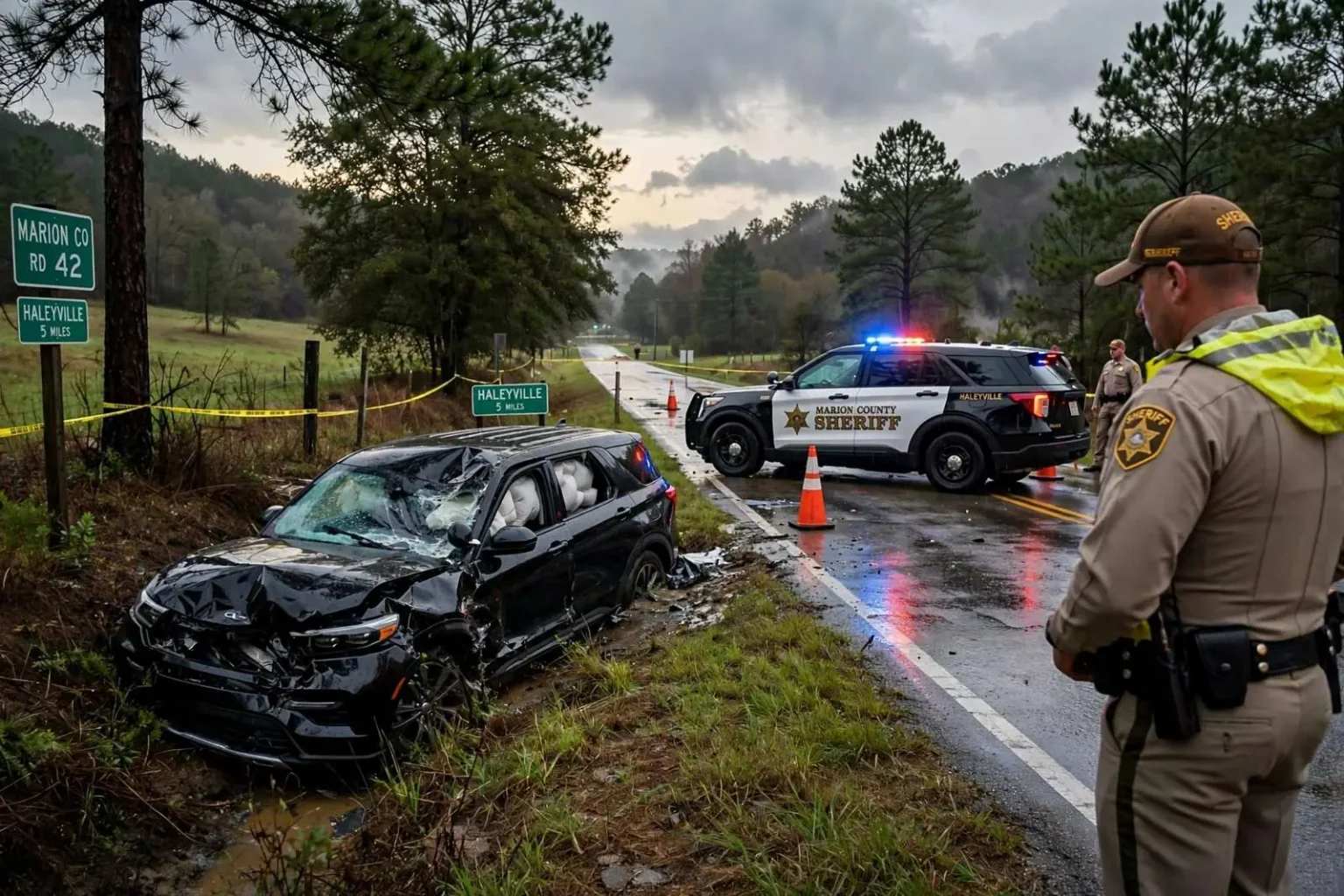
A former veterinarian already facing murder and assault charges in a fatal west Mobile crash could see his bond revoked after being involved in a separate wreck hundreds of miles away in north Alabama. Hunter Quillen Coan, 46, is accused of killing 68-year-old John Charles Lindell, a retired probation officer, in a crash in west Mobile while allegedly under the influence of prescription drugs.
That case has been pending since the spring, when a Mobile district judge allowed Coan to live with family in Haleyville while undergoing court-ordered drug testing and permitted him to retain his driver’s license during the case. Those conditions — residence in north Alabama, periodic testing and continued driving privileges — were the terms under which Coan has been free while awaiting further proceedings in Mobile County.
Prosecutors say Coan was involved in another traffic accident near Haleyville in late September, and a Mobile assistant district attorney has since asked the court to revoke his $75,000 bond in the pending murder case. The motion cites information from the district attorney’s office in Marion County, where the more recent crash occurred, alleging that Coan ran other vehicles off the road and appeared impaired at the scene.
The prosecutor’s motion argues that allowing Coan to remain free on bond poses a serious risk to public safety, given the nature of the pending charges against him and the circumstances of the more recent incident. Court filings indicate the state is treating the north Alabama crash as evidence that the conditions of his release are no longer adequate to protect the community.
The pending murder case
The charges trace back to a crash in west Mobile that claimed the life of Lindell, who had spent his career as a probation officer before retiring to the Gulf Coast. Prosecutors allege Coan was driving under the influence of prescription drugs at the time — a category of impairment that prosecutors say presents the same dangers as alcohol, but which can be harder to detect and prove, because there is no roadside test equivalent to a breathalyzer and impairment must be established through observation, toxicology and expert testimony.
Under Alabama law, a driver involved in a fatal crash while under the influence of a controlled substance can face murder charges even without any intent to harm anyone — the legal theory being that driving while impaired shows an extreme indifference to human life. The companion assault charges in the case indicate that others were injured in the same wreck, and that the state is holding Coan accountable for the full range of harm caused that day.
The spring bond hearing set the terms now in dispute. Granting bond in a murder case is not automatic in Alabama, and when judges do set bond they weigh the defendant’s ties to the community, his criminal history, and the risk of danger to others. Allowing Coan to move to Haleyville — a small city on the Marion-Winston county line — reflected, at least in part, the court’s willingness to let family support him while the case moved forward, with drug testing as the mechanism to monitor his sobriety.
The defense response
Coan’s defense attorney has pushed back strongly against that characterization, filing a response disputing nearly every fact presented by the prosecution. According to the defense filing, the September crash involved only Coan’s vehicle and was caused by a sudden onset of severe stomach pain and cramping, not impairment from alcohol or drugs.
The defense motion states that troopers who responded to the scene found no evidence of impairment, and that a Marion County deputy who evaluated Coan at the time reached the same conclusion. The defense argues the prosecution’s revocation motion relies on secondhand characterizations rather than the documented findings of the officers who were actually at the scene, and that a single-vehicle crash with no injuries and no impairment findings is not a basis to jail a man who has been complying with his bond conditions.
The response also underscores what is at stake procedurally. Bond revocation in Alabama requires a hearing before the judge who set the original conditions, and the state bears the burden of showing that conditions can no longer assure safety or the defendant’s appearance. The defense will argue that the state’s motion is built on an incomplete account of the Marion County incident, while prosecutors will point to the allegations of erratic driving as exactly the sort of warning sign the bond was supposed to prevent.
What happens at a bond revocation hearing
At a revocation hearing, the standard of proof is lower than at trial — the court considers whether the evidence shows a violation of bond conditions or a danger to the community by a preponderance of the evidence, not beyond a reasonable doubt. Both sides will likely present the responding officers’ accounts, any available medical documentation of Coan’s stomach condition, and results of any testing performed at the scene or afterward.
Judges in these situations have several options short of full revocation: tightening conditions, ordering electronic monitoring or GPS tracking, increasing the frequency of drug testing, or prohibiting driving altogether. Prosecutors seeking full revocation argue that none of those measures would have prevented the September crash, while the defense maintains that the existing conditions have worked — Coan tested as directed and lived where the court told him to live.
The outcome matters for the murder case itself. A defendant who loses his bond goes into the Mobile County jail to await trial, which changes his daily life, his ability to assist his attorney, and often the tone of plea negotiations. A defendant who keeps his freedom under stricter terms remains at his family’s home in Haleyville, where the court can watch him more closely than before.
The wider problem of prescription-impaired driving
The case sits within a difficult enforcement landscape. Prescription drug impairment has become one of the most stubborn highway-safety problems in Alabama and nationally, precisely because the drugs involved are legal for the person holding the prescription. Toxicology can establish that a medication is present, but determining whether the level and combination rendered the driver dangerously impaired requires expert interpretation, and unlike alcohol there is no bright-line legal limit for most medications.
Safety agencies have warned for years that combinations of pain medications, muscle relaxants and anti-anxiety drugs can degrade reaction time and judgment as severely as alcohol. Prosecutors in fatal-crash cases increasingly build their cases from pharmacy records, toxicology panels and crash reconstruction, piecing together what a driver had in his system and how it would have affected his driving in the moments before impact.
For a defendant like Coan — a former veterinarian with professional training in pharmacology, according to the background the case has developed — the dispute over the September crash turns on exactly that kind of interpretation: whether the officers who saw him saw a man suffering a medical event or a man under the influence. Both accounts can describe the same scene differently, which is why the revocation hearing will hinge on witness testimony and documentation rather than any single test result.
Two counties, one defendant
The geography of the case now spans the state. The fatal wreck occurred in west Mobile, a sprawling area where high-speed arterial roads and heavy traffic make impaired driving crashes especially lethal. The new incident occurred near Haleyville, in the hill country of northwest Alabama, where two-lane roads and curves demand steady hands even from sober drivers. Marion County authorities documented the second crash; Mobile County prosecutors are using it to revisit the terms of Coan’s release.
Court records indicate the revocation motion remains pending, and no hearing date has been announced. Until it is resolved, Coan remains on bond under the spring conditions — living with family in Haleyville, submitting to court-ordered drug testing, and holding the driver’s license the Mobile district judge allowed him to keep.
For Lindell’s family, the development reopens the grief of a loss that has been pending in the court system since the spring. Each filing in the bond dispute carries the same underlying tension that defines cases like this one: the presumption of innocence that keeps a defendant free, set against the community’s interest in ensuring that a man accused of killing someone while impaired never again endangers the road.
How the courts weigh freedom against safety
Bond disputes like this one force judges to balance two commitments that point in opposite directions. The constitution promises that someone accused of a crime — even a serious one — will not be punished before conviction, and bond exists to preserve that promise while assuring the defendant shows up for court. But the same hearing confronts the reality that some defendants, if released, present genuine risks that no amount of supervision can fully neutralize.
Alabama judges have grown more cautious in recent years about releasing defendants charged in impaired-driving deaths, particularly when allegations of new offenses arise while the original case is pending. A new crash during the pendency of a murder charge is, from the court’s perspective, the most direct available evidence about whether the original release decision was sound — and prosecutors inevitably frame it that way, while the defense insists that each incident must be judged on its own facts.