University of South Alabama Mobile
Confessions and a Discarded Theory as Letson Murder Trial Nears Its End
Jurors in the trial of Jamie Letson heard how a timeline error once pointed detectives toward a University of South Alabama campus officer, and how a 2008 interview changed the case.
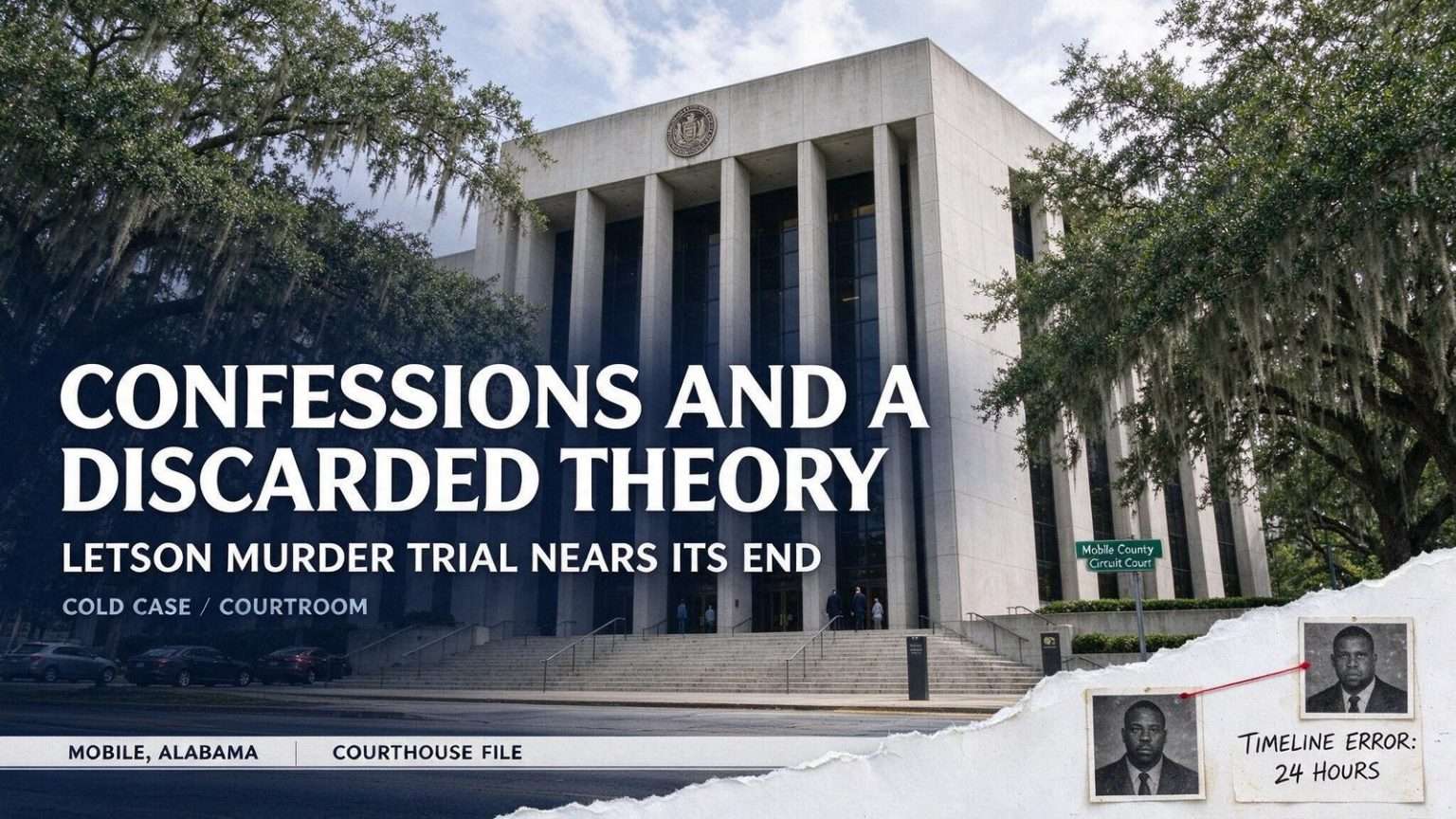
The murder trial of Jamie Kellam Letson, charged in the 1980 killing of University of South Alabama student Katherine Foster, moved toward a close this week in Mobile County Circuit Court, with the defense’s central theory largely dismantled and the state leaning on Letson’s own words.
The case reached the courtroom nearly three decades after Foster’s death, and the years between shaped nearly every argument in it. Witnesses who had been young detectives were now retirees. Evidence collected with the techniques of 1980 had to be weighed against decades of later science. And the passage of time gave the defense a theory — an alternative suspect long dead — that only history could supply.
The theory that collapsed
Much of the defense argument had been built on an old law enforcement theory that pointed toward a University of South Alabama campus police officer, a man detectives once regarded as strange and who took his own life in 1983.
Detectives who responded to that suicide found circumstances they described as troubling. Over time, though, the theory came apart. An enclosed space in the dwelling that investigators once viewed with alarm was explained as an accommodation for an elderly relative with Alzheimer’s disease who was prone to wandering. Suicide, it developed, ran through the officer’s family, with several relatives, including his mother, having killed themselves, which weakened the inference that guilt over Foster’s death had driven him to it.
The unraveling followed a pattern familiar in cold-case litigation. Details that read as sinister in an old file often dissolve under fuller inquiry: a locked room becomes a caregiver’s modification, a suicide becomes a family’s sad inheritance rather than a guilty man’s escape. In a trial where the original investigation had gone cold decades earlier, each side had to decide how much of the old file’s folklore to build on — and the defense had chosen to build much of its alternative-suspect theory on it.
Underneath all of it lay a single error. A 24-hour discrepancy about when Foster disappeared caused detectives and forensic scientists to miscalculate in several directions at once. It bolstered Letson’s alibi, and it lent credibility to the suspicion that the campus officer had held Foster captive for a day or more before killing her.
The mistake illustrated why timelines are the spine of any murder investigation. Establish when a victim vanished, and everything else — who had opportunity, whose account checks out, how long the body lay where it was found — arranges itself around that anchor. Get it wrong by a day, and the arithmetic shifts: alibis that should have failed instead held, and investigators found themselves imagining a captive interval that may never have existed to explain evidence that no longer fit.
A defense witness who helped the state
Former Mobile Police Department detective Wilbur Williams, who retired in 1998 after 25 years and later became chief of police in Andalusia, testified Monday as a defense witness. His testimony appeared to strengthen the prosecution instead.
Williams agreed the campus officer had been a suspect, but said his opinion would have been decidedly different had he known of Letson’s confessions. He said the defense lawyer who spoke with him about the case had not told him of those developments. Once the chronology of Foster’s disappearance and death was correctly established, Williams said, suspicion fell heavily on Letson, who had opportunity, her alibi dissolved by the corrected timeline, and motive.
The episode was a study in how witness preparation can backfire. A veteran investigator called to validate the defense’s alternative theory instead walked the jury through the case as corrected — the fixed timeline, the dissolved alibi, the confessions he had never been told about. In a trial that had already spanned decades, the state could hardly have asked for a better messenger than the detective whose own years on the force predated the revelations.
What jurors could and could not hear
Jurors would not consider what may be Letson’s most damning statement. Interviewed by Mobile detectives, she is said to have described the killing in detail, but because she had asked for a lawyer, Judge Michael Youngpeter disallowed the prosecution’s use of that statement.
The ruling turned on one of the most settled protections in American criminal procedure. Once a suspect in custody invokes the right to counsel, questioning must stop, and statements made afterward cannot be used by the prosecution — a rule designed to prevent exactly the pressure-cooker questioning the guarantee exists to check. The exclusion cuts against the truth-seeking function of a trial, but it reflects a deliberate choice: the justice system accepts losing some evidence rather than tolerating interrogation that ignores the invocation.
Prosecutors instead exploited other admissible admissions at every opportunity. According to a police transcript, Letson met on Nov. 21, 2008, with Mobile detective Mike Morgan, Deputy Chief Jimmy Barber and District Attorney’s Office investigator Donna Cayton, after apparently waiving her right to counsel.
That interview became the trial’s evidentiary centerpiece. In it, Letson spoke freely about the killing in a way she had never done in the decades before — and because the session followed a valid waiver, the words were fair game for the jury in a way the earlier statement was not.
In that interview she described walking with Foster into woods near the campus traffic circle, and firing. “She was in front of me and I shot her in the back of the head,” she said, according to the transcript. She recalled a roar inside her head and a thought that followed: “Oh, my God, what have I done?” She said she believed she fired a second time, and that Foster had staggered rather than fallen at once, a detail that matched physical evidence long unexplained: Foster’s own blood on the sole of her shoe.
The shoe detail carried particular weight with jurors. For nearly thirty years, investigators had possessed a piece of physical evidence that suggested Foster was not shot where she fell — that she had moved, staggered, bled as she stood. Letson’s account of a second shot and a victim who staggered rather than dropped explained, for the first time, what the blood on the shoe had always implied.
Asked where the gun came from, Letson said she had taken it from her grandmother, intending to kill herself with it. She said she threw it into a garbage container on campus. Pressed on details, she said repeatedly that she could not be certain. “Now I’m telling you I was real crazy when all this was going on,” she said. “I’ve already told you I shot the girl.”
The gun’s disappearance had been one of the case’s enduring voids: a murder weapon never recovered, from a 1980 killing in which no one had ever been charged until Letson’s arrest. Her account of its origin — a household gun taken with self-destruction in mind — offered the jury both an explanation and a window into her state of mind, and her disposal of it in campus trash explained why the decades of searching had come up empty.
Her shifting certainty also became part of the defense’s burden. A defendant who describes the killing in vivid detail, then pleads unreliability when pressed on specifics, gives jurors a choice of readings: a confused woman recalling terrible events, or a woman carefully hedging a story that could be checked. The state’s answer was the physical evidence — the blood on the shoe, the location near the traffic circle — matching the parts of her account she told without hedging.
Motive, in her own account
Letson described an obsession with a young man, Tom Jaudon, that she said had begun in high school and grew worse at the university, and that she had told family and friends he was her boyfriend when he was not. “I made up all this stuff in my head,” she said.
Motive testimony occupies a particular place in a circumstantial-era cold case. With the crime itself three decades old and the direct evidence limited to the defendant’s own words, the prosecution’s task was to assemble a picture in which Letson had reason, opportunity and a timeline that fit. Her description of a fabricated relationship — an imagined romance presented to family and friends as real — gave the jury a psychological through-line for a killing that otherwise defied ordinary explanation.
The account also connected the trial to its beginning. Foster’s 1980 death had shadowed the university community for a generation, a killing near the campus traffic circle that went unsolved while the years accumulated. The trial, in its final days, was performing the reckoning that time had deferred: sorting what actually happened in 1980 from the theories, errors and folklore that thirty years of an open file had gathered around it.
A veteran assistant district attorney, JoBeth Murphree, was under defense subpoena but apparently would not be called. The trial was expected to conclude Thursday or Friday.
Closing days, closing arguments
With the witness list narrowing, the trial moved into its endgame. The defense’s remaining levers were limited: the excluded statement, which the jury would never hear; the unreliability of details in Letson’s own account; and the argument that a confession produced decades after the fact, from a defendant who described herself as “real crazy when all this was going on,” deserved scrutiny rather than deference. The prosecution’s position was simpler and, by the week’s end, better evidenced: a corrected timeline, a dissolved alibi, physical evidence matched to an admission made on the record.
The structure of the case illustrated how cold-case prosecutions differ from ordinary trials. There would be no eyewitness to the shooting, no fresh crime scene, no 911 call from the night of the killing. Instead, the jury weighed old evidence read in a new light — a shoe sole’s blood finally explained, an enclosed space finally understood, a 24-hour error finally corrected — alongside a defendant’s own recorded words. The state’s theory asked jurors to trust that time, properly revisited, sharpens a case rather than blurring it.
For the courtroom’s regulars, the week carried the weight of a case that had waited a generation for its answer. Foster’s killing had been among Mobile’s most enduring unsolved deaths, a student shot near her own campus while the investigation went cold and the alternative theories multiplied. Whatever the jury decided, the trial had already performed one function: establishing, on the record and under oath, how the mistakes of 1980 had pointed investigators in the wrong direction for nearly thirty years — and how the confessions, once admissible, pointed them back.