Nodine Lawyers to Depose County Officials as Judge’s Recusal Stirs Debate
Defense attorneys scheduled depositions of a fellow commissioner, county lawyers and a circuit judge, while a judge's 12-page recusal order drew a pointed response from Mobile's presiding judge.
Attorneys for Mobile County Commissioner Stephen Nodine moved to question a group of county officials under oath in connection with the impeachment case against him, and questioned whether politics had crept into the proceeding. The move signaled the beginning of an aggressive defense, one aimed as much at the machinery of the case as at the allegations themselves.
Criminal defense lawyers John Williams and Dennis Knizley scheduled depositions of fellow Commissioner Mike Dean, assistant county attorney and Republican district attorney candidate Mark Erwin, Circuit Judge Rusty Johnston, County Attorney Jay Ross and political consultant Jon Gray. The depositions were set after prosecutors disclosed their witness list to the defense.
The roster of prospective witnesses read like a map of Mobile County government and its political orbit: a sitting commissioner, the county’s legal staff, a circuit judge and a political consultant — the very people whose testimony could illuminate how the impeachment case was assembled and who stood to gain from it. Depositions in an impeachment proceeding are rare enough that each one drew attention, and defense lawyers used them to build a record that could later support motions to disqualify or dismiss. Taking sworn testimony from county officials before any hearing also shifted the case’s momentum: rather than answering the prosecution’s allegations one by one, the defense intended to put the prosecution’s own process on trial first.
‘Impeachment or Politics?’
“After reviewing the witness list, I have a concern whether this matter is about impeachment or politics,” Knizley said. “Two DA races in two counties are getting ugly, and I am becoming uncomfortable that the campaigns may be affecting prosecutions.”
The complaint went to the heart of the unusual circumstances surrounding the case. Mobile County’s district attorney’s race featured a contested Republican primary, and one of the prosecutors’ own witnesses — assistant county attorney Mark Erwin — was himself a candidate. Across the bay, the Baldwin County district attorney’s office, expected to handle the criminal case arising from the Mother’s Day shooting death in Gulf Shores, had its own political currents. Knizley’s argument was that prosecutors with campaign stakes had every incentive to appear tough on a high-profile defendant, whatever the facts.
Knizley declined to make the list public, saying he saw no advantage for his client in doing so. Chief Assistant District Attorney Nicki Patterson confirmed the defense received the list but did not respond to a request that it be disclosed as a public record.
“It is Mr. Tyson’s list, and why he does not want anyone to know who is on it you will have to ask him,” Knizley said, referring to District Attorney John Tyson Jr. “I do not want to disclose it and have it appear that me or my client somehow want to interject politics into this impeachment proceeding.”
Knizley, himself a former candidate for district attorney, said he was neutral in the Mobile County race and called Republican candidates Ashley Rich and Erwin “both fine lawyers.” He said the witness list puzzled him: “In light of the allegations made in the impeachment information and report, I know of nothing of any real value they could add.”
The jab cut at the substance of the case. Impeachment proceedings against a county commissioner turn on allegations of misconduct in office, and a defense that finds the witness list irrelevant is arguing, implicitly, that the case is built on volume rather than proof. Knizley’s neutrality disclaimer was itself a defensive move — forestalling any claim that the defense was pursuing its own political agenda while accusing the prosecution of the same.
A 12-Page Recusal
Johnston, who was the duty judge when the Nodine matters first arose, entered a 12-page order removing himself from any involvement in the case. His stated reason was the circuit bench’s financial reliance on the county commission.
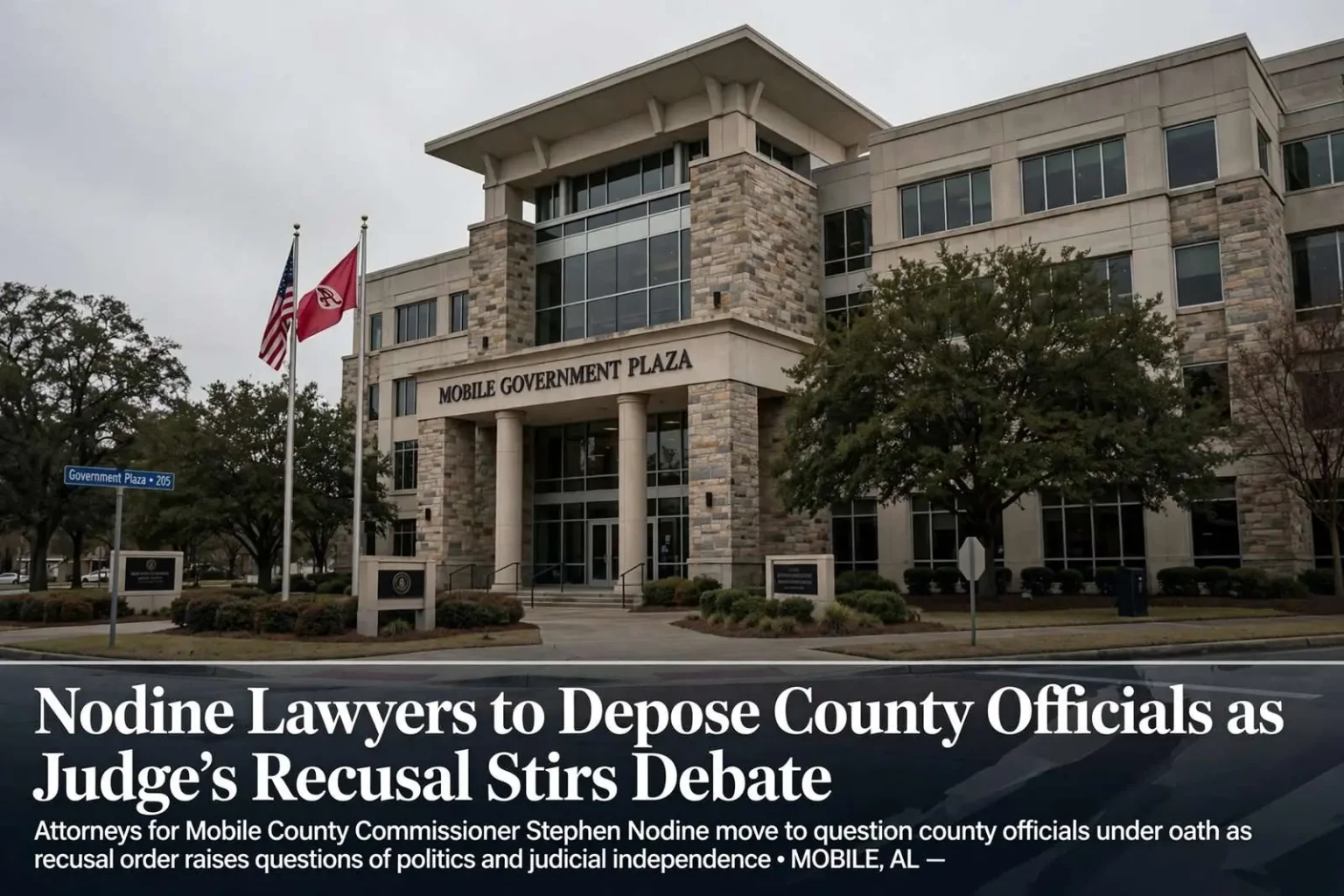
“Apart from the avant garde architecture, Mobile Government Plaza is the finest county courthouse in Alabama,” he wrote, crediting past and present members of the Mobile County Commission. Maintenance, security, the corrections center and other services, he noted, are provided by the county, some of them beyond what the law requires.
The landmark plaza that houses both the city and county governments and the circuit court has long been maintained at county expense, and Johnston’s order walked through that dependence in unusual detail. He recused from every matter involving the impeachment or any criminal case against Nodine, including routine ones.
“It would stretch all credulity for the public to be asked to believe that a judge, or any judge, who must rely on the county commission for everything in his office from water to drink to maintenance of the bathroom, could expect the members of the public to believe that the court would be absolutely impartial in the trial of said case,” Johnston declared.
The order was remarkable less for its conclusion — recusals happen every day — than for its length and its candor. Judges ordinarily recuse in a paragraph, citing a conflict and moving on. Johnston instead produced a treatise on the structural dependence of an Alabama circuit court on the very county commission one of whose members it was being asked to try, effectively inviting every other judge to confront the same question.
The Presiding Judge Responds
Presiding Circuit Judge Charlie Graddick found the order perplexing, and said it changed nothing.
“There has been no objection from either side, so there is no issue concerning recusal in this case,” Graddick said. “Frankly, we handle numerous matters where the county is a party and Judge Johnston does, too. Frankly, his order has no effect on anything, except himself and really not even him because he wasn’t assigned the case. Why he felt compelled to write such a lengthy order, I have no idea.”
Graddick’s point was practical. Alabama courts routinely hear cases involving counties — contract disputes, tort claims, tax challenges — and no judge recuses in every one of them. A commissioner’s impeachment, he suggested, was no different in kind from any other case where the county has an institutional interest. The recusal ruling changed nothing about the assignment of the case, since Johnston had not been the judge assigned to it in the first place.
Johnston maintained that cases involving the county generally were different in kind from a case involving Nodine, because in the latter the public would question the court’s impartiality. The distinction he drew — between routine institutional litigation and a proceeding whose fairness would be publicly contested — was the kind of question that appellate courts and judicial ethics boards have long argued over without settling.
Asked whether the dispute prompted him to seek the removal of Circuit Judge Sarah Stewart, who was assigned to preside over the impeachment trial set for June 8, Knizley was blunt: “Why would I want to do that?”
The rhetorical shrug said as much as a motion would have. Defense counsel had obtained, free of charge, a judicial opinion documenting the court system’s financial dependence on the county commission — a document that could be quoted in any future challenge. There was no need to push further against the assigned judge while that windfall was still fresh.
The Cases in the Background
Behind the impeachment proceeding stood a far more serious matter. Nodine remained the only suspect identified by Baldwin County authorities in the Mother’s Day shooting death of Angel Downs, 45, outside her Gulf Shores townhouse. Baldwin County District Attorney Judy Newcomb was expected to convene a grand jury.
The Baldwin case shadowed everything that happened in Mobile County. An impeachment proceeding, however raucous, is a civil matter in legal terms — a procedure for removing an official from office. A murder charge would be something else entirely, with a potential sentence measured in decades. Prosecutors in Baldwin County had publicly identified Nodine as the sole suspect in the shooting, and the convening of a grand jury would determine whether the case moved from investigation to indictment.
He had surrendered his passport when processed on the Mobile County drug charges, according to Knizley, and had entered no plea in the impeachment case. The passport surrender was one of the few routine entries in a file that was otherwise anything but: a commissioner stripped of his duties, fighting removal through an unprecedented local proceeding, while two separate district attorney’s offices — each facing re-election campaigns — weighed parallel cases against him. The constitutional provision allowing county officers to be impeached is invoked so rarely in Alabama that even seasoned courthouse lawyers were charting new ground as the case moved forward.
For Mobile County, the spectacle carried institutional consequences. The commission was left with two seated members while its third fought for his office, and the county’s legal staff — already in the middle of a generational transition — was drawn directly into the litigation. Whatever the eventual outcomes in Mobile and Baldwin counties, the case had already redrawn the line between politics and prosecution in a way that Mobile’s courthouse regulars would be debating for years.