Depositions in Nodine Impeachment Case Draw a Crowd of Lawyers
Sworn testimony gathered ahead of the impeachment trial of Mobile County Commissioner Stephen Nodine drew unusual attention in local legal circles, with a June 8 trial date looming before Circuit Judge Sarah H. Stewart.
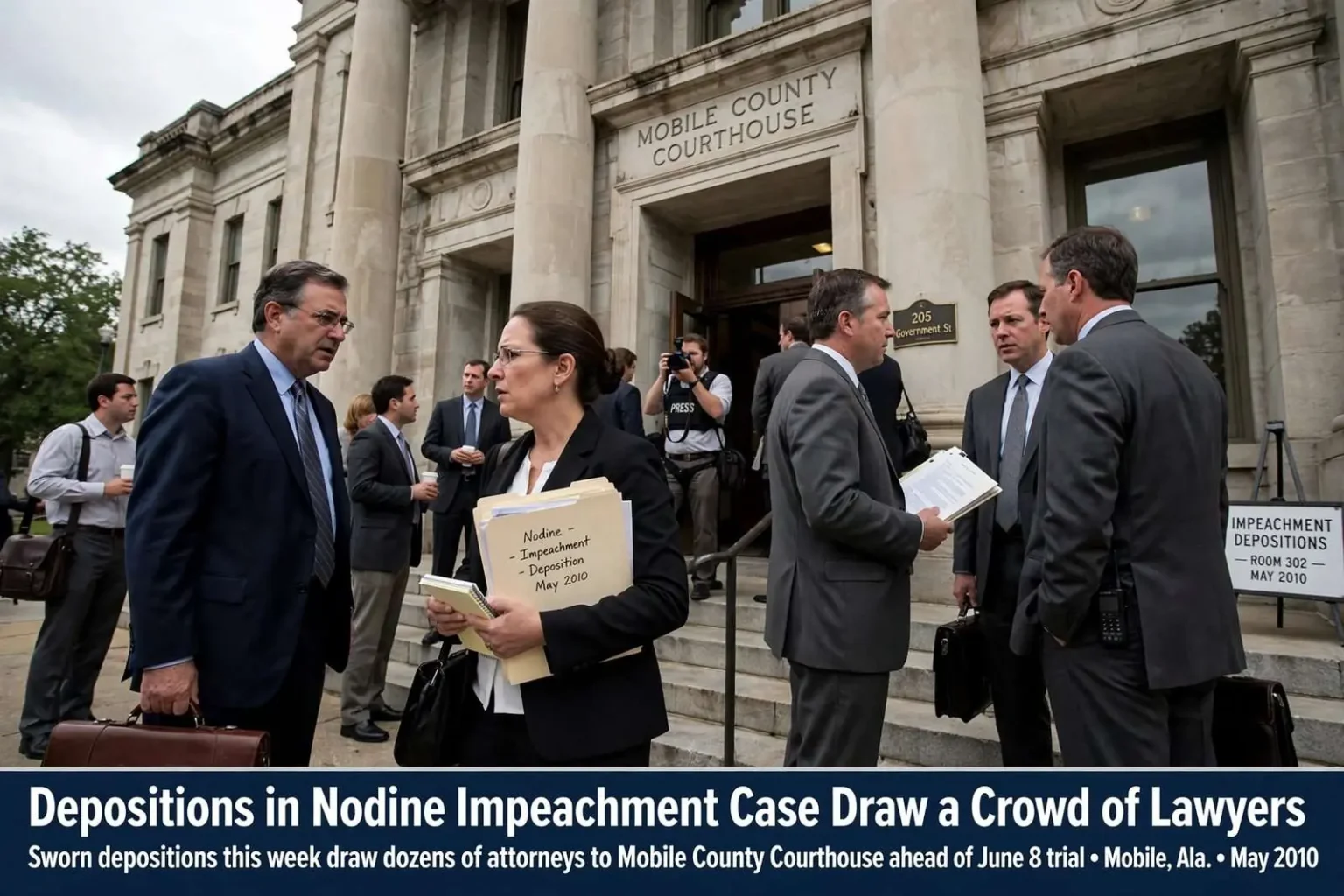
Sworn depositions taken this week in the impeachment case against Mobile County Commissioner Stephen Nodine drew unusual attention inside the Mobile County courthouse, where lawyers on both sides spent days questioning county officials, political operatives and potential witnesses ahead of a trial set to begin June 8.
The impeachment action, filed in Mobile, is separate from the criminal case Nodine faces in Baldwin County, where he stands accused of murder in the May 9 shooting death of Angel Downs, a woman with whom he had a long relationship. Nodine has entered no admission of guilt, and the impeachment proceeding is a civil action aimed only at removing him from the office he was elected to hold through 2012. The distinction matters in Alabama law: a civil removal proceeding carries a lower burden of proof than a criminal prosecution, and it moves on a schedule controlled by the courts rather than the calendar of the criminal cases across the bay.
Nodine’s prominence made the proceedings a spectacle from the start. A county commissioner since 2004 and a former chairman of the commission, he had been one of the most visible figures in Mobile County government — a Republican whose district covered west Mobile and whose ambitions had, at various points, reached toward higher office. His arrest nine days earlier on the Baldwin County murder charge had already consumed local news; the impeachment filings transformed a criminal case into a question about the conduct of county government itself.
An Unusual Scene in the Deposition Room
Eyebrows were raised in the legal community when Mobile County Commissioner Mike Dean arrived to be questioned under oath without a lawyer at his side. Dean, a veteran commissioner whose district included much of south Mobile County, was not a target of the proceeding but a percipient witness to county government’s dealings with it — and sitting for a sworn deposition in a removal case without counsel struck practicing attorneys as an avoidable risk.
By contrast, county attorney Mark Erwin, who is also a Republican candidate for Mobile County district attorney, appeared with counsel of his own, attorney Ken Nixon, and declined to answer some questions on grounds of attorney-client privilege. The privilege objections were consequential: Erwin had advised the commission in its dealings with Nodine, and his refusals closed off a vein of testimony the state had hoped to mine. His candidacy for district attorney — a race reaching its primary climax in the same weeks — put him in the unusual position of a lawyer-witness whose sworn statements could become campaign material in the very race he was running.
Attorneys on both sides also remarked on the performance of public relations and political consultant Jon Gray, whose answers to yes-or-no questions tended to run long. Gray himself conceded, according to people familiar with the sessions, that brevity was not his strong suit. A political consultant’s deposition is rarely the centerpiece of an impeachment case, but Gray’s work connected him to many of the figures the depositions touched, and his extended answers gave both sides material to work with in shaping the record.
Defense Sees Politics in the Paperwork
Nodine’s attorney, Dennis Knizley, said the discovery process was producing exactly what he expected. “I am getting my discovery, and it is, as anticipated, miring down deeply into politics and not impeachment,” Knizley said, repeating a complaint he first raised when he saw the state’s witness list. In his view, the prosecution appeared to be driven more by political score-settling than by a genuine effort to remove an unfit officeholder.
Knizley had earlier framed the concern in blunter terms. “Two DA races in two counties are getting ugly, and I am becoming uncomfortable that the campaigns may be affecting prosecutions,” he said. Both Mobile County and Baldwin County were in the closing days of contested district attorney primaries, and the Nodine matter had become a live issue in each. In Baldwin County, the office prosecuting the murder case was led by an appointed incumbent facing a primary fight; in Mobile County, the county attorney himself was running for the same office. Knizley’s argument was that the confluence gave both prosecutions an appearance of political timing that an impeachment trial would only magnify.
Asked how the questioning was going, Knizley offered a short assessment: the depositions, he said, “are going very well.” For a defense lawyer, a deposition phase that drags the state’s theory through politics is time spent well — every answer from a county official or consultant about motives and campaigns is material a jury can be shown later.
Witnesses and Allegations
Among the witnesses the state listed in the impeachment action were Emily Simmons, Christine Sally and Amanda Jordan. Separately, friends of Downs told people close to the case that Nodine had threatened her life during this year’s Mullet Toss at the Flora-Bama, the annual spring gathering on the Alabama-Florida line that draws thousands to the beach each April. Baldwin County authorities were building a domestic abuse component into their prosecution. None of those allegations had been tested in open court, and Nodine had not responded to them under oath.
The gap between the allegations and the sworn record defined the case’s early phase. Witnesses on the state’s list had given statements to investigators, but depositions were the first venue in which they could be questioned, challenged and placed on a formal transcript that would follow the case into whatever courtroom it reached. The Flora-Bama allegation, if it surfaced in testimony, would place the events of the case’s timeline in public view; until then, it moved through the unofficial channels of the courthouse rumor mill.
What Comes Next
Circuit Judge Sarah H. Stewart was set to preside over the impeachment trial beginning June 8. Under Alabama law, an impeachment proceeding against a county officer is tried in circuit court, and a judgment of removal ends the officer’s term. The mechanism is rare in practice — Alabama county commissioners face removal proceedings seldom enough that the procedure itself drew attention from lawyers across the state — and its outcome would determine not only Nodine’s fate but how the remainder of his term was filled.
Several attorneys following the case said privately that they expected Nodine to step down at some point in the proceeding rather than take the witness stand and answer questions under oath, because anything he said in the impeachment case could be used against him in the pending criminal prosecutions. The bind was structural: defending his seat required testimony his criminal defense could not risk, while silence in the impeachment case left the state’s allegations unanswered on the record. Few public officials facing that dilemma have ridden it to a verdict.
For readers coming to this story years later, the context matters: in the spring of 2010, the Nodine case consumed local politics on both sides of Mobile Bay. It touched the county commission, the sheriff’s office, two district attorney campaigns and, eventually, the shape of county government itself. The depositions taken in late May were the first sustained look the public got at how tangled those threads had become.
The daily routines of Mobile County government continued around the case. The commission still met, budgets still moved, and the county’s responsibilities — roads, drainage, health services across its unincorporated stretches — carried on with one member absent and another newly prominent as a witness. The impeachment action existed precisely because of that collision between ordinary government and extraordinary accusation: a county could not simply wait out a criminal trial that might take years, and the accused official could not be unseated without the proceeding the state had filed.
The courthouse crowd the depositions drew told their own story about the case’s reach. Mobile County’s legal community is small enough that most of the attorneys connected to the matter knew one another professionally, and a proceeding that put county officials, a sitting commissioner, the county attorney and political consultants all under oath in the same week was, by the standards of local practice, unprecedented in recent memory. The transcripts those sessions produced ran to hundreds of pages, and both sides emerged claiming advantage — the state with its witnesses preserved, the defense with its politics argument documented.
Whatever the June 8 trial brought, the deposition week had already fixed the case’s public character: a proceeding formally about the fitness of a county commissioner, conducted amid murder charges, primary campaigns and the private expectations of every lawyer in the courthouse. The trial before Judge Stewart would put the question to a decision. The depositions had already shown how much of the answer lay beyond the impeachment papers themselves.
The June 8 trial date also compressed the decisions of everyone connected to the case. County officials scheduled to testify faced the choice of how fully to answer; the commission faced interim arrangements should the seat be vacated; and the district attorney candidates across both counties faced questions about a prosecution that would remain in the news through their own elections. A trial calendar is a schedule for all of them at once, and the weeks between the depositions and the opening of the case gave each side its last chance to shape a record that had already grown long.