From Spring Hill to Kilimanjaro: Rep. Jamie Ison Trains for Africa’s Highest Peak
State Rep. Jamie Ison, a former director for the deaf and blind, was training twice a day to join blind mountaineer Erik Weihenmayer on a late-summer climb of Mount Kilimanjaro, with the toughest day set to fall on her 52nd birthday.
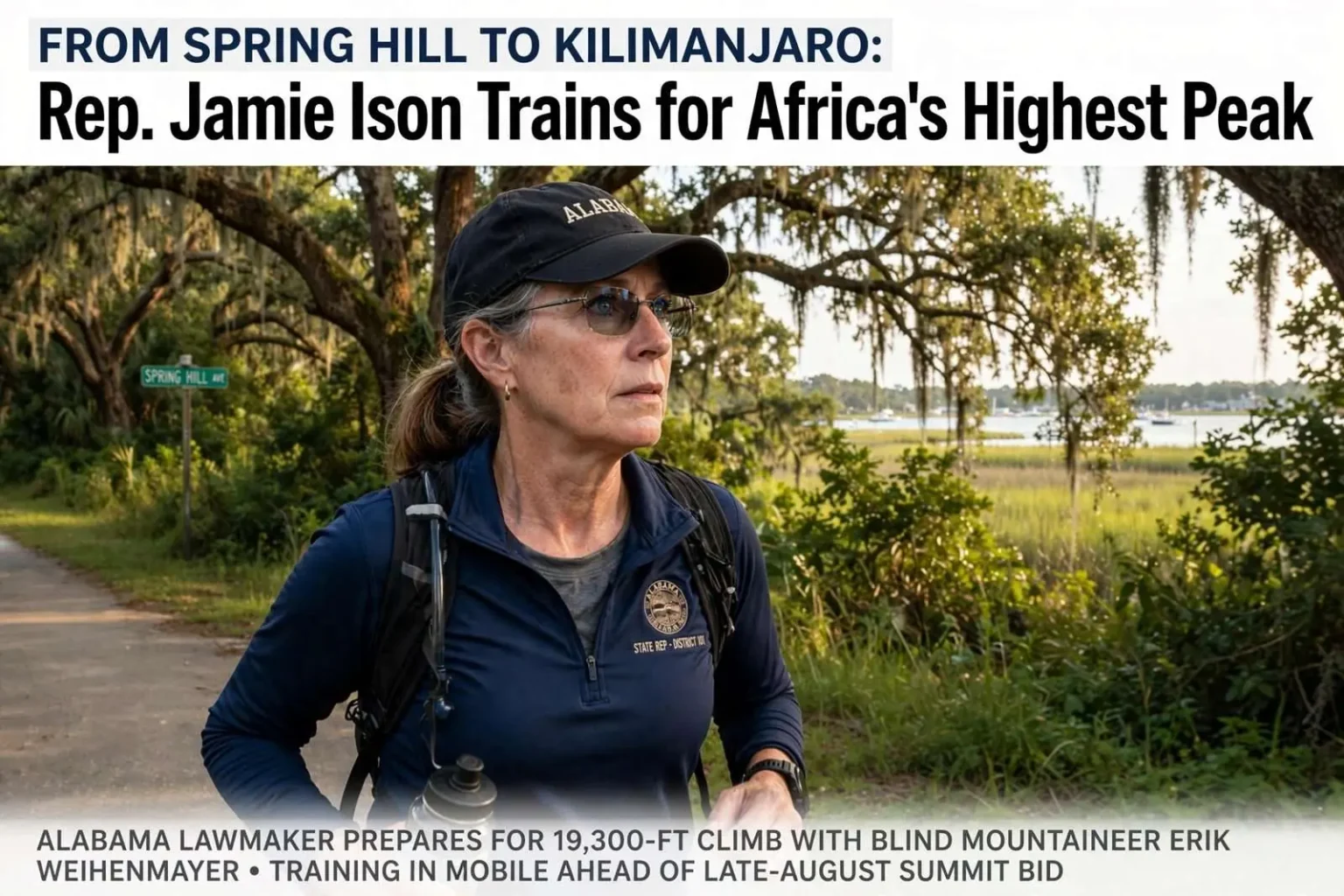
State Rep. Jamie Ison had spent a career and then a political life meeting challenges, first through 17 years directing the Alabama Institute for the Deaf and Blind’s regional office, then in the give-and-take of the Alabama Legislature. Her next mountain, she said, would be a literal one. Later in the summer she planned to join blind mountaineer Erik Weihenmayer and his party in an attempt to scale Mount Kilimanjaro, the 19,300-foot Tanzanian peak long counted among the most beautiful mountains on earth.
For a Mobile-area lawmaker, the plan was an unusual one. Alabama’s legislative calendar and coastal constituency rarely collide with the altitude and glaciers of East Africa, and few members of the State House have traded the district office for an ice axe. But Ison, who built a reputation in both human services and politics for taking on work most people would decline, approached the climb the way she approached her other challenges: as something to be trained for, scheduled and done.
“It is the biggest physical challenge I have decided to take on in a long, long time,” Ison said of the climb. Kilimanjaro demands no technical climbing skill of the sort required on Everest-grade ice, but its altitude is unforgiving: the mountain rises from savanna to glacier-capped summit in a single massif, and the rapid ascent is what defeats most of the trekkers who attempt it each year. Stamina, acclimatization and simple stubbornness decide who stands on the top of Africa.
An invitation she meant to accept
The idea took shape earlier in the year, when Weihenmayer mentioned his Kilimanjaro plans and the possibility arose of Ison joining him. By her account, she told him not to extend the invitation unless he meant it, because she was very likely to say yes. That kind of plain dealing has marked her public life — the Mobile Republican has been known locally for saying exactly what she intends to do and then doing it — and this time was no different.
Both were serious, and in less than three months, she said, they would be on a 29-hour flight to Africa. Turning a casual conversation into a summit bid in under a quarter of a year left little room for hesitation. Every week mattered in a training window that short, which is why Ison threw herself into a conditioning program almost as soon as the plans were fixed.
The announcement of her plans drew attention quickly back home, and for good reason. Alabama legislators are not often associated with expeditions to East Africa, and the image of a Gulf Coast representative training on stairmasters in August humidity for a summit bid alongside blind climbers was, by any local standard, newsworthy. Constituents in District 101, which covers some of Mobile’s most established neighborhoods, got a very different kind of campaign-season story than the usual budget and traffic debates.
Weihenmayer was no ordinary guide. The first blind climber to reach the summit of Mount Everest, he had also stood atop the highest peak on each of the seven continents, feats that earned him the affectionate nickname Super Blind among fellow mountaineers. His Everest ascent in 2001 made international news and redefined what the climbing world assumed a blind athlete could attempt, and the Seven Summits list put him in a category occupied by only a handful of adventurers of any kind.
He lost his sight at 13 to a degenerative eye disorder and went on to become an accomplished skier and skydiver as well as a climber, using his ascents as metaphors in a busy career as a motivational speaker. His message — that blindness and other barriers need not dictate the limits of a life — dovetails with the work Ison spent 17 years doing at the Alabama Institute for the Deaf and Blind, the state agency that serves Alabamians with visual and hearing impairments through education, rehabilitation and employment programs. She had spent her professional life arguing that people without sight could do extraordinary things; Weihenmayer had spent his proving it at 29,000 feet.
Training twice a day
Ison, whose climbing to that point had mostly consisted of ascending Spring Hill, was preparing in earnest. The joke about her neighborhood hill carried a point: Mobile is nearly flat, sitting at sea level on the edge of Mobile Bay, and nothing in the local topography mimics a mountain that towers more than three and a half miles above the ocean. Whatever conditioning the climb required, she would have to create it herself.
Her regimen ran twice daily: four to six miles of walking and running in the mornings, afternoon sessions on the stairmaster and treadmill, and a mile in the pool. The routine swallowed a significant share of every day, on top of legislative duties and family obligations, but the arithmetic of high-altitude trekking is simple — the stronger the legs and lungs, the better the odds on summit day.
She was hunting for nearby trails to break in a pair of heavy climbing boots and planned a practice climb in Colorado later in the summer. The boots matter more than newcomers expect: a new pair of stiff mountaineering boots can raise blisters that end a trek at 15,000 feet, so veterans insist on hundreds of trail miles before a big ascent. The Colorado trip, meanwhile, would give her a taste of genuine altitude that no Gulf Coast workout could provide.
Mobile’s humidity, she noted wryly, might even help by mimicking the labored breathing of thin mountain air. Anyone who has run in an Alabama August knows the sensation of breathing through a wet cloth, and Ison figured that if her lungs could work in that, the dry thinness of Kilimanjaro’s upper slopes would at least feel familiar. “I’m really working on my stamina, but I have a long way to go,” she said.
A birthday above the clouds
The expedition Weihenmayer would lead included eight blind climbers from the United States, a pair from Europe and roughly ten sighted companions. The mix was deliberate: each blind climber moved with sighted teammates who described footing, handed over gear and shared the rope, a structure that turns a summit push into a genuinely cooperative effort rather than a stunt or a spectacle.
By their schedule, it would take seven days to reach the summit once the ascent began, and the most strenuous day happened to fall on Ison’s 52nd birthday. Few people mark a birthday with a push toward 19,300 feet, and Ison allowed that the timing gave the climb a personal symmetry she had not planned. The seven-day timetable is standard for Kilimanjaro, built that way to let climbers acclimatize gradually, and it means living in tents and mountain huts for a week while the air grows measurably thinner each night.
She expected to leave Mobile in late August and return in mid-September, capping the trip with a two-day safari and a visit to a school for the blind at the mountain’s base. Tanzania’s proximity to the equator makes the climb possible in the Northern Hemisphere’s late summer, and the safari and school visit turned the expedition from an athletic feat into a broader journey — one with obvious resonance for a woman whose career has been built around services for people who are blind.
Ison, who represents House District 101, hoped to line up sponsors so the climb could benefit local charities, among them Camp Rap-A-Hope, the one-week summer camp for children and teenagers battling cancer that grew out of the Medical Society and Medical Alliance of Mobile County two decades earlier. The camp, which serves young cancer patients from the Gulf Coast region at no cost to their families, depends entirely on community donations, and a high-profile climb seemed a natural way to focus attention and fundraising on its work. Sponsorship drives tied to the expedition gave businesses and individuals a concrete way to participate: pledge by the foot, by the day or by the summit, with every dollar routed to charities serving Mobile families.
“Given my background, working with blind people for many, many years, this is an incredible opportunity,” she said. The words summed up why she said yes in the first place: a legislator who had spent her career championing Alabamians with disabilities saw a chance to climb beside a team of blind athletes and bring the story home to Mobile.
Whether the team stood on the summit or not, the climb promised Mobile a story worth retelling — a local representative trading the State House in Montgomery for the highest free-standing mountain on earth, climbing with the most famous blind mountaineer in the world, and doing it all to raise money for sick children back home.