University of South Alabama Mobile
A Letter to the Dead: Trial Opens in 1980 Killing of USA Student Katherine Foster
Thirty years after Katherine Foster was shot on the University of South Alabama campus, jurors were seated in the murder trial of Jamie Letson, whose handwritten letter of amends may become evidence.
“After all these years I have come to you. It is me, Jamie, the girl who took your life.”
So begins a handwritten letter that authorities say Jamie Letson composed with the intention of reading it at the grave of Katherine Foster, the University of South Alabama student whose 1980 killing on campus went unsolved for three decades. Letson’s murder trial opened this week in Mobile County Circuit Court.
The document sits at the center of a case that is unusual in nearly every dimension — a killing three decades old, a suspect identified almost from the start, an investigative error that shielded her for a generation, and a confession of sorts written not for police but for a grave the writer could not find.
A letter written as a step toward recovery
Authorities contend Letson wrote the letter as a step in a program of recovery from substance abuse. Unable to find Foster’s grave, she read it aloud in a Pascagoula cemetery while her Alcoholics Anonymous sponsor waited in the car, according to a Mobile police detective.
The recovery-program origin of the letter shaped the fight over whether jurors would ever see it. Prosecutors Will Dill and Don Valeska hoped to introduce the letter as evidence. Defense attorney Chris Klotz of Pensacola sought to suppress it, but pretrial rulings made it probable that jurors would be allowed to weigh the document in determining guilt or innocence.
Letters like this occupy contested ground in criminal law. A document written voluntarily, unsolicited by police and never intended for investigators, escapes many of the protections that would suppress a custodial statement — and that is precisely what made it valuable to the state. The defense’s counterargument would rest on the letter’s circumstances: it was written as a private act of recovery, its statements are emotional rather than sworn, and its author, by then years into addiction and its aftermath, may have been accepting responsibility for something the state still had to prove.
The cemetery detail, testified to by a detective, gave the letter its place in the trial’s narrative. A woman driving to Mississippi to read a confession aloud to a grave she could not find — with her sponsor waiting in the car — is an image jurors would not soon set aside, whatever they ultimately decided about the rest of the evidence.
The case against Letson
Authorities believe Letson lured her longtime friend into woods on the University of South Alabama campus and shot Foster twice in the head with a handgun she had taken from her grandmother. Police say Letson was jealous of Foster over a young man both knew.
Detectives were pointed toward Letson at the very beginning of the investigation in 1980. But a foul-up over the day Foster was reported missing caused forensic scientists to miscalculate the time of death, which in turn appeared to substantiate Letson’s alibi. The error helped keep the case unsolved for a generation.
The mechanism is one homicide investigators know well. Time-of-death estimates rest on the interval between death and discovery, and a mistake in the reported-missing date shifts the entire window. A suspect whose whereabouts can be verified for the wrong window looks cleared; the file thins, the tips stop, and the case drifts to the back of the stack. Nothing about the miscalculation proved innocence — it simply removed the pressure that keeps an investigation alive.
Letson, 49, was arrested at a shelter in Jackson, Mississippi, in 2008 after Mobile police reopened the cold case. The reopening reflected the era’s advances in cold-case work, as departments revisited old files with modern forensic techniques and renewed attention to witnesses whose loyalties and memories had changed over three decades.
A more explicit statement she is said to have given detectives was disallowed because she had asked for an attorney before making it. The ruling left the letter — written freely, years earlier, for the dead rather than for police — as the state’s most direct account of what Letson says she did.
What the letter says
The letter, as described in court filings, moves from confession to lament. “I don’t know where to begin. I was your friend, but I was obsessed with Tom, and you were in my way,” it reads. “For what it is worth, Tom hated me after your death … although no one could ever prove that I shot you, everyone knew that I was obsessed with Tom, that I had manipulated my way into his life, and I think many people suspected that I killed you.”
Elsewhere it turns to the life Foster did not get to live. “In ending your life, I robbed your family and loved ones of a future with you,” the letter reads. “At the very least I robbed you of the chance to experience a full life, no children, no fulfilling career.”
Foster, the letter recalls, had planned to travel to Ireland to work with children and had already gone to Mexico to help the poor in Saltillo. “I came here to make amends to you, but there is no way I can make an amends for killing you,” it continues. “There is no way to make things right.”
Prosecutors would treat those passages as admissions — a narrative only the killer could construct, matching the physical evidence and the long-standing theory of the case. The defense would treat them as the words of a woman working through a recovery program’s exercises, accepting blame in writing for reasons that are spiritual rather than evidentiary. The jury’s task was to decide which reading the document deserved, in combination with everything else the state put before them.
The details about Foster’s life — the planned work in Ireland, the mission trip to Saltillo, Mexico — carried weight beyond sympathy. They established who Foster was at 20, a student already engaged in service work, and they gave the jury a measure of what her death had cost that no forensic exhibit could supply.
In the courtroom
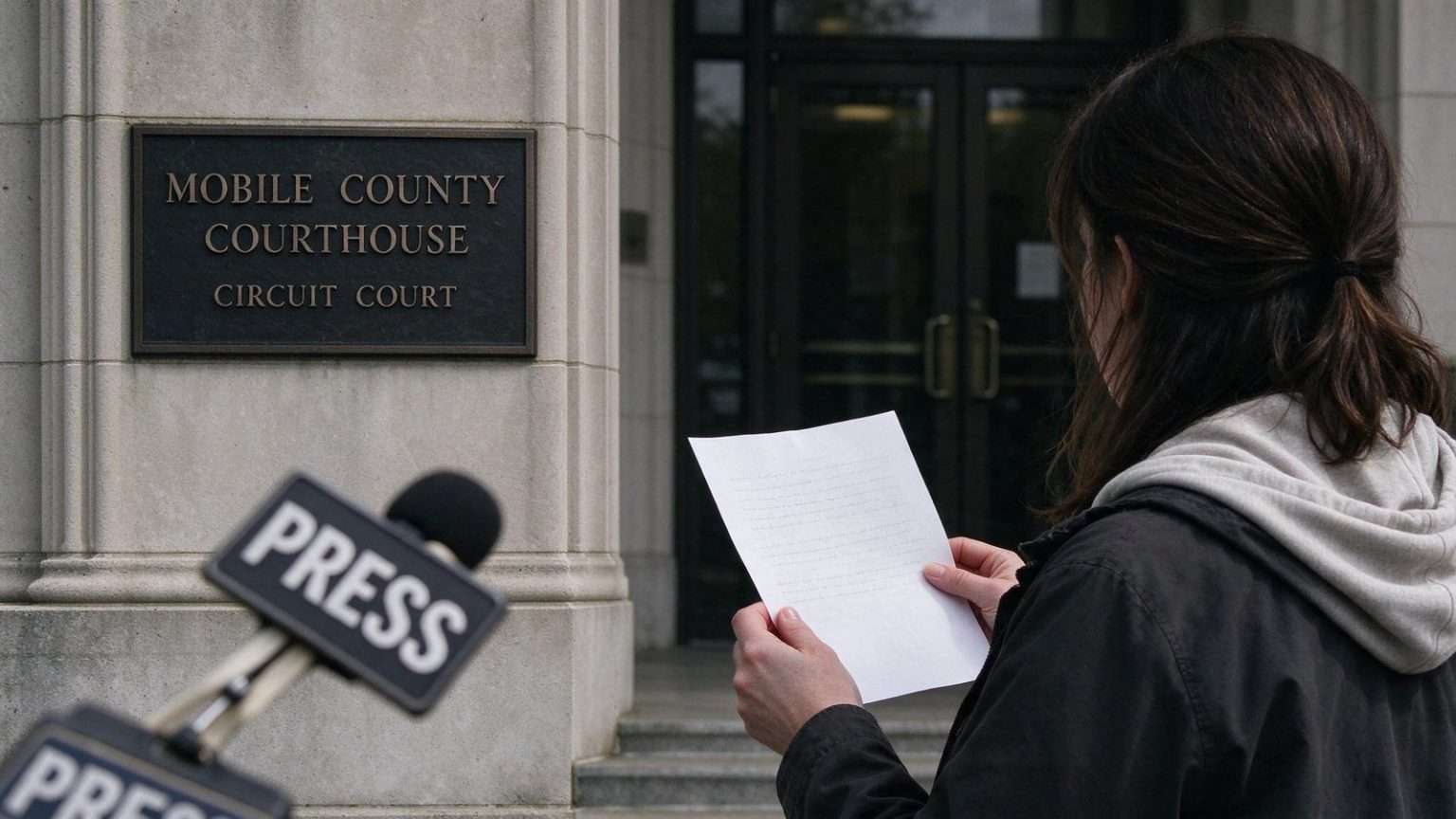
The trial, before Circuit Judge Michael Youngpeter in an eighth-floor courtroom at the Mobile County Courthouse, was expected to last two weeks. Lawyers spent most of Monday striking a jury, with opening arguments expected the following day.
Selecting a jury for a 30-year-old case is a distinct challenge. Prospective jurors are questioned about whether they remember the case, whether they have read or heard anything about it, whether they know the families, and whether they can set aside three decades of rumor. Some remember the original investigation; others were children when Foster died. The pool from which the lawyers worked reflected Mobile County itself — a generation that grew up with the case as an unsolved mystery and another that knew it only from the news of the arrest.
Foster would have been nearly 50 had she lived. Her aging parents attended the proceedings, and her mother, Joanne, sat with prosecutors as they questioned prospective jurors.
The presence of the victim’s family in a decades-old case carries its own gravity. Parents who buried a daughter in 1980 and watched the case go nowhere for 30 years were finally hearing evidence presented in open court, and their seats near the prosecution table made the passage of time visible to everyone in the room.
Letson’s criminal history includes a series of drug, petty theft and forgery charges. She has pleaded not guilty, and the state carries the burden of proving its case beyond a reasonable doubt.
That burden remains the same whether a case is three days old or three decades old. The jury will not be asked whether the letter sounds like a confession; it will be asked whether the evidence, taken as a whole, removes every reasonable doubt that Jamie Letson murdered Katherine Foster on the University of South Alabama campus in 1980.
Cold cases and the long memory
The Foster case belonged to a category that has grown steadily more visible in American policing: the cold case reopened. Mobile police’s decision to revisit the file in the years before Letson’s arrest followed a pattern seen across the country, as departments formed dedicated cold-case units, reapplied advancing forensic methods to decades-old evidence, and re-interviewed witnesses whose memories had matured and whose fear of speaking had faded.
Old cases pose problems no new case does. Evidence stored under the standards of 1980 may have degraded; witnesses have died or scattered; the neighborhood around a crime scene has changed shape entirely. What cold-case investigators rely on instead is persistence — the paper trail the original detectives left behind, the inconsistencies the original file recorded but never resolved, and the slow accumulation of details that mean nothing alone and everything together.
The University of South Alabama campus, where Foster was killed, has grown enormously since 1980 into one of the Gulf Coast’s major universities, with a teaching hospital and thousands of students who pass each year over ground where the 1980 killing remains a whispered piece of campus lore. The trial returned that history to the open, and to a courthouse a few miles from the woods where it began.
Whatever verdict the jury reaches, the trial stands as the end of a 30-year arc: a detective’s original suspicion, an error that buried it, a letter written in Mississippi to a grave that could not be found, and a courtroom in Mobile where the file finally had to answer for itself.