University of South Alabama Mobile
Mississippi Man Charged in Fatal Crash That Killed USA Graduate
A Purvis, Mississippi man faces a manslaughter charge in the April crash that killed a 24-year-old USA graduate.
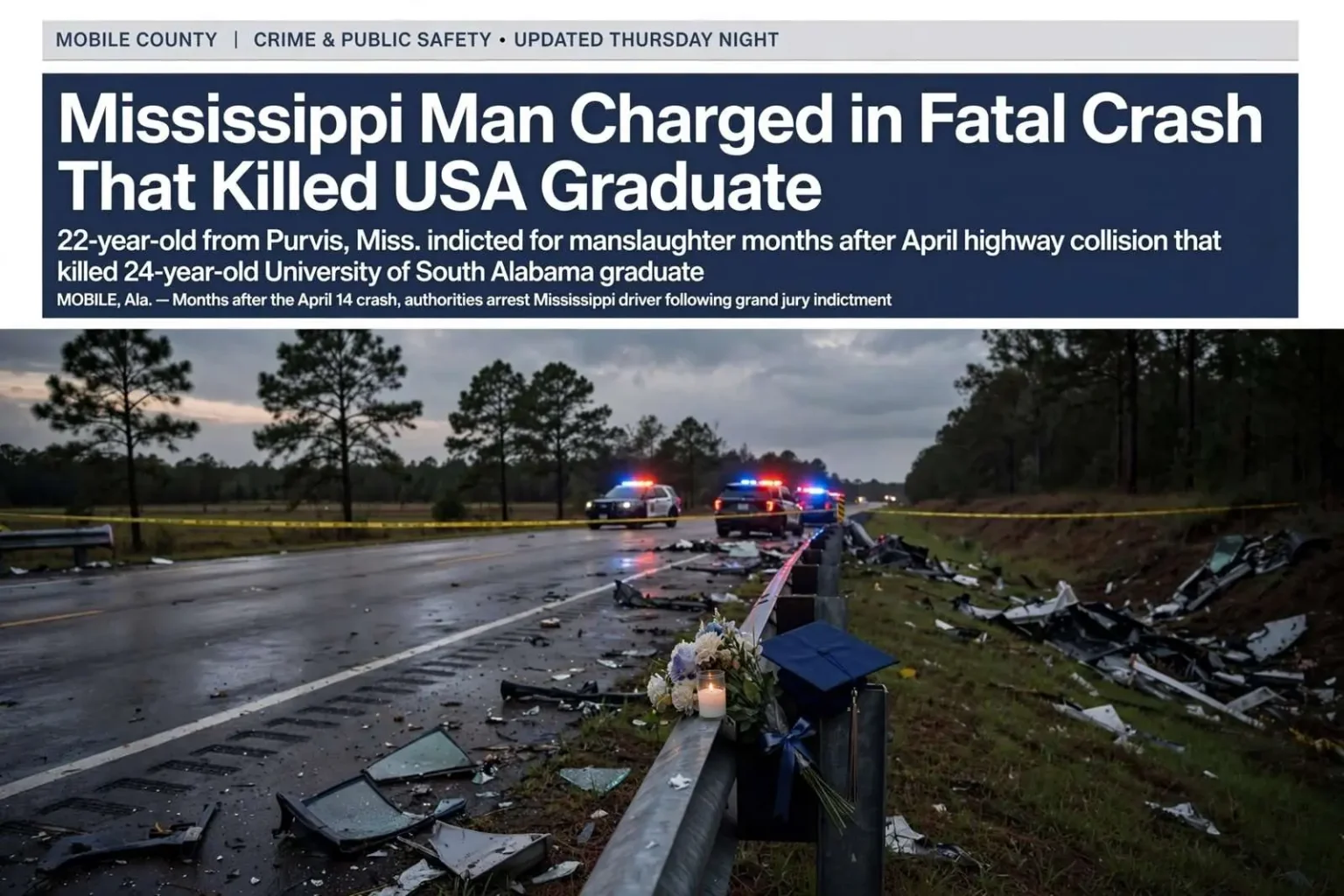
A Mississippi man is facing a manslaughter charge in connection with a fatal traffic crash in Mobile County that killed a 24-year-old University of South Alabama graduate last spring. The arrest, coming months after the wreck itself, shows how long the path from a highway collision to a criminal courtroom can run — through accident reconstruction, toxicology review and a grand jury’s deliberation before charges are ever filed.
Mobile County sheriff’s deputies arrested Jonathan Mikeal Raynes, 22, of Purvis, Mississippi, on Thursday night on one count of manslaughter. Jail records show Raynes was released on bond a short time later, around 10:10 p.m. He had been indicted by a Mobile County grand jury the previous month. The indictment transformed what had been a traffic fatality investigation into a felony prosecution, moving the case from the patrol division’s files to the circuit court docket.
The charge stems from a crash on April 14 that killed Miranda Kristin Hamilton, according to Alabama State Troopers. Investigators say Hamilton was driving a 2000 Ford F150 when a 2001 Dodge Ram crossed into her lane and struck her vehicle head-on. The impact caused Hamilton’s truck to roll over multiple times. Head-on collisions at highway speed are among the deadliest crash types on record, and rollover after impact compounds the violence a vehicle’s occupants absorb.
According to the grand jury indictment, Raynes crossed the center line while driving and drifted into oncoming traffic. Authorities believe he was sending a text message at the time of the crash, a detail that investigators say played a central role in building the case against him. Phone records, in cases like this one, can establish activity on a device at the moment of impact, and prosecutors have increasingly relied on them to connect distraction to criminal culpability.
Crashes in which a vehicle crosses the center line present investigators with a distinctive evidence picture. With no second driver’s account to rely on, troopers reconstruct the collision from the physical record: where the Ram first drifted over the line, the angle of impact, the scatter of debris and the resting positions of both vehicles. Rollover sequences after a head-on strike add further complexity, since the truck’s final position can be dozens of yards from the point of first contact.
The investigation that produced Thursday’s arrest involved more than the scene itself. State troopers compiled the reconstruction, sheriff’s deputies prepared the warrant paperwork, and a Mobile County grand jury — the citizen panel that hears evidence in secret and decides whether probable cause exists for a felony charge — returned the indictment the previous month. That sequence is how Alabama moves a highway death into the felony courts, and it explains why the arrest came a season after the wreck.
A Life Cut Short Before Commencement
Hamilton, a University of South Alabama graduate, died just weeks before she was scheduled to walk across the stage at USA’s spring commencement ceremony. Friends and family remembered her as someone who was, in the words of those close to her, “full of life and beauty.” The timing of the crash — so close to the milestone her degree represented — sharpened the grief that spread through the university community and her hometown circles in the weeks that followed.
Commencement season at the university draws families from across the Gulf Coast each spring, and the ceremonies that year carried a particular sorrow for those who knew Hamilton. Graduates around her crossed the stage carrying the memory of a classmate whose seat stood empty. Universities in such circumstances often confer a degree posthumously or present it to the family, a gesture that acknowledges the work the student completed even when the ceremony cannot be attended.
Hamilton’s death also rippled through the circles of young professionals and students around the campus, where news of a peer’s death in an avoidable crash landed with particular force. Traffic safety advocates note that young adults’ social networks are among the most effective channels for messaging about distracted driving, precisely because losses like this one are felt personally rather than abstractly.
The Charge and What Comes Next
Raynes is scheduled to appear before Mobile County Circuit Court Judge Robert Smith for an arraignment later this month. The arraignment is the formal step at which a defendant hears the charge and enters a plea, and it sets the schedule for the pretrial process that follows — motion practice, evidence disputes and, if no resolution is reached, trial. The manslaughter charge carries the possibility of significant prison time under Alabama law if he is convicted, though the case remains in its early stages as it moves through the county’s court system.
Manslaughter prosecutions arising from traffic crashes occupy a specific corner of Alabama criminal law. Prosecutors must show more than negligence; the charge typically turns on conduct that a jury finds showed a disregard for human life. Evidence of phone use at the moment of a fatal crash has become a recurring feature of such cases, as attorneys on both sides contest what the device records prove and what a driver knew or should have known while using it.
The case will continue to move through Mobile County Circuit Court in the coming months. Court records will show whether Raynes reaches a plea agreement or proceeds to trial on the manslaughter charge tied to Hamilton’s death. Either path will take time; felony dockets in the county move on schedules measured in months, and cases with technical phone evidence often see contested hearings before any resolution.
Alabama’s Texting Law and the Crackdown on Distracted Driving
Distracted driving cases involving text messaging have drawn increased scrutiny from Alabama law enforcement and prosecutors in recent years, as crash data has repeatedly linked cell phone use behind the wheel to serious and fatal collisions on state highways. Alabama law currently prohibits texting while driving, and cases like this one are often cited by traffic safety advocates pushing for stronger enforcement and public awareness campaigns across the Mobile area and the rest of the state.
Alabama’s texting-while-driving ban, in effect since 2012, makes it a primary offense, meaning a trooper or officer can stop a driver for that violation alone. The law prohibits reading, writing or sending text messages while a vehicle is in motion, with limited exceptions for navigation and emergency communication. Enforcement, however, remains difficult: unlike speeding, texting behind the wheel is hard to observe from a patrol car, which is why prosecutors and safety officials have leaned on data-driven evidence in the serious cases.
The federal crash data behind those campaigns is stark. Studies of driver distraction have consistently found that reading or sending a text takes a driver’s eyes off the road for seconds at a time — long enough, at highway speed, to travel the length of a football field without looking. Safety agencies have compared the impairment associated with texting to that of driving at or beyond the legal alcohol limit, and run-off-road and cross-center-line crashes are the crash types most often associated with the behavior. Young drivers show the highest rates of phone use behind the wheel in national surveys, a fact that has pushed schools, insurers and state agencies to target awareness campaigns at drivers exactly the age of the man now charged in Hamilton’s death.
A Case With Two States’ Reach
The crash connected communities across state lines. Raynes lived in Purvis, a small city in Lamar County, Mississippi, near Hattiesburg, and Hamilton’s life centered on Mobile, where she had studied at USA and built the network of friends who mourned her. The corridor between Hattiesburg and Mobile, carried largely by U.S. 98 and Interstate 10, is one of the busiest connections between the two states, and crashes on it regularly involve drivers from both sides of the line.
Prosecuting a Mississippi resident in an Alabama court adds procedural layers — extradition, travel for hearings and coordination between defense counsel and out-of-state witnesses — but the legal questions at the heart of the case are the same ones Alabama prosecutors have pressed in distracted-driving fatalities for years: what the phone records show, what the driver was doing in the seconds before the center line was crossed, and what level of criminal blame that conduct deserves.
For Hamilton’s family and friends, the arraignment date marks another painful mile in a process that began on an April afternoon. Court appearances, anniversaries and hearings will punctuate the months ahead as the case works toward resolution. Advocates who follow such cases say that public attention fades quickly after charges are filed, but the lesson the case carries does not: a few seconds of attention on a phone screen is a bet that no driver gets to take back.