East Brewton Council Eyes New Paving and Street Repairs as Roads Show Wear
East Brewton's city council is considering new paving and street repair work to address road wear, with additional project details expected as the plan moves toward a final decision.
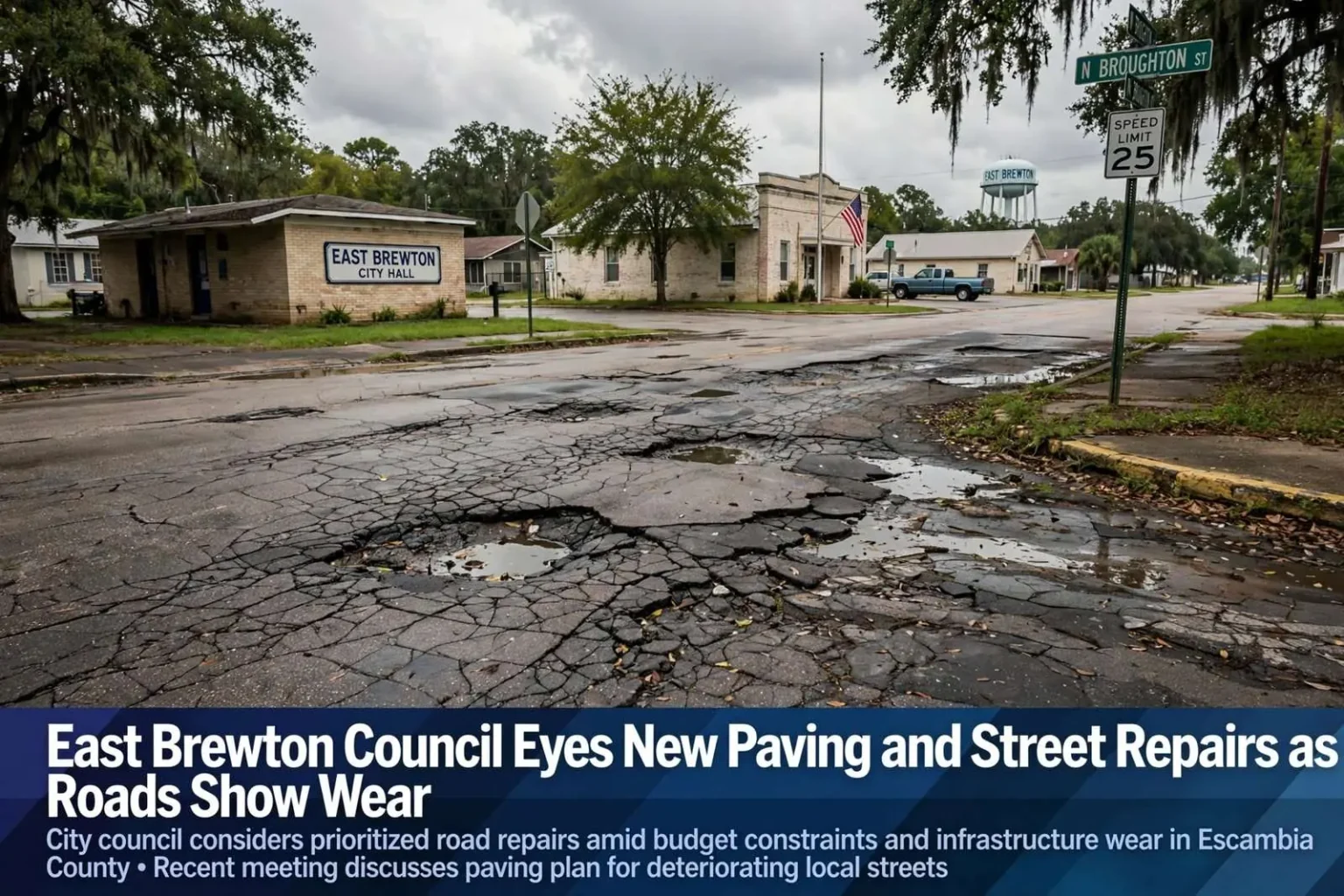
The East Brewton City Council is weighing new paving and street repair work as city leaders look to address wear on local roads, according to discussion at a recent council meeting. The conversation marks an early step in what is typically a months-long process for small Alabama municipalities, moving from general acknowledgment of the problem to a prioritized list of streets, engineered estimates and, ultimately, an award of work to a contractor.
Street paving and repair projects are a recurring budget item for small Alabama municipalities like East Brewton, where road maintenance costs compete with other infrastructure priorities such as water, sewer and drainage work. For a city of East Brewton’s size, the annual paving budget is never large enough to resurface every street that needs attention, which forces a continuous process of triage — fixing the worst stretches first while trying to keep older pavement from deteriorating further.
Pavement is a depreciating asset, and municipal engineers note that preventive resurfacing costs far less than full reconstruction. A street that is milled and resurfaced at the right time can last another decade or more; a street left too long may require patching, base repair and rebuilding that costs several times as much. That math is why councils across the state revisit paving lists every year, trying to catch streets in the window where a modest investment still buys a full rehabilitation.
East Brewton sits in Escambia County near the Florida line, where a climate of heavy rain, hot summers and the occasional freeze takes a toll on asphalt. Water is the great enemy of local roads: it seeps through cracks, softens the base beneath the pavement and leaves the familiar alligator-cracked potholes that residents report each spring and summer. Municipalities in south Alabama plan their paving calendars around those realities, often scheduling work in drier months to give new surfaces the best chance to cure properly.
How Paving Priorities Are Set
City councils typically weigh paving priorities based on complaint volume, traffic counts and the age of existing pavement when deciding which streets move to the front of the repair queue. Complaint volume is the most direct signal — council members hear from residents whose roads are the roughest — but raw complaints can overstate traffic on residential streets. Traffic counts add objectivity, pointing the city toward arterials that carry school buses, garbage trucks and commuter traffic daily.
The age and condition of pavement rounds out the picture. Many Alabama municipalities commission periodic street assessments that rate each road’s surface condition, giving public works departments a ranked list that survives changes in administration. Cities that maintain such lists can also demonstrate fairness in spending — an important consideration when every neighborhood believes its street should be next.
Utility coordination is another practical factor. Paving a street and then tearing it up a year later to replace a water line wastes public money, so public works departments try to sequence utility work ahead of resurfacing wherever possible. Councils reviewing paving plans routinely ask whether water, sewer or gas projects are anticipated on the same corridors before committing to new asphalt.
Once a priority list is set, small cities generally solicit bids from paving contractors, compare unit prices by the ton or by the square yard, and award contracts based on available funds. Cost per mile varies with the depth of resurfacing, the amount of base repair required and the price of liquid asphalt, which fluctuates with oil markets and can swing a project budget from one year to the next.
Funding the Work
Road money for Alabama municipalities flows from several familiar sources. Cities receive shares of state gasoline taxes earmarked for streets and roads, collect their own local gas taxes in some cases, and draw on general fund allocations that compete with police, fire and parks spending. Escambia County communities have also benefited from federal programs in recent years, including disaster recovery funding following hurricanes that have battered south Alabama roads and drainage systems.
The state’s 2019 gas tax increase, approved by the Legislature as the Rebuild Alabama Act, added dedicated revenue for local transportation projects, with a portion distributed directly to municipalities for road and bridge work. That funding stream requires cities to document how money is spent on qualifying projects, and it has allowed small towns across the state to resurface streets that had waited years for attention.
Grants can stretch a small city’s paving budget further when they are available. Community development block grants, state aid programs and cost-sharing arrangements with the county all offer routes to larger projects, though each comes with application cycles, matching requirements and timelines that do not always align with a council’s wish to act quickly. City clerks and engineers in towns like East Brewton spend considerable effort matching needs to the grant programs that can pay for them.
Inflation has added pressure to the paving equation in recent years, with the costs of asphalt, fuel and contractor labor rising faster than many small cities’ revenues. Councils that once stretched a budget across five or six miles of resurfacing now find the same money covering less work, which makes the selection of streets all the more consequential. Public works directors across the state advise councils to protect paving funds during tight budget years, warning that deferred maintenance only multiplies future costs.
Local participation can also influence the scope of a paving year. Civic groups and neighborhood associations that document conditions on specific streets — with photographs and dates — give councils a clearer record than scattered complaints alone. In towns the size of East Brewton, where council members are neighbors as often as not, that ground-level input frequently shapes the final list as much as any engineering survey.
What Comes Next
Further specifics on which streets would be prioritized, the total project cost and funding sources were not detailed in initial reporting on the council’s discussion. That is not unusual at this stage: councils often direct public works staff to assemble cost estimates and a candidate street list before committing in public to a final plan. Residents should not expect shovels in the ground immediately — the distance between a council discussion and a paving machine on a street typically runs through budget review and contractor bidding.
City officials are expected to provide additional information as the paving plan moves toward a final decision in upcoming meetings. When that information arrives, it will likely include the proposed street list, an engineer’s or contractor’s estimate, and the anticipated funding source for each segment. Council meetings in small cities are open to the public, and residents who want a voice in which streets are fixed first have the best opportunity to influence the outcome by attending and speaking during the public comment portions of those sessions.
For homeowners, the practical effect of a paving program is hard to overstate. Smooth streets mean fewer alignments and suspension repairs, better drainage during heavy rain, safer routes for school buses and emergency vehicles, and, in many cases, improved property values. Real estate agents in small Alabama towns routinely hear from buyers who ask about road condition before making offers, and a visible paving program is one of the clearest signals a city can send that it is investing in itself.
The council’s attention to road wear also reflects a broader truth about municipal governance in Alabama’s small towns. Streets are the most visible piece of public infrastructure — every resident drives them daily — and the condition of the pavement shapes perception of city government as much as any budget document. Councils that communicate a clear, fair plan for resurfacing tend to build the public trust that makes future infrastructure decisions easier.
Paving season in south Alabama generally runs through the drier, cooler months, when contractors can mill and lay asphalt without weather delays and new pavement cures under favorable conditions. Councils that finalize their street lists by late fall typically see work completed before the next hurricane season, keeping fresh surfaces out of the path of the heavy storms that can undo months of progress in a single weekend of rain.
Residents can track the project’s progress through the city’s meeting notices and agendas, which are typically posted ahead of each council session. Once contracts are awarded, paving schedules are often announced through city hall and local media, giving drivers along the affected streets advance notice of closures and flagging operations. Patience is part of the process — crews move street by street, and weather can push timelines — but the finished product endures for years.
As the plan advances in coming meetings, residents of East Brewton can expect the conversation to shift from whether to pave to which streets and when. The council’s next sessions will provide the detail — specific streets, costs and funding — that turns this week’s discussion into a schedule, and the community will be watching to see which roads make the first round of work.