Escambia County Residents Want Old Lillian Hwy Restaurant Torn Down — County Says Renovation Is Coming First
Neighbors along Lillian Highway say the abandoned former Vallarta's restaurant is a blighted eyesore and want it demolished, but Escambia County says the owners plan to renovate within 60 to 90 days.
ESCAMBIA COUNTY, Fla. — People living along a stretch of Lillian Highway say they’ve had enough of a dilapidated building in their neighborhood — but the county says demolition isn’t on the table just yet.
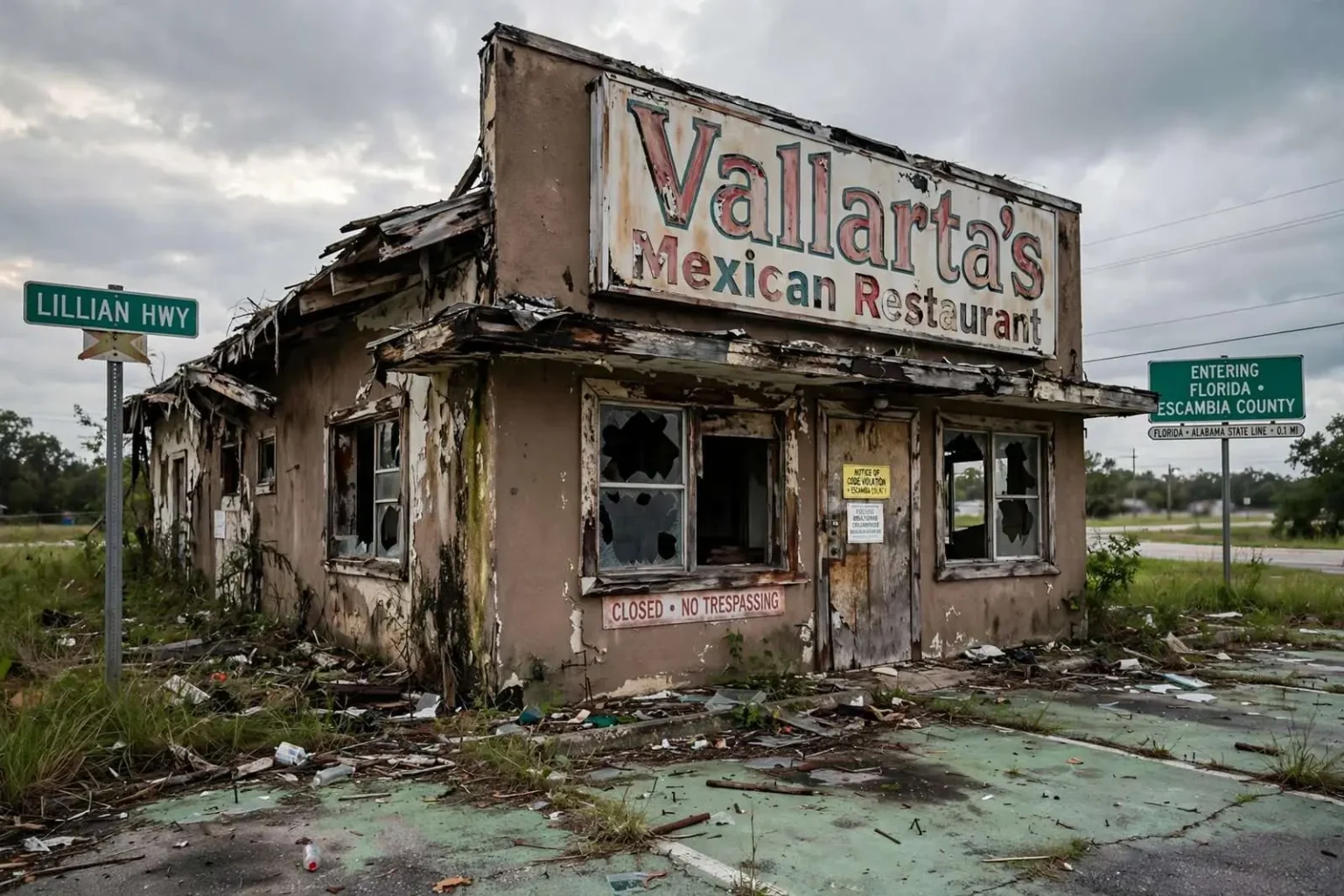
The former Vallarta’s Mexican Restaurant, abandoned for roughly 12 years according to neighbors, has become what one nearby resident calls an eyesore that’s dragging down the whole street.
“It’s just really a dump unfortunately,” said neighbor Mike Schumacher.
Rotting Wood, Broken Glass, and Open Windows
Schumacher says the building is visibly falling apart, with rotting wood, stray construction nails, broken glass, and code-violating open windows — and, most recently, a homeless presence moving in.
“That leads inside, and this window is against code,” Schumacher said. “It’s supposed to be closed in. You can’t have an open window.”
“The ceiling is falling down,” he said. “The nails and everything exposed. So when we get storms, what happened last time is we had a bad storm and this collapsed.”
He says the property’s condition is more than a cosmetic problem for the neighborhood.
“And it brings down property values as well,” Schumacher said. “It doesn’t look good for the community, especially if you’re in a market to buy a home in the neighborhood.”
A First Impression at the State Line
The restaurant sits right near the Florida-Alabama border, making it one of the first properties visitors see after crossing the Lillian Bridge — a detail neighbors say makes the blight especially frustrating for a gateway corridor into Escambia County.
Schumacher and his neighbors want the building demolished outright. But Tim Day, natural resources deputy director for Escambia County, says that’s not an option right now — because the owners have plans to bring it back.
“In talking with the owners today, they’re still working with some engineers to finalize some structural engineering that they need to do to get the permits to be able to hopefully start renovating the site in hopefully 60 to 90 days,” Day said.
Owners Plan a Revival — If It Happens
According to Day, the property owners intend to revamp the site by expanding the parking lot and reopening it as a “Pedro’s” Mexican restaurant. But he acknowledged they haven’t made much progress so far.
“What we’re doing now is we’re going to go ahead and re-notice them just because there seems to be ongoing issues,” Day said. “And it’s kind of dragging out just a little bit. But as long as the ownership is able to keep moving forward in a predictable fashion, I wouldn’t expect those code enforcement proceedings to continue to elevate.”
In other words: as long as the owners keep moving, the county will hold off on escalating enforcement — but if the promised renovation stalls again, the case could climb toward tougher action.
Whether the owners actually break ground on the revival remains to be seen. For now, neighbors along Lillian Highway say they’ll keep watching — and pushing — until something changes at the gateway property they see every day.
Why Counties Move Slowly on Demolishing Private Property
The frustration Lillian Highway neighbors feel toward Escambia County’s measured approach is a familiar dynamic in code enforcement cases across Florida and the rest of the country. Local governments generally cannot simply order a private building demolished because neighbors, or even county staff, consider it an eyesore. Property owners retain constitutionally protected rights even over structures in poor condition, and due process typically requires a documented sequence of notices, opportunities to correct violations, and, in most jurisdictions, a public hearing before a code enforcement board or special magistrate before a county can move toward the far more drastic remedy of ordering demolition or seeking a court order to do so. That process exists specifically to prevent a government from destroying someone’s asset — often worth a substantial sum even when the building itself has degraded — without giving the owner a genuine chance to remedy the violations first. It is why an official like Tim Day, describing an owner who is “still working with engineers” toward permits, will generally hold off on escalating enforcement as long as there is a credible, documented path toward compliance, even when the timeline frustrates the surrounding neighborhood.
How Unsafe Structure Cases Typically Escalate
Florida counties, like most local governments, generally follow a graduated escalation model for problem properties. A case usually begins with a code enforcement officer documenting specific violations — the kind of open-window, exposed-nail, and structural issues Schumacher described — followed by a formal notice of violation giving the owner a defined window to correct the problems. If violations persist, the case can move to a code enforcement board or special magistrate hearing, where the county can seek fines that often accrue on a daily basis until the violations are fixed, creating financial pressure on the owner beyond just the threat of further legal action. Only after repeated non-compliance, or in cases where a structural engineer’s assessment finds the building poses an imminent life-safety hazard, do most jurisdictions move toward condemnation and demolition orders — and even then, liens for the cost of demolition are typically placed against the property, which the county can pursue for reimbursement over time rather than absorbing the demolition cost as a public expense. Day’s comment about “re-noticing” the property because of “ongoing issues” describes a common middle step: restarting or refreshing the formal notice clock to keep the case moving through that process rather than letting it stall indefinitely without documentation.
The Real Cost of Vacant, Blighted Buildings
Neighbors’ concerns about property values are backed by a substantial body of research on the effects of vacant and blighted structures on surrounding neighborhoods. Urban planning and criminology researchers have repeatedly found that vacant buildings depress nearby home values, and studies in multiple cities have documented that concentrations of vacant structures correlate with higher rates of vandalism, illegal dumping, and, as neighbors here have already observed, informal homeless encampments moving into unsecured buildings. The broader “broken windows” theory in urban studies — the idea that visible signs of disorder in a neighborhood, even something as simple as an unrepaired building, can signal that an area is not being monitored or cared for, potentially inviting further neglect or petty crime — has been debated and refined over the decades, but the underlying observation that a single decaying property affects how an entire block is perceived by buyers, renters, and visitors remains widely accepted among housing economists and city planners.
Gateway Corridors and Why First Impressions Matter to Local Economies
The property’s location near the Lillian Bridge, one of the first sights greeting drivers crossing from Alabama into Florida along that route, touches on a specific concern that economic development officials take seriously: the condition of “gateway corridors,” the entry roads and intersections that form a community’s first impression for visitors, tourists, and potential new residents or businesses. Local governments and chambers of commerce frequently prioritize code enforcement and beautification efforts along these corridors precisely because research on place-based economic development suggests that a visitor’s first few minutes in a community disproportionately shape their overall impression and willingness to return, spend money, or consider relocating there. A blighted building sitting at a state-line crossing carries a different kind of civic weight than an equally dilapidated structure tucked several blocks off a main road, which is part of why the frustration among Lillian Highway residents extends beyond simple property-value concerns to a broader sense that the building reflects poorly on the whole community to everyone passing through.
The Uncertain Fate of Vacant Restaurant Buildings
Former restaurant buildings present particular redevelopment challenges compared with other types of vacant commercial property, since a structure built around commercial kitchen equipment, grease traps, ventilation systems, and specific plumbing configurations often requires significant renovation before it can reopen as any business, let alone the same type of restaurant. That specialized infrastructure is part of why a new owner considering a full culinary revival, as described for the planned “Pedro’s” Mexican restaurant, typically must budget for extensive kitchen and code-compliance upgrades on top of basic structural repairs — a reality that can help explain why announced restaurant revivals in long-vacant buildings frequently take longer, and cost more, than owners initially estimate, and why economic development officials watching similar projects elsewhere have learned to treat renovation timelines with some caution until permits are actually issued and construction visibly begins.
Living With a Long-Vacant Building
Residents’ descriptions of a storm-damaged ceiling and an accumulating homeless presence point to another pattern common to long-vacant structures: the longer a building sits unsecured, the more its problems compound. An initially minor issue, like a leak or a broken window, tends to worsen without regular upkeep, and unsecured buildings frequently attract informal occupants seeking shelter, which can introduce fire risk from makeshift heating or lighting and further deter any would-be buyer or renovator from moving quickly. Code enforcement officials in many jurisdictions have to weigh that compounding-damage problem against the due-process protections described above, sometimes issuing separate “secure the structure” orders — requiring an owner to board windows, fence the property, or otherwise limit unauthorized entry — as an interim step well short of demolition, precisely to address the safety and nuisance issues neighbors raise without forcing the larger and more legally fraught demolition question before the owner’s redevelopment plans have had a fair chance to play out. Whether Escambia County pursues that kind of interim securing order here is a decision usually made case by case, weighing the building’s specific hazards against how far along the owner’s stated engineering and permitting work has actually progressed.