Flomaton police seek help identifying fan theft suspect
Flomaton police are seeking the public's help to identify a man who stole a fan from a local laundromat, Chief Thompson said.
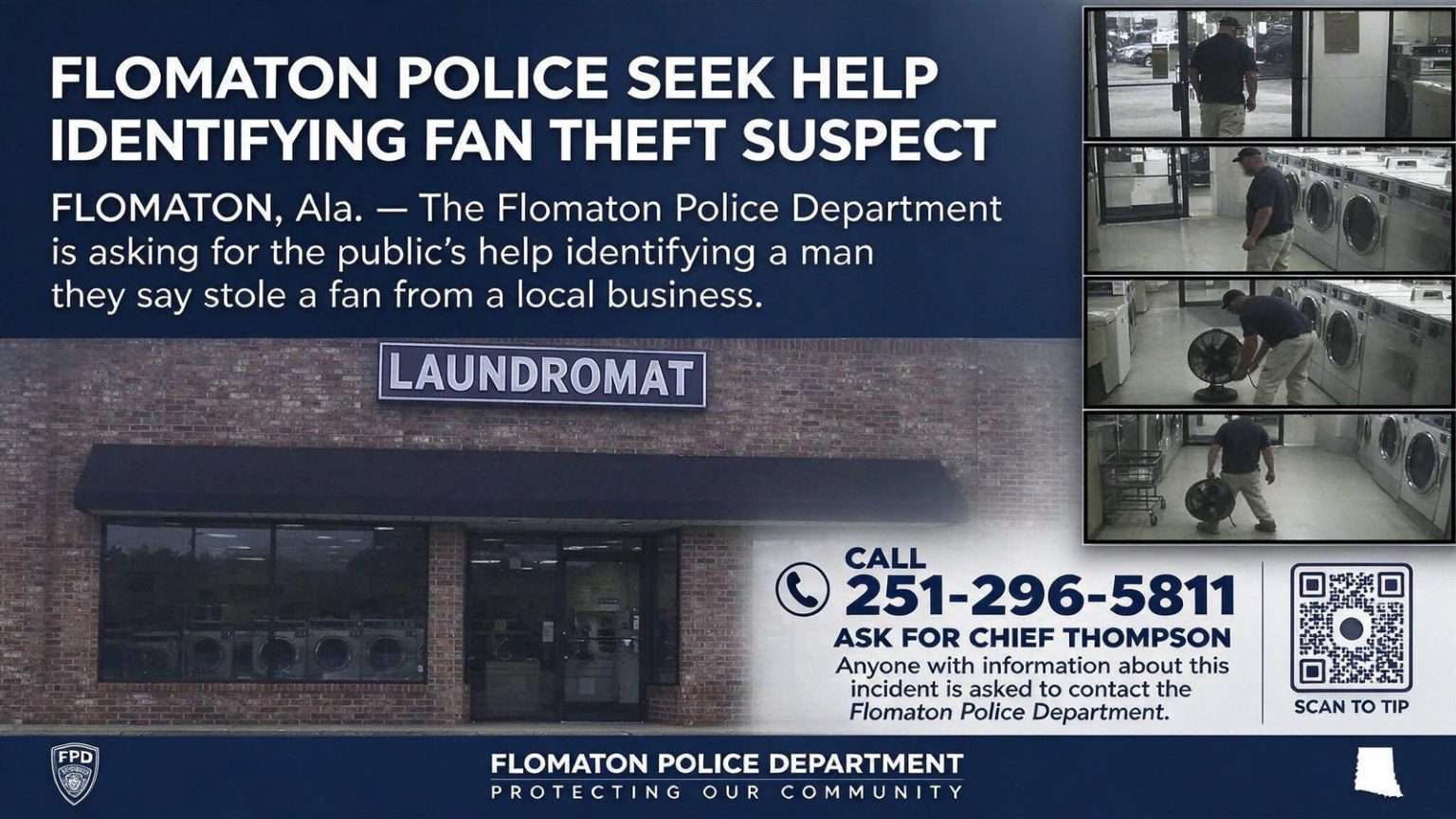
FLOMATON, Ala. — The Flomaton Police Department is asking for the public’s help identifying a man they say stole a fan from a local business, and the case has put one of Escambia County’s smallest cities at the center of a familiar small-town investigation. According to police, the man seen in surveillance photos took a fan from a laundromat. Investigators are asking anyone with information to call 251-296-5811 and ask for Chief Thompson.
The item at the center of the case — a fan — gives the investigation an everyday quality that residents will recognize. Fans are among the most practical pieces of equipment a household or a business can own in south Alabama, where heat and humidity make air circulation a necessity from spring through fall, and the theft of one from a business that serves people doing their laundry is the kind of small loss that nonetheless lands on a small business’s bottom line. Police did not release the value of the fan or the exact date of the theft, but the surveillance photos they distributed give investigators a clear image of the man they want to identify.
The case in Flomaton
Flomaton sits on the Alabama-Florida line in Escambia County, where U.S. Highway 29 and the rail lines cross into Century, Florida, and the town functions as one of the gateways between the two states. Its police department is small, as its residents would expect of a town of roughly 2,000 people, and its investigations of this kind depend heavily on the community’s willingness to look at a photo and make a phone call. That is the department’s request now: anyone who recognizes the man in the surveillance images is asked to call 251-296-5811 and ask for Chief Thompson.
The setting — a laundromat — is worth noting because of what it says about small-town commercial life. Laundromats in towns Flomaton’s size serve renters, workers, and families whose housing situations don’t include washer and dryer hookups, and they run on thin margins: utility costs, machine maintenance, and attendant wages all compete with modest revenue. Equipment thefts and losses hit those businesses directly, and a stolen fan is both a replacement cost and a reminder of the security burden small businesses carry. Owners of laundromats, convenience stores, and similar businesses across Escambia County routinely invest in camera systems for exactly the reason this case illustrates — when something walks out the door, the recording is the investigation.
Surveillance-based investigations work when the public participates. Police in Flomaton, like their counterparts across south Alabama, can document a theft on video but cannot put a name to a face without help, and the pool of people who might recognize the man in the photos is the community itself — customers, neighbors, and anyone who was in the area when the theft occurred. The department has asked that anyone with information call and ask for Chief Thompson directly, ensuring the tip goes to the officer leading the case.
How small theft cases are handled
Under Alabama law, a theft of property valued at less than $500 is classified as theft in the fifth degree, a Class A misdemeanor, with higher-value thefts rising through the degrees into felony territory. A fan stolen from a laundromat would ordinarily fall into the misdemeanor range, but the classification understates the process that follows: an identification, a warrant, an arrest, and a case presented to Escambia County’s court system. Misdemeanor theft convictions can carry jail time, fines, and restitution, and repeat offenders face escalating treatment.
The low value of the property does not make the investigation less serious to the department pursuing it. Small-town police departments handle dozens of cases of this scale — thefts from vehicles, shoplifting, equipment thefts from yards and businesses — and each one contributes to a pattern. Departments track repeat offenders and locations, and business owners share information with one another; a man photographed taking a fan from a laundromat may match other incidents in the area, which is one of the reasons police ask the public to report what they know even when the item taken seems trivial.
For the public, the department’s request comes with the same cautions that apply to every identification appeal. Residents who recognize the man should call investigators rather than confront him or post accusations on social media, where mistaken identifications carry real consequences for innocent people. The phone number — 251-296-5811, ask for Chief Thompson — routes information straight to the case officer, and callers can ask about anonymity if they have concerns about being identified.
Flomaton’s community context
The town where this happened is one of the small communities that make up the fabric of south Escambia County, alongside Brewton, Atmore, East Brewton, and Pollard. Flomaton’s history is tied to the railroad junction that gave it its name — a blending of “Florida” and “Alabama” at the state line crossing — and its modern identity is that of a border town with schools, churches, small businesses, and a police department that knows its residents by name. Cases like this one move through such a community quickly: surveillance photos circulate by phone and social media, and the question of who the man is usually gets answered faster than an outsider would expect.
The laundromat theft also reflects a broader pattern that small businesses across the Gulf Coast manage daily. Camera systems, exterior lighting, and watchful neighbors are the standard security toolkit, and most thefts in towns Flomaton’s size are solved through exactly the combination this case represents: a camera that recorded the act, a police department willing to work a low-dollar case, and a public asked to supply the final piece. Whether that piece arrives depends on residents picking up the phone.
The investigation remains open, and the Flomaton Police Department’s appeal stands: the man in the surveillance photos took a fan from a local laundromat, and investigators want to know who he is. Anyone with information is asked to call 251-296-5811 and ask for Chief Thompson. In a town the size of Flomaton, that call may come quickly — and when it does, the case will move from a photograph to a warrant in the ordinary course of small-town police work.
Why fans matter in south Alabama
It is worth pausing on the item itself, because a stolen fan in Escambia County is not the trivial matter it might seem to readers in cooler climates. South Alabama’s long warm season stretches from April well into October, and the heat index — the combination of temperature and humidity that determines how dangerous the air actually feels — regularly pushes into the danger zone during summer months. For elderly residents, families with young children, and workers without air conditioning, fans are not accessories; they are the difference between a livable room and an unsafe one, and public health agencies across the Gulf South include fans in their heat-safety guidance every summer.
Businesses depend on them too. A laundromat full of running dryers generates its own heat, and air circulation is part of keeping the space tolerable for customers waiting on their laundry. A missing fan in that setting is a comfort problem for every customer who walks in until it is replaced, which is why small business owners tend to treat equipment thefts as urgent regardless of the dollar value. The replacement cost is measured not just in the price of the fan but in the days of discomfort and the lost goodwill that follow.
The seasonal timing matters as well. Fan thefts tend to cluster in the hottest months, when the demand is highest and when secondhand resale of box fans and window units moves quickly through yard sales, flea markets, and online listings. Investigators in cases like this one are aware of that market, and residents who see equipment being resold under questionable circumstances are among the most useful sources of tips a police department receives.
The value of small-case police work
Some readers will wonder why a police department invests investigative effort in a fan. The answer lies in how small departments actually operate and what residents expect from them. In a town Flomaton’s size, the police department is the community’s guarantee that property crime has consequences at every scale, and that guarantee collapses quickly if low-value thefts go unworked. Businesses that report thefts and see no follow-up stop reporting; offenders who experience no consequences escalate; and the town’s overall crime picture deteriorates one small case at a time. Working the fan case is, in that sense, preventive work.
There is also the record-keeping function. Every documented theft — even one built from a laundromat’s camera footage and a public appeal — adds to the department’s knowledge of who is active in the community and where problems cluster. When investigators eventually identify the man in the surveillance photos, the case may connect to others: additional thefts, outstanding warrants, or patterns that only become visible when the small cases are assembled. Escambia County’s departments coordinate on exactly this basis, sharing information across Flomaton, Brewton, Atmore, and the county sheriff’s office.
And for the laundromat’s owner, the department’s effort is the difference between absorbing the loss in silence and seeing the system respond. Small business owners in towns like Flomaton weigh their security investments against thin margins, and their confidence that a report to police leads somewhere is what keeps them investing in cameras, lighting, and participation in investigations like this one. The public appeal for the fan theft serves the whole business community by demonstrating that the process works.
How to help
Residents with information about the man in the surveillance photos should call 251-296-5811 and ask for Chief Thompson. The call is the entire ask — no forms, no office visit, no formal statement required to start. Callers should describe how they recognize the man, where he can be found, and anything they know directly about the theft or the fan’s whereabouts. Residents who saw something around the laundromat, even if they did not recognize the man in the photos, can also contribute: the time of the theft, the direction the man went, and whether a vehicle was involved all help investigators build the case.
The department has not released a detailed description of the suspect or the business’s exact location beyond identifying it as a local laundromat, and the surveillance photos remain the public’s best identifier. Anyone who encounters the photos circulating locally and recognizes the man should use the department’s number rather than responding to the person directly or broadcasting guesses online. Small communities rely on accurate tips, and inaccurate ones cost investigative time and harm reputations.
The case closes the way most small-town theft cases do: with a phone call that puts a name to a photograph, a warrant, and a court date in Escambia County. Until then, the Flomaton Police Department’s request stands, the number is 251-296-5811, and the officer to ask for is Chief Thompson. For a town built on the state-line crossing where neighbors know one another, identifying the man in the photos is likely one good phone call away.