Atmore Woman Dies in Two-Vehicle Crash on Alabama 21
A 65-year-old Atmore woman died and another woman was injured when two vehicles collided on Alabama 21 north of Atmore, troopers said.
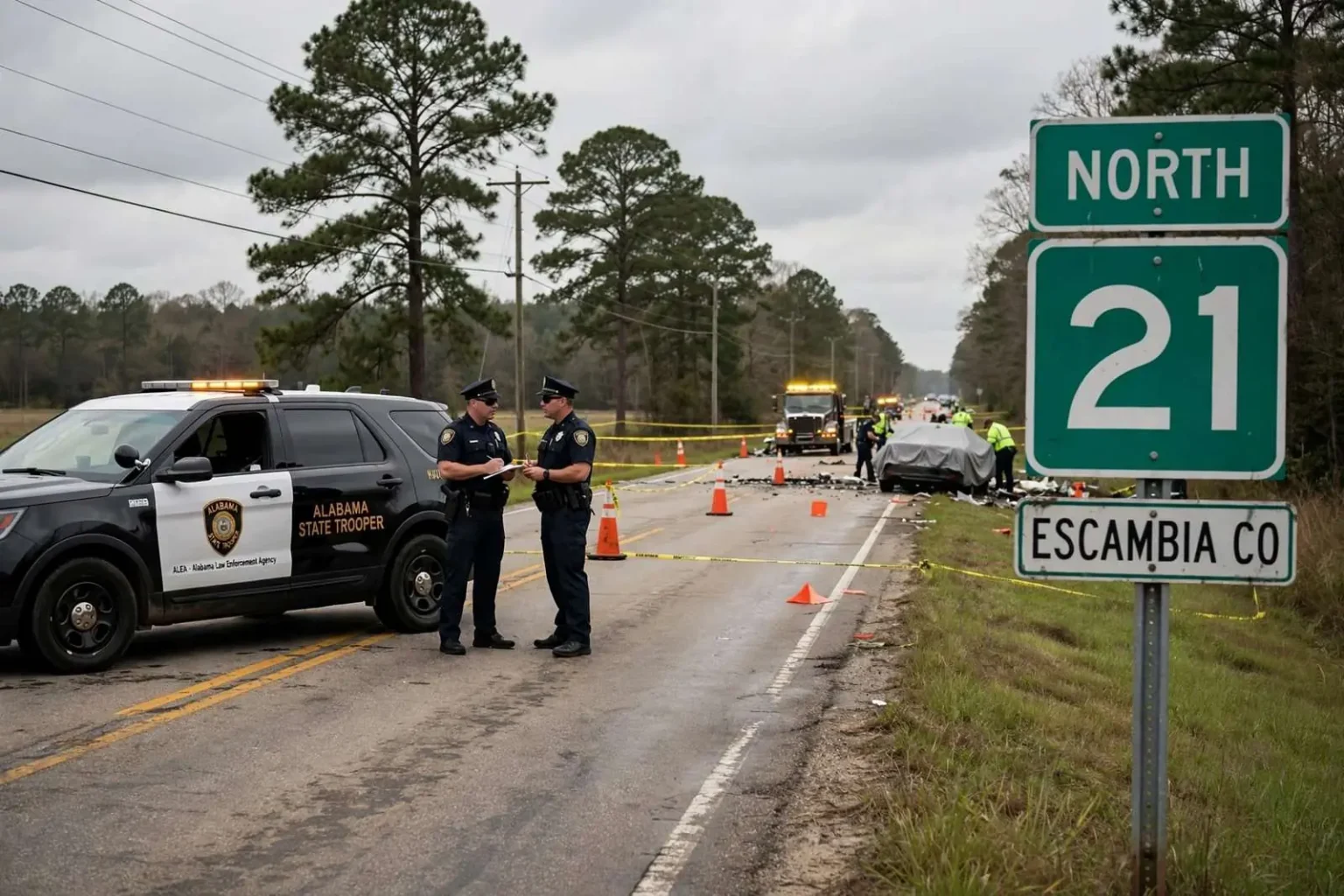
A 65-year-old Atmore woman died Tuesday morning following a two-vehicle crash on Alabama 21 north of the city, according to Alabama State Troopers.
The woman, a passenger in a Chevrolet Malibu, suffered fatal injuries when her vehicle was struck by a Chevrolet Impala roughly four miles north of Atmore, a state trooper said. The crash occurred just before 11 a.m. She was taken to Atmore Community Hospital, where she later died from her injuries.
The driver of the Malibu, a 70-year-old woman, was also transported to Atmore Community Hospital for treatment. Authorities did not release details on the severity of her injuries. The driver of the Impala was not injured in the crash, troopers said.
News of the collision spread quickly through Atmore, a city of a few thousand residents where serious wrecks on the surrounding highways are felt personally across the community. Emergency crews closed or restricted the roadway while they worked the scene, and motorists who regularly use the stretch of Alabama 21 north of town found their midday routines disrupted as investigators documented the aftermath.
An Investigation Continues
Alabama State Troopers said they continued investigating the crash through the afternoon to determine the exact cause and sequence of events leading up to the collision.
Troopers work fatal crashes methodically. Investigators photograph and diagram the scene, document skid marks and vehicle rest positions, and examine the vehicles themselves for signs of mechanical failure. Statements from the drivers and any witnesses are taken, and in many cases investigators seek search warrants for vehicle data recorders, which can reveal speed and braking information in the seconds before impact. Only after that work is complete do troopers determine whether any citations or charges are appropriate — a process that frequently takes days or weeks rather than hours.
No further details about potential charges or contributing factors, such as speed, weather or road conditions, were released at the time investigators provided their initial account of the crash. That silence is standard procedure in the early stages of a fatal crash investigation, when troopers avoid releasing details that could complicate the case or prove premature once the full evidence is in.
Alabama State Troopers typically continue to gather evidence, including vehicle inspections and witness statements, in the days following a fatal collision before determining whether any citations or charges are warranted. When the investigation concludes, findings are usually forwarded for review, and any charges are announced separately from the initial crash report.
A Heavily Traveled Corridor
Alabama 21 is a heavily traveled two-lane highway connecting Atmore to areas throughout Escambia County, and it has seen its share of serious crashes over the years given its mix of local and through traffic.
The highway serves two roles at once, and that duality shapes its risk profile. Locals use it for daily errands and commutes between Atmore and smaller communities to the north and south, while through travelers use it as a regional connector across the county. The combination of familiar local drivers and unfamiliar passers-through, on a road with intersections, driveways and farm entrances along its length, creates the kind of environment where a momentary mistake can produce a serious collision.
Fatal crashes on rural Escambia County highways like Alabama 21 often draw close attention from area residents, many of whom rely on the roadway daily for travel between Atmore and surrounding communities. In small towns, the victims of highway crashes are often known to the people reading about them, and word of a serious wreck travels through churches, workplaces and social media long before official details are released.
State troopers routinely patrol the corridor and have periodically flagged sections of the highway for increased enforcement following serious wrecks. Enforcement details targeting speed and seat belt use are a familiar presence on rural Alabama highways, and troopers often emphasize that the simplest measures — slowing down, staying alert, buckling up — remain the most effective protection against the kind of crash that claimed a life north of Atmore.
Atmore and Its Roads
The Atmore community, a close-knit city in northern Escambia County, has faced a string of serious traffic incidents on area highways in recent years, prompting occasional discussion among local officials about road safety improvements, though no specific changes were announced in connection with this crash.
Atmore sits near the Florida state line and serves as a commercial hub for northern Escambia County, drawing shoppers, workers and travelers from surrounding rural communities as well as visitors passing through on nearby Interstate 65. The city is also home to the Poarch Band of Creek Indians’ reservation and its substantial commercial enterprises, which add to the daily traffic moving through the area. Alabama 21 runs through that landscape as one of the city’s principal links to the wider county.
Rural highway safety is a persistent concern across south Alabama, where two-lane roads carry a large share of daily travel. State and county engineers periodically review crash data to identify intersections and road segments that warrant attention, and improvements — when they come — tend to arrive gradually: better signage, clearer pavement markings, guardrails, improved lighting or turning lanes at problem intersections. Major reconstruction of rural highways is rare, which leaves driver behavior and enforcement as the primary levers for reducing serious crashes in the interim.
Hospitals like Atmore Community Hospital play a critical role in the aftermath of wrecks on the surrounding highways. As the closest emergency facility to the crash site, it received both injured women from the Malibu, and its staff worked on the passenger before she died from her injuries. In rural Alabama, the first hour after a serious crash — the period emergency responders call the golden hour — often determines whether a critically injured patient survives, and the distance to definitive trauma care is a factor that shapes outcomes on the region’s outlying roads.
Anyone with information about the crash was asked to contact Alabama State Troopers as the investigation continued. Witnesses who saw either vehicle before the collision can provide troopers with details that may never appear in the physical evidence, from the speed of travel to the behavior of a driver moments before impact. Troopers typically respond to the scene within minutes of a fatal crash report, and their early observations often anchor the entire case file that follows.
For now, the investigation remains the province of the troopers who worked the scene Tuesday, and the family and friends of the woman who died are left to grieve a loss that unfolded in the span of a morning on a road they have traveled countless times. Her death stands as the kind of routine-looking wreck with devastating consequences that rural Alabama knows too well — two vehicles, one intersection of paths on a two-lane highway, and a community mourning one of its own.
Alabama State Troopers, operating under the Alabama Law Enforcement Agency, are the primary investigators for traffic fatalities on state highways and rural roads across Alabama. In the southwestern part of the state, troopers cover a wide patrol area that includes Mobile, Baldwin, Escambia, Monroe and surrounding counties, which means fatal crash investigations are often handled by a small team working multiple scenes in a given week. The agency’s crash reconstruction specialists can be called in for complex collisions, adding further time to the process before a final report is complete.
The dynamics of two-vehicle collisions on two-lane highways are well documented. Many occur at intersections, where a driver pulling out or turning across oncoming traffic misjudges distance and speed. Others happen during passing attempts, when a driver crosses the centerline into the path of oncoming traffic, or when a vehicle drifts over the line due to distraction or fatigue. Because there is no median to separate opposing directions of travel, the margin for error is small, and impacts at highway speeds frequently produce the serious injuries that urban crashes with barriers and divided roadways sometimes avoid.
Seat belts factor heavily in whether occupants of a struck vehicle survive. In side-impact crashes especially, the occupant seated closest to the point of impact bears the brunt of the collision, and restraint use is often the difference between walking away and fatal injury. Troopers investigating this week’s crash will account for restraint use among all three occupants as part of the standard report, information that feeds statewide safety statistics and enforcement priorities.
The days ahead will bring the routine but necessary work of closing out the case: final reports filed, evidence processed and findings communicated to the families involved. For Atmore, the crash serves as another reminder on a list the community would rather not extend — that the highways binding its small towns together demand the full attention of everyone who drives them.