Every Student in Escambia County’s Public Schools Will Eat Free This Year Under a Federal Nutrition Program
Escambia County's public school students will receive free breakfast and lunch this year under a federal Community Eligibility Provision program, removing income-based applications for meal assistance.
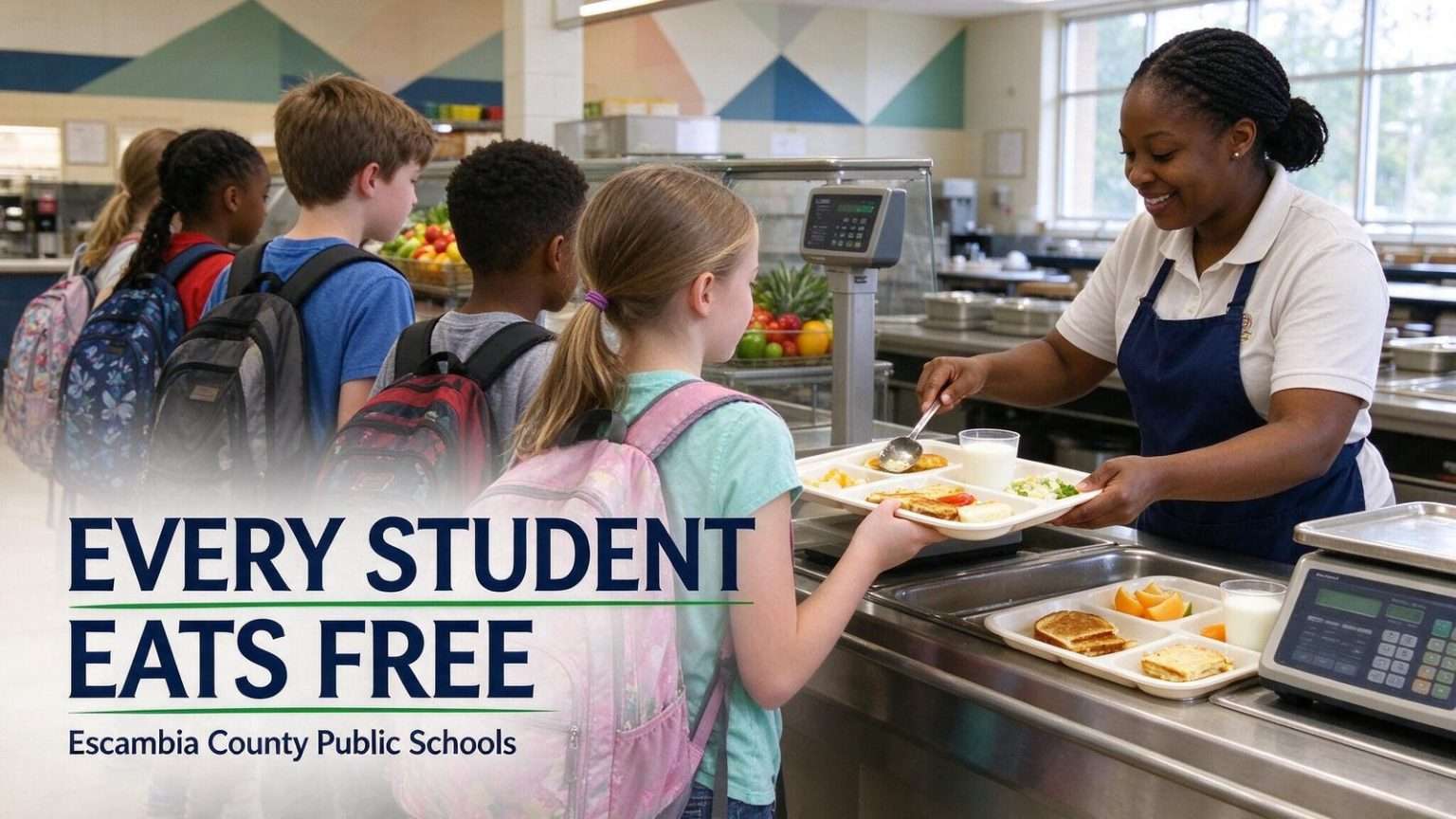
Students across Escambia County’s public school system will have access to free breakfast and lunch this school year, under a federal program that allows entire districts with high poverty rates to offer universal free meals without requiring individual family applications. The arrangement, commonly run through the federal Community Eligibility Provision, lets qualifying school systems serve free meals to every enrolled student regardless of individual household income, cutting through the paperwork and stigma that can come with a traditional free-and-reduced-lunch application process.
For families, the shift removes one of the more persistent back-to-school financial pressures: the daily or weekly cost of school meals, which can add up significantly for households with multiple children enrolled across the district. A family with two or three students can easily spend hundreds of dollars a semester on cafeteria charges under a paid-meal system, and even families that qualify for reduced-price meals face a recurring expense that universal programs eliminate entirely.
It also simplifies administration for the school system, which no longer needs to process, verify and track individual family eligibility applications. Under the traditional model, school nutrition departments spend substantial staff time collecting household income forms, verifying them and following up with families who return incomplete paperwork. When eligibility is determined at the district level instead, those resources shift back toward food preparation and service, and no student is turned away at the register over an account balance.
How the Community Eligibility Provision Works
The Community Eligibility Provision was created by Congress as part of the Healthy, Hunger-Free Kids Act of 2010 and rolled out nationally after a multi-year pilot phase. It is designed for districts and individual schools where a large share of students are already directly certified for free meals because their households participate in programs such as the Supplemental Nutrition Assistance Program or Temporary Assistance for Needy Families, or because the children are in foster care, migrant families or Head Start.
Where that identified-student percentage meets the federal threshold, a district can claim meal reimbursements at the free rate for all students without collecting applications at all. The federal government reimburses meals at varying rates based on the district’s identified percentage, with school systems covering any gap between reimbursement and cost. For a rural district like Escambia County, the provision converts a stack of paperwork into a single streamlined claim, and it means cafeteria workers no longer serve as de facto debt collectors for meal accounts.
Alabama education officials have encouraged qualifying districts to adopt the provision since it became widely available, and participation has grown steadily in systems where poverty rates are highest. Escambia County’s move places it alongside a growing list of South Alabama districts that have made the switch in recent years.
A Pattern Across South Alabama
Universal free-meal programs have expanded across high-poverty Alabama school districts in recent years as more systems qualify under federal thresholds, reflecting broader economic conditions across rural counties in South Alabama. Counties across the region — including Escambia, Wilcox, Perry, Dallas and Lowndes — consistently rank among the state’s highest for child poverty, a reality that makes their school systems natural candidates for community eligibility.
The economics are straightforward. In a district where a majority of students already qualify for free or reduced-price meals under the traditional system, the paperwork burden of applications often outweighs any revenue the paid-meal system generates. Applying to every household costs staff time, and unpaid meal charges accumulate into debt that districts must ultimately absorb. Universal eligibility erases that debt cycle at its source and guarantees that no child’s family income determines whether they eat a complete breakfast or lunch on a school day.
What It Means for Escambia County Families
For Escambia County specifically, the change means every student — from kindergartners to seniors — will be able to eat breakfast and lunch at school at no direct cost to their families this year. The county’s public school system serves communities including Brewton, Atmore, Flomaton and East Brewton, stretching across a largely rural county on the Alabama-Florida line where agriculture and timber have long anchored the local economy.
The daily effect on household budgets is easy to underestimate. Breakfast and lunch at school, purchased every day for a full year, represent a meaningful expense per child under a paid system. For a family with several school-age children, universal free meals function like a modest annual tax cut, freeing income for other needs. For families hovering just above eligibility lines under the old system, it removes a frustrating category of household that earned too much to qualify but struggled to cover cafeteria costs anyway.
Nutrition advocates also point to the classroom benefits. Students who eat breakfast at school are more likely to arrive ready to learn, and teachers in high-poverty districts have long reported that morning meals reduce mid-morning hunger, visits to the nurse’s office and behavioral issues tied to empty stomachs. By removing the application hurdle entirely, the program reaches students whose families never completed the paperwork — whether because of language barriers, transience, pride or simple confusion about the forms — who were previously eligible in practice but unserved in fact.
Removing the Stigma Factor
One of the quieter advantages of universal programs is what they eliminate socially. In a traditional system, the cafeteria line itself can reveal a student’s economic circumstances, since paying students and free-meal students historically moved through different processes. Children are acutely aware of that difference, and some families declined to apply precisely because they did not want their children identified as poor.
When every student in the district eats at no charge, the distinction disappears. A senior from a well-off household and a kindergartner from a struggling one go through the same line the same way. School administrators across the country that have adopted community eligibility consistently report higher meal participation — more students eating breakfast in particular — which supports both the district’s federal reimbursement rates and the students’ own nutrition.
The Year Ahead
For the Escambia County school system, the program year ahead will test the arrangement in practice: higher participation counts, smoother cafeteria lines and one less form in the stack of back-to-school paperwork that families bring to registration. District officials elsewhere in Alabama that have made the same switch generally report that the transition is straightforward once reimbursement claims are established, and that the main adjustments involve forecasting food quantities for higher participation.
The broader trend is likely to continue. As long as poverty rates across South Alabama’s rural counties remain above the federal thresholds, the Community Eligibility Provision will remain available to more districts, and the list of systems offering universal free meals should keep growing. For now, Escambia County’s families can plan the school year knowing that feeding their children at school is one expense they will not face — a small administrative change with a very tangible impact at kitchen tables from Brewton to Atmore.
The Numbers Behind the Eligibility
The federal reimbursement formula is what makes universal service financially workable in districts like Escambia County’s. Each meal served is reimbursed at the free rate for a share of students proportional to the district’s directly certified percentage, and at a much lower rate for the remainder. Districts with the highest identified-student percentages recover nearly all of their meal costs from federal funds, while those closer to the threshold must weigh whether local funds can cover the difference.
In practice, the direct-certification data does the work that applications once did. State agencies match student rolls against SNAP, TANF and other assistance records, producing an identified-student percentage for each district without a single form being filled out. That data-driven approach is also more accurate than self-reported applications, which can contain errors, omissions and outdated income figures, and it updates automatically as economic conditions in the county change.
The same data explains why the provision has spread unevenly across Alabama. Suburban systems with lower poverty rates often cannot reach the required percentage and must continue operating the traditional application model, while rural Black Belt counties and border counties like Escambia clear the bar comfortably. The result is a map of Alabama school nutrition that mirrors the state’s economic geography almost exactly.
Back-to-School Relief
The timing of the change matters for families as well. The weeks before school starts bring a concentrated round of expenses — clothing, supplies, fees and registration costs — and meal payments have historically been one more line item on that list. Removing them for the entire year, at the start of the year, lets households plan with certainty rather than watching cafeteria balances accumulate week by week.
School leaders in districts that have already adopted universal meals frequently describe it as one of the most visible anti-poverty measures a school system can take on its own initiative. No other program the district administers reaches every student, every school day, quite as directly. In Escambia County, the guarantee now covers every campus, and the only thing families need to do is nothing at all: their children simply eat, and the federal program pays the bill.