Brewton Is Moving Ahead With a Sewer Project Aimed at Fixing Long-Standing Capacity Problems
Brewton is advancing a sewer system project intended to address long-standing wastewater capacity issues, part of a broader push among small South Alabama cities to modernize aging infrastructure.
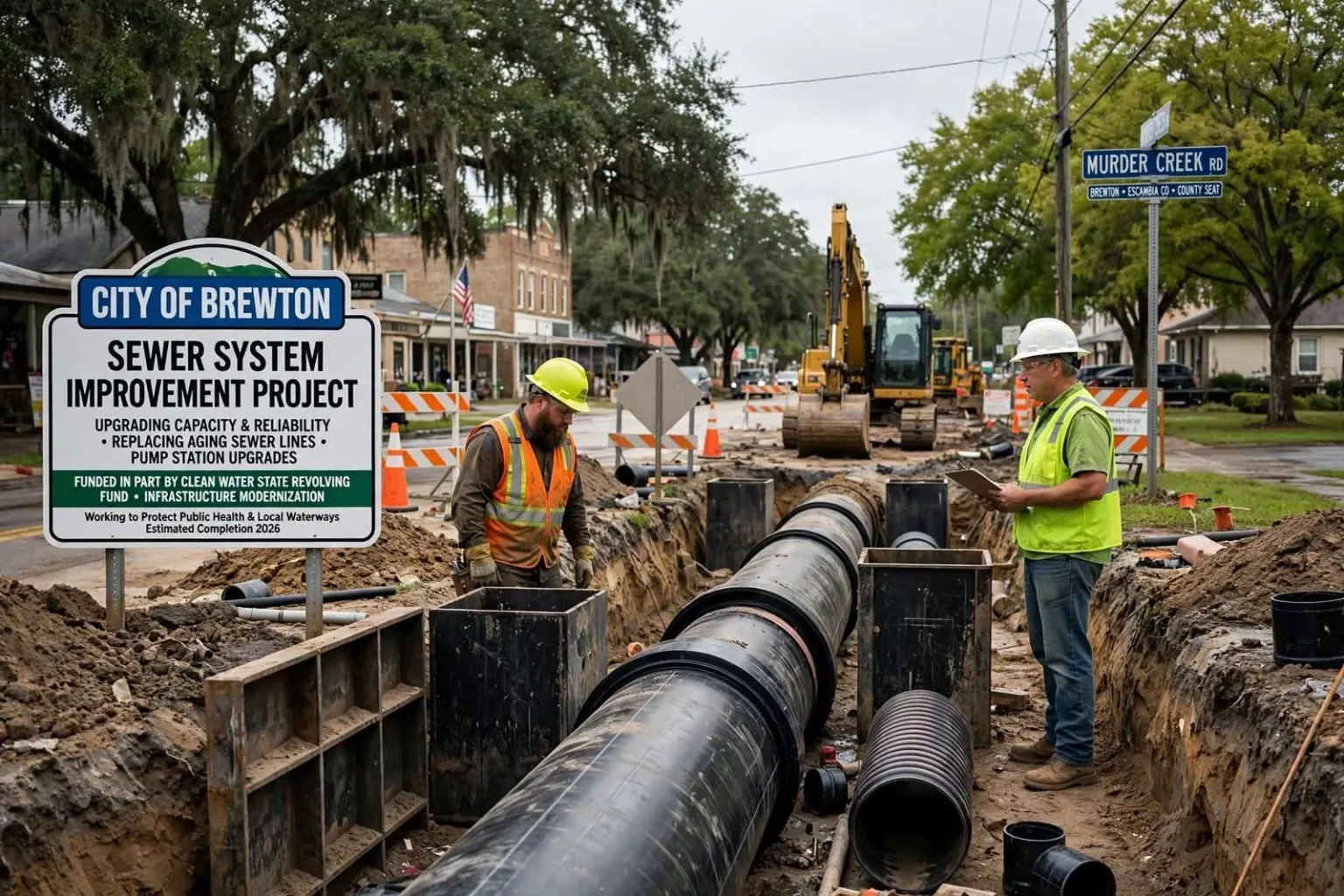
Brewton is moving forward with a sewer system project intended to address long-standing capacity issues in the city’s wastewater infrastructure, according to city officials. The effort marks one of the more significant utility investments the Escambia County city has pursued in recent years, and it comes as communities across South Alabama face mounting pressure to modernize systems that were built decades ago.
Details released so far indicate the project is aimed at improving the reliability of Brewton’s sewer system, an issue that smaller Alabama cities frequently face as aging infrastructure struggles to keep pace with development and heavy rainfall events. The full engineering scope of Brewton’s project has not been detailed publicly, but the category of work is familiar to municipal engineers across the region.
What a Capacity Project Usually Involves
Municipal sewer capacity upgrades of this kind typically involve a mix of pipe replacement, pump station upgrades and treatment capacity improvements. Aging clay and cast-iron lines, common in Alabama cities that grew in the early and middle twentieth century, crack and separate over time, allowing groundwater and stormwater to infiltrate the system. That inflow — engineers call it inflow and infiltration — consumes capacity that should be reserved for actual wastewater.
Pump stations are the other frequent culprit. A sewer system relies on dozens of stations to lift wastewater across the terrain toward the treatment plant, and stations with aging pumps, worn wet wells or undersized electrical service can become bottlenecks during wet weather. Upgrading those stations, along with replacing failing lines and expanding treatment capacity where needed, is the standard prescription for a system that struggles after heavy rain.
Why Rain Matters So Much
Sewer capacity problems can create both environmental and public health concerns when systems are overwhelmed during heavy rain, sometimes resulting in overflows that affect waterways and neighborhoods near aging pipe networks. South Alabama’s climate makes that risk acute: the region receives some of the heaviest rainfall in the country, and intense downpours can push more water into a compromised system in a few hours than the pipes were ever designed to carry.
Overflows can send untreated wastewater into creeks and rivers, including waters that feed the region’s larger river systems and, ultimately, the Gulf. They also create nuisances and hazards in the neighborhoods where they occur. State regulators track such overflows, and cities that repeatedly exceed limits can face enforcement actions and mandated corrective plans — outcomes that make proactive investment far cheaper than waiting for a crisis.
Funding the Work
Cities across South Alabama have increasingly turned to federal and state infrastructure funding sources to tackle these projects, given the high cost of replacing underground pipe networks relative to typical municipal budgets. Buried infrastructure generates no revenue and attracts no ribbon cuttings, which is why it tends to be deferred until problems become visible — and far more expensive to fix.
The Clean Water State Revolving Fund, administered in Alabama through the state revolving fund program, has long been the primary financing tool for municipal wastewater work, offering below-market loans to cities that upgrade their systems. In recent years, federal pandemic relief and infrastructure legislation have added grant and loan opportunities that smaller cities have pursued aggressively, often combining several sources to fund a single project.
For a city Brewton’s size, assembling that financing mix is often the difference between a real construction program and a wish list. City officials have indicated that cost, funding sources and construction timelines will be detailed as the project moves forward, and residents should expect those specifics to be presented publicly before contracts are awarded.
What It Means for Brewton Residents
Brewton residents can expect more specifics on cost, funding sources and construction timelines as the project moves from planning into its next phase, a process city officials will likely detail further at upcoming council meetings. For households, the practical stakes are straightforward: fewer backups during storms, a more reliable system that supports new homes and businesses, and a city that stays ahead of environmental compliance rather than reacting to it.
Reliable sewer service is also an economic development tool. Industries considering a move to a small city ask pointed questions about utility capacity before committing, and a wastewater system with room to grow can help attract the employers that keep young families in town. Brewton’s leaders have long emphasized steady, pragmatic growth for the city, which serves as a commercial hub for surrounding communities in Escambia and Conecuh counties.
Brewton’s Place in South Alabama
Brewton sits along Murder Creek in north-central Escambia County, serving as the county seat and the largest city in the county. The city’s economy has historically been rooted in timber and manufacturing, and its neighborhoods include housing stock that in places dates back generations — which often means water and sewer lines installed in the mid-twentieth century are still carrying today’s load.
That profile makes Brewton representative of a statewide challenge. Alabama has hundreds of small municipal sewer systems, and many of them share the same arithmetic: a modest tax base, infrastructure at or past its design life, and repair costs that exceed annual budgets. Statewide, engineers have estimated that billions of dollars would be needed to bring water and wastewater systems up to modern standards, and every session of the Legislature brings new proposals to address the gap.
Cities that act early tend to fare better. A systematic program of pipe replacement and pump station upgrades, spread over several years and funded through low-cost loans and grants, costs far less than emergency repairs after a catastrophic failure — and it avoids the environmental damage and public health risks that come with overflows.
How Residents Can Follow Along
Municipal projects of this scale move through recognizable stages: engineering studies and design, funding applications, bid advertisement, contract award and finally construction. Each stage typically involves a public vote or public notice, and Brewton’s city council meetings will be the venue where those decisions are made and explained. Residents with questions about cost, financing or timelines have standing opportunities to ask them there.
Construction phases will also bring temporary, localized disruptions — lane closures, excavated streets and temporary service adjustments near active work sites. Cities generally coordinate with contractors to notify affected neighborhoods in advance, and utility departments usually maintain channels for reporting problems during construction.
For now, Brewton’s announcement signals intent: the city has chosen to confront a long-standing capacity problem head-on rather than defer it to a future council and a future crisis. As engineering details, budgets and schedules emerge at upcoming council meetings, residents will get a clearer picture of the scope — and of what a more reliable sewer system will mean for the city’s next few decades.
The Regional Pattern
Brewton’s project fits a broader wave of wastewater investment across South Alabama. From the Gulf Coast to the Black Belt, municipal systems built in the postwar decades are reaching the end of their useful lives at the same time, and city councils across the region have been approving upgrade programs at a pace not seen in generations. The combination of federal infrastructure money, state grant programs and growing regulatory pressure has made deferral harder to justify.
Rural and small-city systems face the toughest math of all. A large city can spread the cost of a treatment plant across a broad customer base, while a city of a few thousand residents must fund the same category of equipment with far fewer ratepayers. That is why the state revolving fund program and targeted grants matter so much to places like Brewton — they translate an impossible budget line into a financeable project.
The environmental stakes are shared, too. Wastewater overflows do not respect city limits, and creeks that run through Brewton carry water toward downstream communities and ultimately into Mobile Bay’s watershed. Investments that keep raw sewage out of waterways benefit everyone along the drainage, which is part of why state and federal agencies prioritize this category of spending.
Looking Ahead
The coming months should bring the concrete details residents are waiting for: how much the project costs, which funding sources cover which pieces, how long construction will last and which neighborhoods will see work first. City officials will likely walk through those elements at council meetings as engineering reports are finalized and funding applications move forward.
Residents can also expect the usual rhythm of a public works project — a design phase that feels slow, followed by construction that feels sudden. The slow phase is where the important decisions get made: which lines get replaced first, how pump stations are sequenced and how the city phases work to keep service uninterrupted.
What is already clear is the direction. Brewton has committed to tackling its sewer capacity problem, and that commitment positions the city to protect public health, meet environmental obligations and support future growth. For a small Alabama city, few investments pay off as consistently, or as quietly, as pipes that work — and the project now underway is aimed squarely at making that happen for decades to come.