Republicans Fight Over Their Own Ballot in the District 22 Senate Special Election
A challenge to keep Citronelle businesswoman Judy Belk off the Republican ballot failed on a split vote, as three GOP contenders lined up for the seat left vacant by the death of Sen. Pat Lindsey.
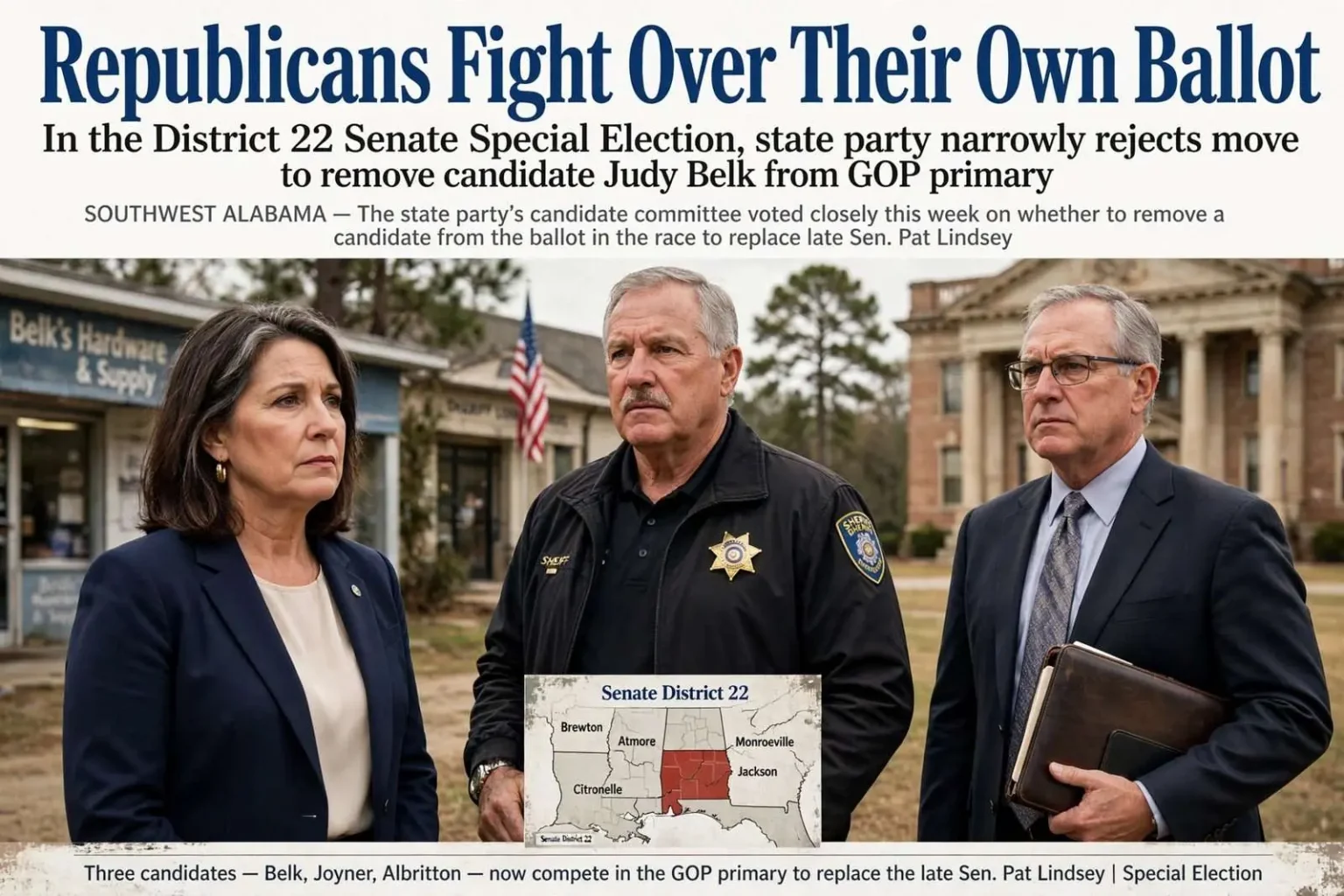
The Republican scramble for Alabama’s Senate District 22 turned inward this week, as the state party’s candidate committee narrowly rejected an effort to throw one of the party’s own candidates off the primary ballot. The dispute was the latest twist in a special election that has already drawn unusual attention across a broad stretch of rural southwest Alabama, where voters will choose a successor to a senator whose death left one of the state’s most expansive rural districts without representation.
The seat came open with the death of state Sen. Pat Lindsey, D-Butler, a longtime incumbent whose district reached across a broad stretch of rural southwest Alabama. Lindsey was one of the few remaining Democrats holding a Senate seat in the state’s rural Black Belt and southern counties, and his tenure made him a fixture of southwest Alabama politics. The special election that followed drew three Republicans and, on the Democratic side, no contest at all — a sign of how thoroughly the political landscape of the region has shifted in recent years, and of how heavily the GOP primary now functions as the real election in this part of the state.
With no Democratic primary to watch, the Republican contest has become the center of gravity for the race, and the fight over who belongs on that primary ballot says as much about Alabama party politics as it does about any single candidate.
The ballot challenge
Supporters of Republican candidate Danny Joyner asked the state party to remove Citronelle businesswoman Judy Belk from the GOP ballot, citing her two previous campaigns for Congress as a Democrat against U.S. Rep. Jo Bonner. The motion to deny Belk a spot failed in a split vote of the candidate committee, leaving her name on the ballot and the question of her party loyalty formally settled — at least for the duration of this campaign.
The challenge rested on a straightforward argument: Belk had sought federal office twice as a Democrat, running against Bonner, the Republican who represented southwest Alabama in the U.S. House, and her recent electoral history was therefore on the other side of the aisle. Her supporters, and evidently a portion of the committee, saw the matter differently — that a candidate’s party registration and current candidacy should carry more weight than past races, and that voters, not a party committee, should sort out questions of ideological reliability.
Party loyalty rules of this kind are common in Alabama, where the parties retain considerable authority over who may run under their banner, and where a candidate’s history on the other side’s ballot is fair game. The state’s major parties have long reserved the right to deny ballot access to candidates whose records suggest they are opportunistic switchers rather than genuine converts, and local party committees across Alabama have invoked those powers repeatedly over the years — sometimes in high-profile fights, sometimes in obscure county races that never make the news.
The vote’s closeness suggested the committee was genuinely divided over whether Belk’s past candidacies disqualified her — or whether the challenge was a tactical move by a rival campaign. In a three-candidate primary, removing any one name materially changes the arithmetic, and a contested removal of a well-known local figure like Belk could clear a wide path for the challenger who brought the motion. Whether the committee members who voted to keep Belk on the ballot did so out of principle, skepticism of the challenge, or simple reluctance to hand one campaign an advantage is not recorded, but the split verdict itself has already become part of the story of the race.
For Belk, surviving the challenge means her second act in coastal Alabama politics continues. A Citronelle businesswoman, she built her profile in the northern reaches of Mobile County, a region whose voters often feel distant from both Mobile and Montgomery. Her two congressional runs against Bonner, though unsuccessful, gave her name recognition across the district that few first-time state candidates enjoy, and her general-election campaign experience — including fundraising, scheduling and the grind of retail politics across multiple counties — is the kind of preparation that shows up in a special election decided on a compressed calendar.
Joyner brings in a consultant
Joyner, meanwhile, added professional help. Media and political consultant Sherry Hall of Timbes and Yeager began working with his state Senate campaign, a sign that the Brewton candidate intends to compete on organization and messaging as well as name familiarity. Timbes and Yeager has been a fixture of Gulf Coast political consulting for years, and campaigns in the region that hire the firm generally signal that they expect to run a modern, media-driven operation rather than a purely ground-game race.
Hall described Joyner as “a very conservative Republican,” a framing designed to answer the loyalty question before anyone asks it of him. In a primary where one rival survived a challenge over her Democratic past, establishing conservative credentials early is a defensive necessity, and Hall’s characterization put that marker down at the outset of the campaign’s public phase.
Joyner was born and raised in Brewton, the seat of Escambia County and one of the larger communities in the district’s eastern end. His roots there give him a natural base in a part of the district where local identity runs strong and where voters tend to favor candidates they feel they know personally.
He ran for the same Senate seat in 1998 against Lindsey and lost, though he took a respectable 44 percent of the vote — a showing made more notable by the circumstances: his campaign was hobbled by the death of his 20-year-old son from multiple sclerosis. For any candidate, losing while grieving is a punishing experience; for Joyner, the 1998 result has become part of his biography in a way that transcends the numbers. Supporters point to the 44 percent as evidence that he could compete against a well-entrenched incumbent even under the worst imaginable conditions, and the intervening years have done nothing to dim that argument in a district that has moved steadily toward Republicans since the late 1990s.
After a career in law enforcement, Joyner founded a company called Safety and Security Consultants. His professional background gives him a natural platform for talking about public safety, courts and corrections — issues that matter in a district that includes significant rural territory where sheriff’s departments and small police forces carry heavy loads with modest budgets. Law enforcement backgrounds also carry weight with the older, rural voters who dominate turnout in special elections, when the electorate skews toward the most reliable participants rather than the broad coalition a November general election brings.
The rest of the field
Also seeking the Republican nomination was Greg Albritton, a former state legislator and attorney from Atmore. Albritton’s service in the Legislature gives him the kind of institutional experience that neither of his rivals can match — a working knowledge of the budget process, of committee practice and of the Montgomery networks through which a first-term senator must move legislation. In a district that stretches from the Mississippi line to the Florida line and includes some of the poorest counties in the state, a candidate who already knows how state government works has a ready-made argument about who can deliver from day one.
The three-way shape of the primary matters. With Joyner, Belk and Albritton all in the race, a candidate can win the nomination with a plurality well short of a majority, which changes the incentives for everyone. Candidates must decide whether to contrast themselves sharply with their rivals or to hold their fire and hope the opposition splits the same base of support. A split vote of the kind the candidate committee produced on the Belk challenge only sharpens those calculations, because it signals that the field will remain intact and that no one will be removed by party action.
The district and its politics
Senate District 22 reaches across a broad stretch of rural southwest Alabama, taking in territory that runs from communities near the Mississippi border eastward through Washington, Clarke, Conecuh, Monroe, Escambia and neighboring counties. It is a district of small towns — Brewton, Atmore, Monroeville, Jackson, Grove Hill and others — where county courthouses, school systems and timber and agriculture drive the local economy. Distance from Mobile and Pensacola shapes daily life, and transportation, hospital access and rural school funding are perennial concerns for the senator who represents the area.
The district’s political history mirrors the wider transformation of rural Alabama. For decades, conservative Democrats like Lindsey held such seats almost as a birthright, a legacy of the party alignments of the last century. Over the past two decades, those same voters have shifted overwhelmingly to the Republican Party in federal and state races, leaving rural Democratic incumbents increasingly isolated. Lindsey’s death, coming in that environment, virtually guaranteed that the contest to replace him would be decided among Republicans — which is precisely what happened, with no Democratic contest at all on the other side of the ballot.
That realignment is what gives the loyalty fight its resonance. In a district where the GOP primary is the election, the question of who qualifies as a real Republican is not an abstract debate about party purity — it determines who gets to represent tens of thousands of constituents in Montgomery. Party committees that once worried chiefly about Democratic infiltration now police the boundaries of their own expanding coalition, and the District 22 challenge was a textbook example of that new reality.
What comes next
The special election calendar compresses everything. Without a Democratic race, the Republican primary winner will move on to the general election unopposed or facing only nominal opposition, making the primary the effective end of the contest. That compresses the campaign into a short, intense period in which name recognition, local organization and turnout operations matter more than money alone. Candidates who have run before — and all three Republicans in this race bring prior campaign or office-holding experience of one kind or another — begin with an advantage in knowing how to budget time and resources when the schedule leaves no room for recovery from a slow start.
The split committee vote on Belk’s status may also foreshadow the tone of the campaign itself. A challenge that fails narrowly leaves hard feelings on both sides, and the survivor of such a fight typically makes the loyalty issue a talking point against the rival who brought it. Expect the Republican contender who ultimately wins the nomination to have defined himself or herself not just against the others’ records, but on the question of who best embodies the conservative label in a district that now reliably expects it.
For residents of southwest Alabama, the immediate stakes are more practical than partisan. The district has gone months without a senator, and the winner will inherit a legislative delegation burdened with the concerns that rural districts always carry: securing road and bridge money, protecting rural hospitals and clinics, funding small-town school systems and defending local interests in a state budget process that concentrates resources in the population centers. Whoever emerges from the Republican primary — Joyner with his law enforcement roots and Brewton base, Belk with her Citronelle business background and congressional campaign experience, or Albritton with his Montgomery resume — will take office with those expectations already waiting.
The candidate committee’s divided verdict ensured that voters, not party gatekeepers, will settle the loyalty question. In Alabama’s modern rural politics, that is where such questions increasingly end up — argued out at fish fries and campaign stops across a district that spans more territory than most voters will ever see in a single day, and decided by the narrow slice of them who show up on a special election day.