Flomaton Asks to Be Placed in the West End as Escambia County Splits Its Health Care Authority
The Flomaton Town Council has adopted a resolution asking to be included in the western service area when the Escambia County Health Care Authority is divided in two, a decision that could steer local hospital tax dollars toward Atmore.
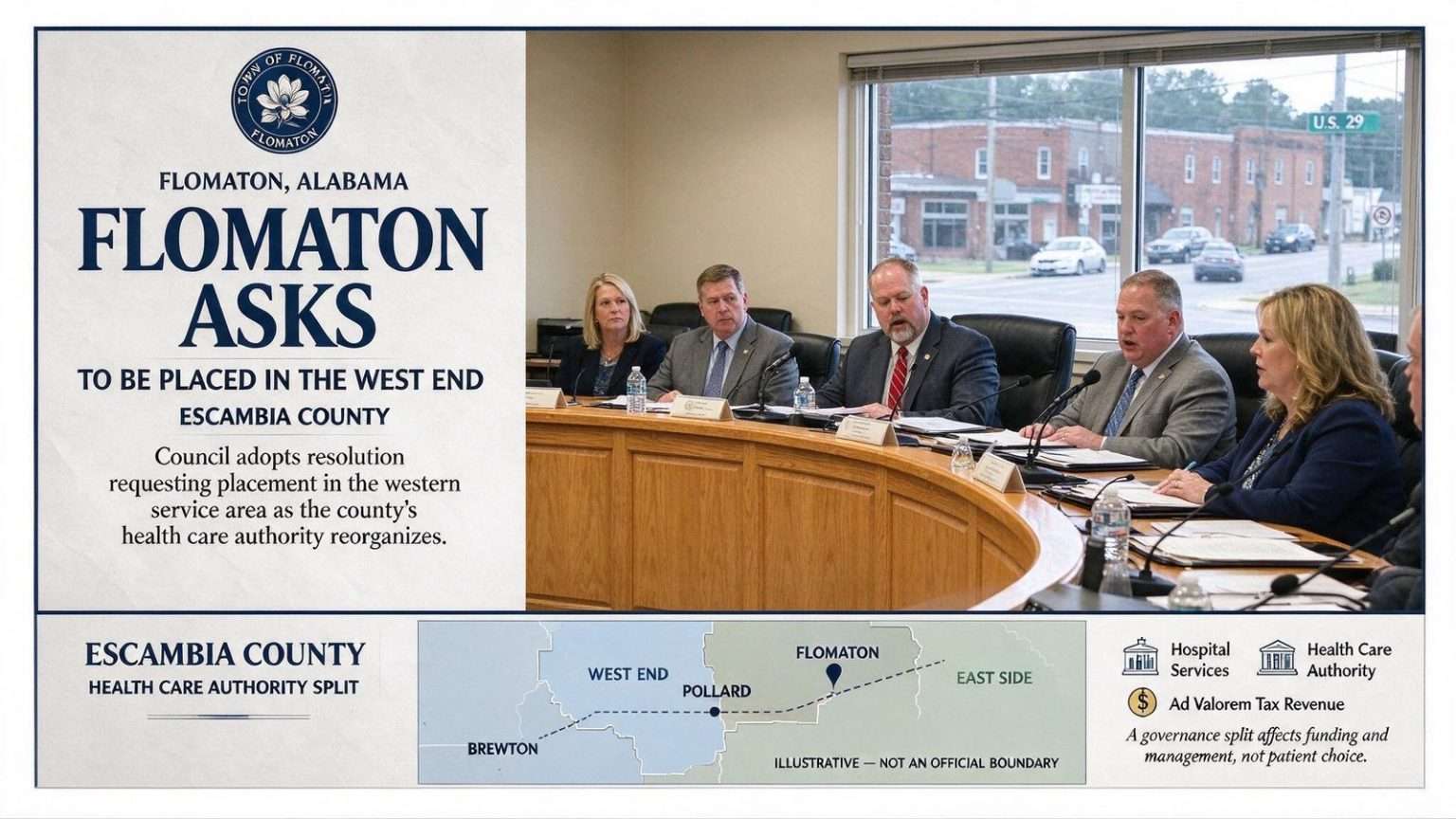
The Flomaton Town Council has stepped into one of the most consequential debates in Escambia County government, adopting a resolution that formally asks town leaders be counted on the west side of the line when the county’s health care authority is split into two separate bodies. The measure was approved during a special meeting called for Wednesday, July 1, a session convened outside the council’s normal schedule because of how quickly the reorganization is moving.
What the Resolution Says
The language is brief but pointed. “The town hereby declares its desire to remain within the western geographic service area as established by the geographical center utilized in the division of the Escambia County Healthcare Authority,” the resolution states. In practical terms, the council is telling the authority’s board where Flomaton believes its residents, and its share of hospital tax revenue, belong.
What the Resolution Means for Flomaton
Councilman Roger Adkinson laid out the stakes for his colleagues. The Escambia County Health Care Authority is currently responsible for three facilities: D.W. McMillan Memorial Hospital in Brewton, the Flomaton Medical Center, and Atmore Community Hospital. With the county apparently headed toward two distinct authorities, a boundary line will have to be drawn, and the ad valorem tax collections that support health care will follow that line, flowing either to the eastern authority or the western one.
Why a Line on a Map Matters
Health care authorities are public corporations created under Alabama law to own and operate hospitals and clinics on behalf of a county or municipality. They are not ordinary county departments. They hold property, borrow money, hire administrators, and, critically, receive the proceeds of dedicated property taxes that voters have approved for health care. When such an authority is divided, the split is not merely administrative. It determines which board governs which hospital, and it determines whose tax base underwrites which set of buildings, payrolls, and service lines.
For a town the size of Flomaton, that arithmetic is not abstract. Ad valorem taxes paid on homes, land, and business property inside the town limits represent a steady, predictable revenue stream. Directing that stream toward one authority rather than the other strengthens the balance sheet of the hospitals under that authority’s care and, over time, shapes what services survive close to home.
The Question of the Center
Council members observed during the discussion that the geographical center of Escambia County sits near Pollard, a small community that would become an unlikely dividing point in a countywide reorganization. Whether that center becomes the actual boundary, and how the line is drawn around it, remains unsettled.
Councilwoman Dr. Anna Lee reminded the council that the final call does not rest with Flomaton. It is ultimately up to the health care authority to decide where the line is drawn. She also offered a note of reassurance to residents worried about being cut off from a familiar hospital or physician: no matter where the boundary lands, patients will remain free to choose which hospital they use and which doctors they see. The division governs money and governance, not personal medical decisions.
Mayor Arthur Odom framed the vote in similarly modest terms, describing the resolution as a way to voice the council’s request rather than an attempt to dictate an outcome. Adkinson made the same point, saying the measure simply lets the authority know how the council feels about being placed in the west end.
What Comes Next
The resolution now becomes part of the record the health care authority will weigh as it works through the mechanics of separation. Residents can expect the conversation to continue in several places at once:
What Happens Next in the Split
At the authority level, where board members must settle on a boundary, divide assets and liabilities, and determine how existing debt tied to the hospitals will be apportioned.
At the municipal level, where other towns in Escambia County may follow Flomaton’s lead and adopt resolutions of their own stating a preference.
At the county level, where commissioners and legislators will be watching the tax implications closely.
For Flomaton, the immediate effect of the July 1 vote is symbolic but not trivial. The town has put its preference in writing, early, before the lines harden. In local government, that is often the only leverage a small municipality has.
Health Care Access in the Escambia Corridor
The debate arrives at a moment when rural hospital stability is a pressing concern across Alabama. Smaller communities depend on facilities like the Flomaton Medical Center for everyday care, emergency services and the local jobs those institutions provide. When a county health care authority is reorganized, the question of which tax dollars support which hospital is, at bottom, a question of which communities retain access to care close to home.
Flomaton sits near the eastern edge of Escambia County, Alabama, an area where residents have long balanced proximity to the hospitals in Brewton and Atmore. A boundary drawn through the county’s geographic center near Pollard would place Flomaton in the western service area, alongside the Brewton hospital that many of its residents already use. The council’s resolution is an early, documented assertion of that preference, filed while the reorganization is still fluid.
The reassurance from council members that patients may still choose their own hospital is an important one. A governance split changes how facilities are funded and managed, but it does not redraw the map of where a sick resident can seek treatment. For the families of Flomaton, the practical meaning of the coming months will be decided not by the line on a map but by whether the hospitals they rely on remain open, staffed and able to serve them.
The Flomaton council’s early action reflects a broader lesson in municipal government: in the reorganization of a countywide authority, the communities that speak first and clearest are the ones most likely to be heard. A resolution carries no legal power to draw the boundary, but it creates a public record of the town’s position that the authority and the county cannot ignore as they move forward.
Residents with questions or opinions about the split are encouraged to follow the work of both the Flomaton Town Council and the Escambia County Health Care Authority in the weeks ahead. As the two new authorities take shape, the decisions made about boundaries, assets and debt will echo in local health care for years to come.
Background on Flomaton and Escambia County
Flomaton is a small town on the Alabama-Florida state line in eastern Escambia County, with a population of roughly 1,500 residents. The town sits at the junction of U.S. 29 and U.S. 31 and is closely tied economically to the surrounding rural communities and to the hospitals in Brewton, the county seat, and Atmore, on the western edge of the county.
Escambia County, Alabama, distinct from the Florida county of the same name, has a population of roughly 36,000 residents spread across communities including Brewton, Atmore, East Brewton, Flomaton and smaller rural communities. The county’s health care authority operates hospitals in three locations, and the recent decision to split the authority into two separate entities is the most significant reorganization of the county’s medical infrastructure in years.
Alabama law gives counties broad authority to create public hospital corporations known as health care authorities, with the power to receive tax revenue, hold property and issue debt. These authorities operate independently of county government in day-to-day decisions but remain accountable to the public through their boards and through the property tax revenue that supports them.
Pollard, the small community near the geographic center of Escambia County, sits along the U.S. 31 corridor between Brewton and the Florida line. As the center point of the county, its location has been referenced in discussions about how a boundary between the two new health care authorities might be drawn, though the actual line will be set by the authority board rather than by reference to a single geographic marker.
Brewton, the county seat of Escambia County, Alabama, is home to D.W. McMillan Memorial Hospital, the larger of the two main hospitals serving the county. The hospital has long been a critical health care resource for the region, providing emergency services, inpatient care and outpatient specialties that residents would otherwise have to travel significant distances to access. The reorganization of the county health care authority will directly affect the hospital’s future funding and governance.
Atmore Community Hospital, on the western side of Escambia County, serves a separate population center near the border with Baldwin County. The hospital’s proximity to the Poarch Band of Creek Indians reservation and the Wind Creek Casino and Hotel in Atmore adds another dimension to the discussions about governance and tax revenue. Both hospitals have historically operated as part of the countywide health care authority, and the reorganization will determine how their separate funding streams are managed.
Health care authorities in Alabama operate under a state law framework that grants them significant independence from county government in day-to-day decisions. The boards that govern them are typically appointed by local officials, but the authorities themselves can hold property, enter into contracts and issue debt in their own names. The split of the Escambia County authority into two separate entities will require careful legal work to allocate assets, contracts and liabilities between the new bodies.