Rubber Ducks and Murder Creek: East Brewton Closes Out a Fourth of July Weekend on the Water
The winning duck in East Brewton's annual Fourth of July duck race was plucked from Murder Creek on Saturday afternoon, capping two days of Independence Day celebrations across the Escambia County area.
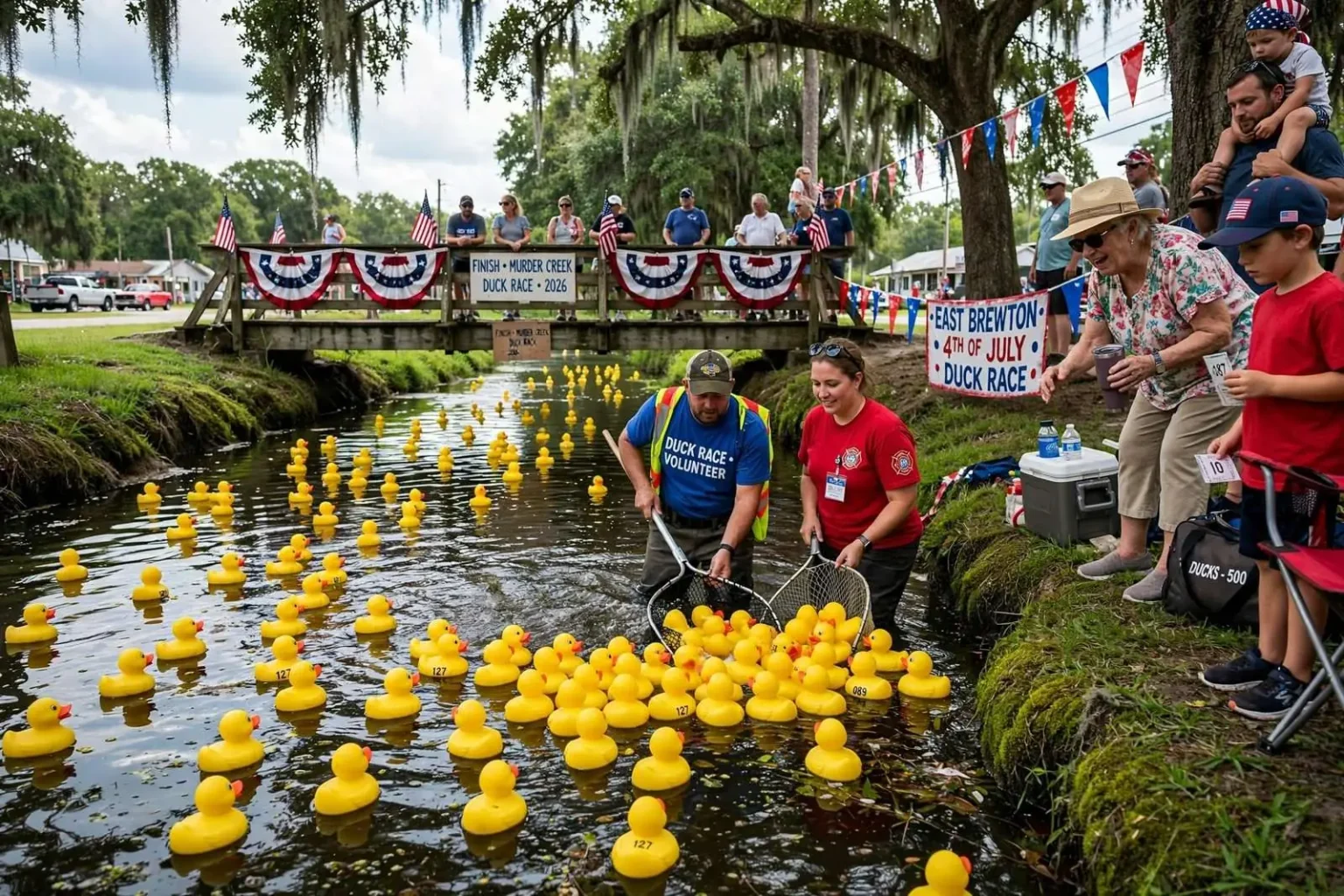
The last act of East Brewton’s Independence Day weekend played out not on a stage or a ballfield but in the current of Murder Creek, where the winning entry in the city’s annual Fourth of July duck race was captured Saturday afternoon. The race closed out two days of celebrations held across the area on Friday and Saturday, a stretch of the calendar that reliably draws families out of the house and down to the water.
How a Duck Race Works
For anyone who has never stood on a creek bank waiting for a wave of plastic waterfowl to round the bend, the format is disarmingly simple, and that simplicity is the point.
Supporters buy a duck, or several, with each numbered bird corresponding to a ticket held by its sponsor.
Every duck is released at once, tipped into the creek upstream in a single splash of color.
The current does the rest. There is no skill, no strategy, and no way to nudge the outcome, which is precisely why the format has proven so durable as a community fundraiser.
The first duck retrieved at the finish wins, and its sponsor claims the prize.
The appeal is that a duck race is one of the few contests in which a child and a grandparent have identical odds. The creek is indifferent. It rewards nothing but luck, and it produces a genuine moment of suspense as the leaders bunch up in an eddy, break loose, and drift toward waiting hands and nets.
A Creek With a Name People Remember
Murder Creek is one of those South Alabama waterways whose name tends to stop visitors mid-sentence. It winds through the Brewton and East Brewton area, joining the Conecuh River nearby, and it has served generations of residents as a place to fish, paddle, cool off, and, on at least one weekend a year, to watch several hundred rubber ducks race one another with no dignity whatsoever.
Staging the race on the creek roots the event in a landscape that residents already know intimately. It is not a spectacle imported from somewhere else and dropped into town for a weekend. It happens in the water that runs through the community, watched from banks and bridges that people cross on any ordinary Tuesday.
Part of a Larger Weekend
The duck race did not stand alone. Fourth of July festivities were held across the area on Friday and Saturday, the kind of two-day rhythm that lets neighboring towns stagger their events so that families can attend more than one. In communities this size, the Independence Day calendar functions as a sort of civic reunion. People who moved away come home for it. Church groups, civic clubs, volunteer fire departments, and local businesses all take a turn at the folding tables.
Why These Events Matter More Than They Look
It is easy to file a duck race under harmless summer fluff. That undersells what these gatherings do for a small city. Events of this kind are, in practice, the infrastructure of local belonging. They give volunteers a reason to organize, they give civic organizations a visible presence, and they routinely raise money that goes back into the community through scholarships, youth programs, park improvements, and emergency assistance funds.
They also serve a quieter function. In a region where many residents commute out of town for work and where daily life is increasingly conducted through screens, a summer festival is one of the few remaining occasions on which a broad cross-section of a community stands in the same place at the same time, watching the same thing.
Looking Toward Next Summer
The ducks have been fished out of the creek and boxed up for another year. What tends to happen next, in towns that run events like this well, is that organizers begin planning the following summer almost immediately, refining the route, recruiting volunteers, and lining up sponsorships while the memory of the crowd is still fresh.
For residents of East Brewton and the surrounding Escambia County communities, the takeaway from the weekend is straightforward. The celebrations happened, the creek delivered a winner, and the tradition continues.
Murder Creek and the Brewton Community
The name Murder Creek carries a history as distinctive as the race itself. The waterway runs through the twin cities of Brewton and East Brewton, two Escambia County communities separated by the creek that gives the event its quirky character. For generations, the creek has been a gathering place, a fishing hole and, each Fourth of July, an unlikely racetrack. Local lore about how the creek got its name is a point of pride and curiosity alike, and the duck race has turned that lore into a community celebration.
East Brewton’s Independence Day duck race is representative of how smaller Gulf Coast towns mark the holiday. Rather than a single large fireworks show, the weekend is built from many smaller gatherings, each organized by a church, club or civic group, each drawing its own crowd. The result is a holiday that belongs to everyone and asks little of anyone, a model that has kept these communities connected across generations. As the plastic ducks dry in a storage box waiting for next July, the memories of the 2026 race join a long line of East Brewton Fourth of Julys on the banks of Murder Creek.
The Economic Lift of a Small-Town Festival
Events like the East Brewton duck race also provide an economic lift that is easy to overlook. They draw visitors from neighboring communities into local stores, restaurants and gas stations, and they give residents a reason to spend the holiday at home rather than driving to a larger city. For small business owners in Brewton and East Brewton, a busy holiday weekend is among the most reliable dates on the calendar.
As the 2026 celebrations recede into memory, the organizers of the duck race and the other Fourth of July events across Escambia County can take quiet satisfaction in the role they play. They are not merely planning parties; they are maintaining the rituals that hold a community together, one rubber duck and one fireworks show at a time.
How Volunteer Organizers Pull Off a Duck Race
Putting on a duck race on a South Alabama creek takes surprisingly little infrastructure, but it does take coordination. Organizers typically buy several hundred numbered rubber ducks in advance, sell numbered tickets to sponsors, and arrange a release point upstream of the finish line. The ducks float down the current, the finish line is staffed by volunteers with nets, and the first duck across the finish line is matched to its sponsor’s ticket number.
Because the event depends on the creek’s current, organizers monitor weather and water levels in the days leading up to the race. Heavy rain can raise the creek and speed the ducks along, while a dry summer can slow the race enough to keep spectators waiting on the bank. The variability is part of what makes the event feel like a community happening rather than a manufactured attraction.
The Money the Race Raises
The funds raised through the East Brewton duck race typically go back into civic and charitable programs in Escambia County. Like similar events across the Gulf Coast, the proceeds often support scholarships for graduating seniors, youth sports leagues, parks and recreation improvements, and emergency assistance for families in crisis. The relatively modest size of the event — several hundred ducks, a few thousand dollars in proceeds — makes it a useful complement to larger fundraisers that the same volunteer organizations run during the year.
For donors, the appeal of a duck race fundraiser is partly the entertainment value and partly the transparency. Sponsors know exactly what their contribution bought, and they can watch the result unfold in real time on the creek bank. That combination of fun and accountability is why the format has been adopted by fire departments, church groups, civic clubs and Rotary chapters across the region.
For residents who would like to take part in next year’s race, the organizers typically begin selling duck sponsorships in the weeks leading up to Independence Day. Sponsorship details are usually posted through the participating civic organization’s Facebook page or in local newspapers, and the cost of sponsoring a single duck is small enough to make participation accessible to families on tight budgets.
The 2026 race joined a long line of similar events held across the Gulf South, from small-town fire department fundraisers to church-sponsored celebrations of community and continuity. Each version is slightly different in scale and tone, but they share the same underlying appeal: a low-stakes contest watched by neighbors who show up year after year, rain or shine, to cheer on numbered ducks they may or may not have sponsored.