More Than 750 Teachers Packed a Fairhope Conference to Learn How Far AI Should Go in an Alabama Classroom
Baldwin County Public Schools' Gulf Regional Innovative Teaching Conference drew more than 750 educators to Fairhope this week, with sessions focused heavily on using classroom technology and AI responsibly.
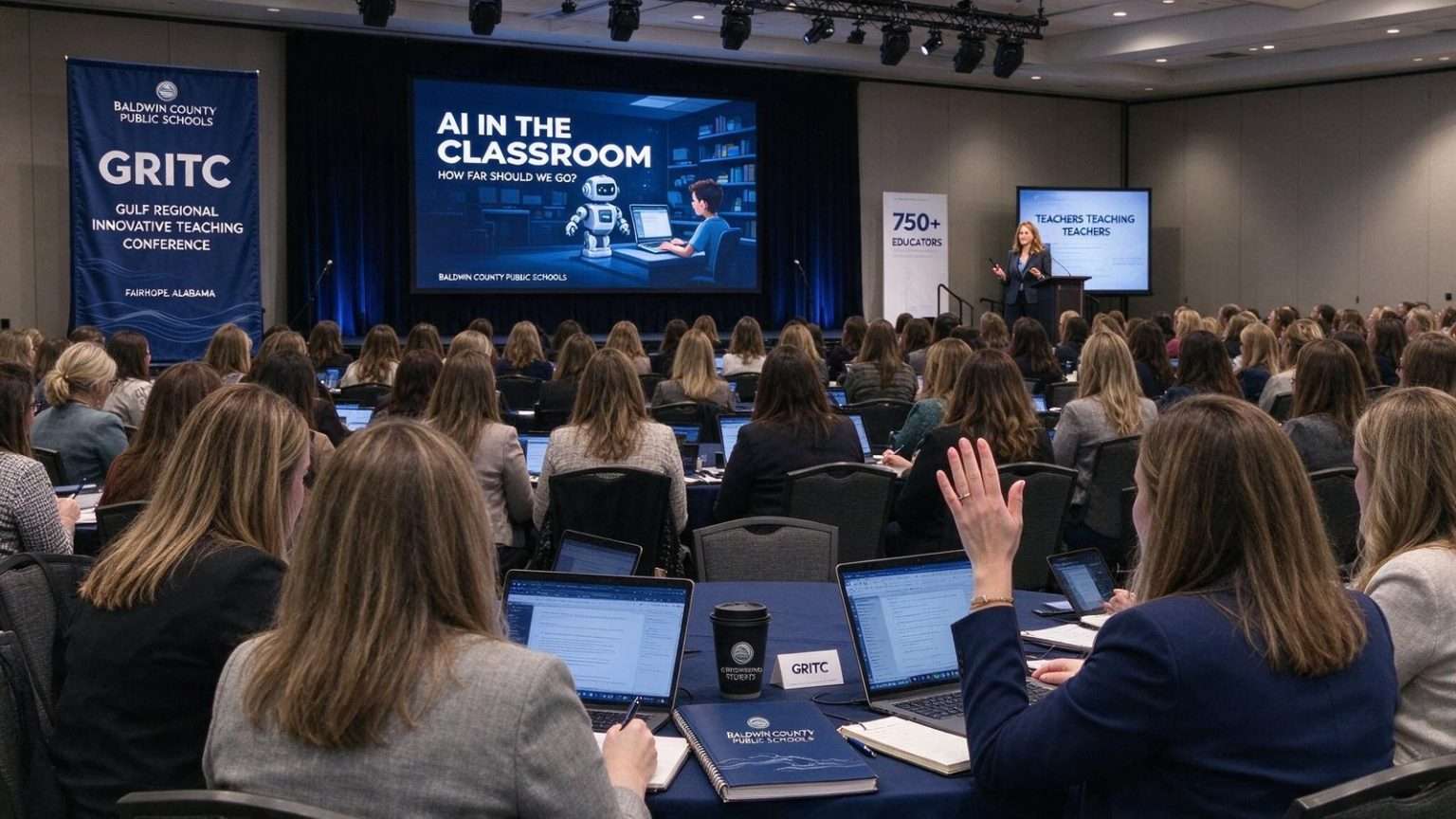
More than 750 teachers from around the region gathered in Fairhope this week for Baldwin County Public Schools’ Gulf Regional Innovative Teaching Conference, a two-day event built around a question school systems across the country are still working out: how much technology, including artificial intelligence, belongs in the classroom.
The conference, known as GRITC, drew educators from well beyond Baldwin County to sit in on sessions created by teachers, for teachers, covering everything from classroom management to hands-on lesson planning. But this year’s dominant theme was technology — specifically, how to use it without letting it use up the parts of teaching that matter most.
Fairhope, the bayside Baldwin County city that hosts the gathering, gave the event a fitting backdrop. The Eastern Shore community has long been associated with the arts and with education, and the annual conference has become one of the signature professional development events in south Alabama, drawing teachers who might otherwise have to travel to Atlanta, Nashville or Birmingham for comparable training.
Teachers Teaching Teachers
The “by teachers, for teachers” structure is central to GRITC’s appeal. Rather than bringing in outside consultants who last visited a classroom years ago, Baldwin County’s conference puts working educators in front of their peers — people who know what a Monday morning with thirty seventh-graders actually looks like, and who can demonstrate a new tool in the context of a real lesson plan rather than a sales pitch.
That peer-to-peer format also keeps the sessions grounded in the daily realities that technology training often ignores: limited devices, uneven Wi-Fi, students who finish early and students who need more time, and the constant pressure of standardized testing calendars. Presenters who have wrestled with those constraints themselves can speak to what works, not just what is theoretically possible.
“This year we’re really focusing on how we’re going to leverage technology to support students, what are the kids actually going to be putting their hands on, and how are they going to use that to extend their learning,” said Jaime Tillman, a teacher at Daphne Middle School.
Tillman’s emphasis on what students will physically do with a tool reflects a shift in how schools evaluate classroom technology. The question is no longer whether a classroom has devices, but whether those devices produce deeper engagement and measurable learning — or simply substitute a screen for a worksheet.
Jeremy King, Baldwin County’s Educational Technology Support Services Coordinator, said the push isn’t optional at this point.
“Our classrooms are full of technology today because that’s what’s in the world,” King said. “We want to make sure that we give teachers the skills that they need to be able to work with students and come into their classrooms today.”
King’s role places him at the intersection of the district’s technology infrastructure and its instructional staff. Baldwin County Public Schools, one of the largest school systems in Alabama, has spent years building out the devices, networks and support staff needed to put technology in front of students across a geographically enormous county — from Fairhope and Daphne on the Eastern Shore to communities along the Gulf and deep into the county’s rural interior. Training the workforce that uses those tools is the natural extension of that investment.
Sessions this year specifically tackled using artificial intelligence responsibly in the classroom, alongside more familiar territory like keeping students engaged during long stretches of screen-based work.
The AI sessions captured a debate unfolding in faculty meetings and state education departments nationwide. Teachers are experimenting with generative AI tools to build lesson materials, differentiate reading passages and draft parent communications, while simultaneously confronting the reality that the same tools can complete a student’s essay in seconds. Districts are being forced to write policies on a moving target, and conferences like GRITC give classroom teachers a first look at how colleagues are handling questions that no textbook addresses.
Room to Experiment Before the Students Arrive
Tillman said conferences like GRITC give teachers room to experiment with new tools before those tools ever reach a classroom of students.
“I feel like technology changes from one week to the next, sometimes one day to the next,” Tillman said. “So conferences like this, where we get to come in and kind of play around with it and learn how to make some mistakes when it’s not in the moment, are so precious.”
Her point about making mistakes in a low-stakes setting speaks to a chronic problem in professional development. Teachers are typically handed a new platform or device days before they are expected to use it with students, with little time to explore its quirks, fail privately and ask the questions they would hesitate to ask in front of a class. A two-day conference devoted to hands-on practice inverts that arrangement.
It also builds the informal network that teachers rely on all year. An educator from Daphne who meets a counterpart from Foley or Bay Minette in a GRITC session on AI writing tools has someone to email in November when a question arises — a colleague who has already tried the same tool with the same age group. In a district as large and spread out as Baldwin County, those cross-campus connections are among the most durable products of any conference.
The regional draw matters for neighboring systems as well. Teachers from outside Baldwin County who attend take the practices home to Mobile-area schools, Washington County classrooms and systems across the state line, extending the conference’s reach well past the district that pays for it. In an era when rural and suburban districts alike compete for a shrinking pool of teaching talent, a reputation for strong professional development is also a recruiting tool — a sign that a region takes its educators seriously.
A Baldwin County Tradition
Baldwin County Public Schools has hosted the conference for years, and it has grown into one of the region’s largest teacher-led professional development events. The district’s willingness to invest in an event of this scale reflects both its size — Baldwin is among Alabama’s fastest-growing counties, and its school system has expanded steadily along with the population pouring into Daphne, Fairhope, Spanish Fort, Foley and Gulf Shores — and its philosophy that teacher training is a continuing process rather than an annual checkbox.
Professional development days are a fixture of every school calendar, but their quality varies widely. Sessions that consist of a lecture and a slideshow tend to fade by October; hands-on workshops where teachers build something they can use in the first week of school tend to stick. GRITC’s model — dozens of concurrent sessions, taught by practitioners, on topics teachers chose to attend — is designed to fall into the second category.
The name itself carries the district’s ethos. Grit — persistence, resourcefulness, the willingness to keep working a problem until it yields — is the quality Baldwin County’s organizers most want to cultivate in their classrooms, and it applies as much to the adults attending as to the students they teach. The acronym spells out the conference’s regional identity and its mission in one word: Gulf Regional Innovative Teaching Conference, held each summer as educators prepare for the year ahead.
What Artificial Intelligence Means for Baldwin Classrooms
The AI focus also carries practical stakes for the region’s classrooms. Baldwin County’s rapid growth means its schools are continually hiring new teachers, and those new arrivals need to be brought up to speed on both the district’s tools and its expectations for how technology is used. Experienced teachers, meanwhile, are confronting tools that did not exist when they entered the profession — and students who use them fluently.
Districts nationally have responded to generative AI with a mix of bans, cautious pilots and full-throated adoption. Baldwin County’s approach, as reflected in the conference programming, leans toward the middle: acknowledging that the technology is already in students’ pockets, teaching teachers to use it for planning and personalization, and emphasizing responsible use rather than pretending it can be wished away.
Looking Ahead to the School Year
With the conference behind them, the region’s teachers head into the school year with new tools, new contacts and a shared vocabulary for the technology questions that will surface all year — from the first time a student submits an AI-written paragraph to the day a new app transforms a struggling reader’s progress. The 750-plus educators who gathered in Fairhope will not all agree on where the lines should be drawn, but they will be drawing them with more preparation than they had before the two days on the bay.
And that, organizers say, is the point: the technology will keep changing, from one week to the next, and the work of keeping teachers ahead of it — or at least even with it — never really stops. GRITC’s answer is to gather the region’s teachers together every year, hand them the newest tools, and let them practice in public together before the students walk in.