A Loxley Family Turned a Camper Into a Rolling ICU So Their Son Could See the World. Five Years Later, They’re Still Living ‘Jack Stone Strong.’
A Loxley family's Make-A-Wish camper trip, granted after their son Jack Stone was diagnosed with a rare form of epilepsy, has turned into a five-year mission of helping other families stay 'Jack Stone Strong.'
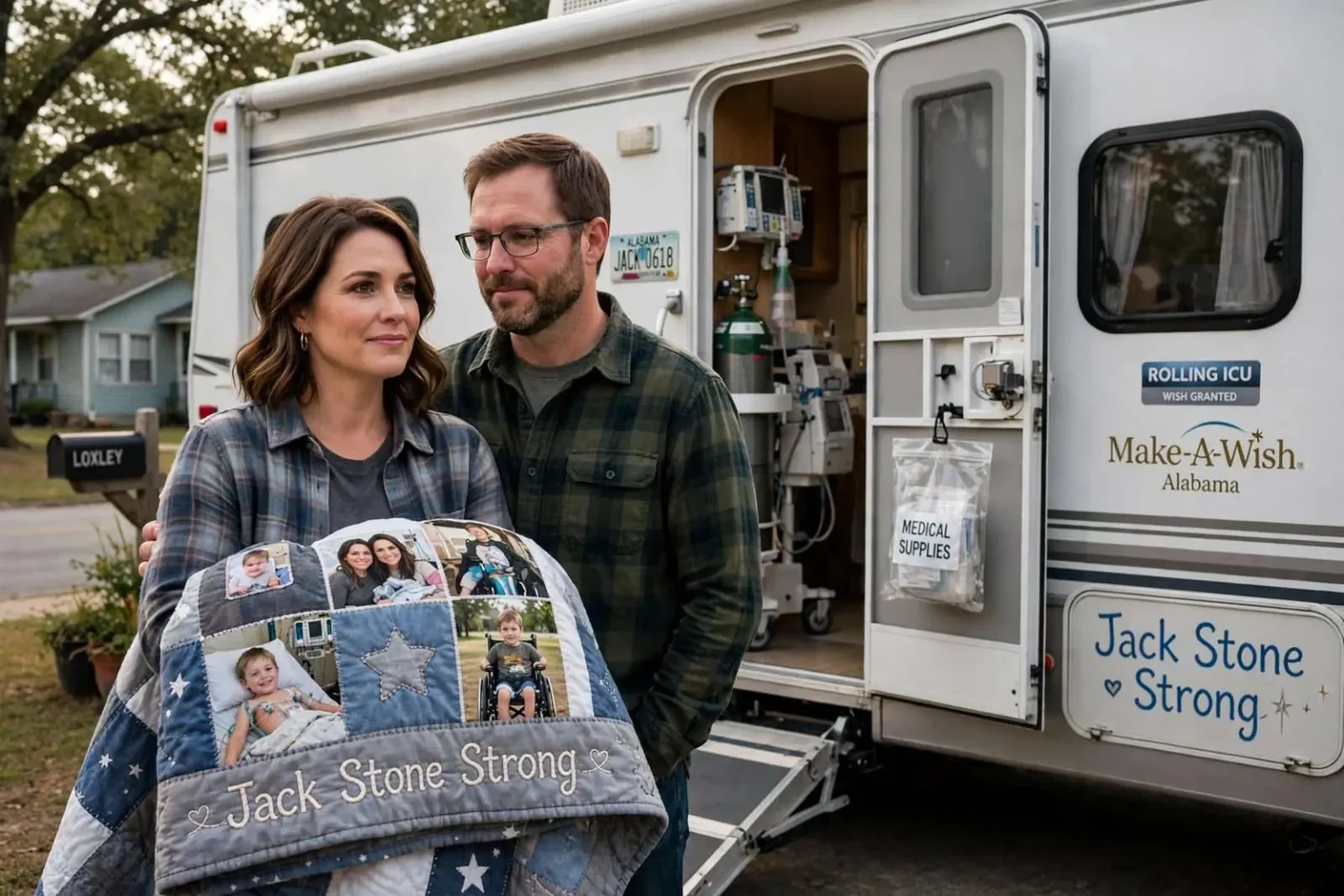
In a Loxley living room, Jennifer McIntosh keeps a memory blanket stitched with photos of her son Jack Stone. One picture stops her every time: a hospital room, tubes and monitors everywhere, and Jack smiling anyway. “This is probably one of my favorite pictures — we are in the hospital, but he’s smiling,” she said.
Jack Stone McIntosh was six years old when he died from a rare form of epilepsy called malignant migrating partial seizures of infancy, a genetic condition that slowly took his speech and his movement but never, his parents say, his will to survive. “He brought light into a dark moment,” his father, Preston, said.
The condition that shaped Jack’s life is among the rarest and most punishing forms of childhood epilepsy. Malignant migrating partial seizures of infancy, known in the medical literature as MMPSI, causes seizures that begin in one region of the brain and then migrate unpredictably to others, beginning in the first months of life and recurring in clusters that standard medications struggle to control. Children with the condition often lose developmental milestones as the seizures continue, and families are left managing equipment, therapies, and hospitalizations that become the architecture of daily life.
For the McIntoshes, that reality arrived early. By the time Jack was two, the family was living most of their life inside hospitals and clinics — a rotation of admissions, specialist appointments, and therapy sessions that stretched from Baldwin County into the regional medical centers where his care was concentrated. Home became a base camp rather than a refuge, stocked with the supplies a medically complex child requires.
A wish like no other
One of Jack’s doctors eventually reached out to Make-A-Wish Alabama on the family’s behalf, and in 2021 that wish was granted — not a trip to a theme park, but a camper outfitted like a rolling intensive care unit, built so a family who couldn’t otherwise travel with a child who had critical medical needs could finally see the world together.
The choice of wish says everything about what the family had been living through. Typical wish experiences send children to destinations or bring them encounters with heroes, but Jack’s medical needs made travel impossible in the ordinary sense: the equipment required to keep him safe and comfortable — monitors, suction, feeds, and the backup systems a fragile airway demands — could not simply be packed into a family vehicle. A medically equipped camper converted that impossibility into a floor plan.
“We learned early on you can’t travel with a kid that has critical medical needs, because you come with all the equipment,” Jennifer said. The camper changed that math entirely. “Make-A-Wish gave us an opportunity to give our child, who wasn’t able to see the world, a chance to see the world,” Preston said.
Outfitted like a rolling ICU, the camper gave the family something hospitals cannot: mobility without sacrifice. Jack’s care routine could continue without interruption while the scenery outside the windows changed, and the family could wake up somewhere new together — an experience that most families take for granted, and that the McIntoshes had been told was out of reach.
Keeping Jack Stone’s name in the work
Jack has since died, but his parents have turned their remaining energy toward keeping his name attached to helping other families going through the same thing, a mission they describe simply as staying “Jack Stone Strong.”
That mission has taken practical shape in Jennifer’s volunteer work. She now volunteers to help grant other children’s wishes, joining the process that once transformed her own family’s prospects. “You will see the magic that changes lives,” she said. “When you help grant wishes, you become a part of that child’s family.”
The volunteers who power wish-granting organizations rarely describe the work as charity; they describe it as participation. A wish is assembled through meetings, planning, donations, and dozens of small decisions, and the people who carry those tasks out become woven into the family’s most consequential memories. Jennifer’s path from recipient to volunteer traces the full circle of that experience — from the family in the room to the hands building the room for someone else.
Advice earned the hard way
Preston’s advice to other parents facing a child’s serious illness is blunt and specific: don’t look away from disability. “If you see a child in a wheelchair, give them the same courtesy you would a child who’s not in a wheelchair,” he said.
The counsel is aimed at the small, everyday interactions that families of children with disabilities navigate constantly — the averted eyes in a grocery store aisle, the conversation directed over a child’s head, the hesitation to speak at all. Parents like the McIntoshes describe those moments as a second burden layered on top of the medical one, and they spend years advocating for a simple substitution: ordinary courtesy in place of awkward distance.
Jennifer’s message is aimed more at parents in the thick of it. “You are stronger than you can ever imagine,” she said. “Every doubt that you’ve ever had, erase it. Children are a blessing, and stay strong.”
The words come from lived experience rather than platitude. Families caring for medically complex children run on routines measured in medications, feeding schedules, and therapy calendars, and the parents inside those routines often discover capacities they never knew they had — nursing-level skills learned on the job, advocacy learned in hospital conference rooms, and endurance learned one night shift at a time. Jennifer’s encouragement to erase every doubt is the summary of that education, offered to the parents just entering it.
The story reaching a wider audience
The McIntosh family’s story has been featured in an ongoing local television series spotlighting Make-A-Wish Alabama families across the region — a reminder, coming out of Baldwin County, of how much a single camper trip can mean when a family has spent years measuring life in hospital stays.
The series exists because stories like Jack’s perform a function statistics cannot. Wish-granting organizations can publish numbers — wishes granted, volunteers engaged, dollars raised — but the understanding of what a wish actually does for a family comes from hearing the parents describe the before and after. In the McIntosh case, the before was a family that could not leave home together; the after was a medically equipped camper and a map of places Jack got to see.
For Make-A-Wish Alabama, the chapter that served the McIntoshes, the story illustrates the breadth of what wishes can be. The organization serves children with critical illnesses across the state, and its wish experiences range from travel and celebrity encounters to the kind of engineered solution the McIntosh family needed — a wish designed around a specific child’s specific reality, because a cookie-cutter experience would have excluded Jack entirely.
And for Loxley, the small Baldwin County community the McIntoshes call home, the family’s mission has become a local touchstone — proof that a town’s compassion networks, its neighbors, and its volunteers can carry a family through years of crisis, and that the gratitude those families feel afterward often returns to the community as service. Jennifer’s volunteer work, Preston’s message about courtesy and disability, and the phrase the family lives by — Jack Stone Strong — have turned one child’s too-short life into a continuing presence in the region’s fight for other families walking the same road.
What the community carried
Families caring for children with critical illnesses rarely survive the journey alone, and the McIntoshes’ story has repeatedly credited the network that formed around them — neighbors in Loxley, church and school communities across Baldwin County, medical teams who treated Jack over years of admissions, and the volunteer machinery of the wish-granting process itself. That support structure is invisible in medical charts but decisive in outcomes: it is what allows parents to keep working, keep parenting, and keep hoping through circumstances that would otherwise consume them.
The regional spotlight the television series provided also served that network, by showing donors and volunteers across south Alabama exactly where their contributions land. A wish is funded by community dollars and staffed by community volunteers, and every story like Jack’s functions as both a thank-you and an invitation — evidence that participation, at any scale, becomes part of a family’s memory of the hardest season of its life.
The camper still stands as the story’s central image: a vehicle built for a child whose world was measured in hospital rooms, granted so that he could see the world instead. That the family now works to give the same experience to others is the measure of what the wish accomplished — not a single trip, but a permanent change in what the McIntoshes believe is possible.