Robertsdale Fair Will Let Neurodivergent Artists Show Their Work for the First Time, Then Send Guests Into 2-Minute Speed-Chat Socials
Where the Pieces Meet's third annual Special Needs Resource Fair in Robertsdale adds a new neurodivergent entrepreneur showcase, plus a ticketed speed social designed to help neurodivergent adults build friendships.
A Baldwin County nonprofit is adding a new twist to its annual special needs resource fair this month, giving neurodivergent and special needs entrepreneurs their own curated showcase for the first time alongside the event’s usual lineup of service providers. The addition reflects a shift in how families and advocates talk about disability services — less about what people need and more about what they can build, sell and contribute.
Where the Pieces Meet will host its third annual Special Needs Resource Fair on Saturday, July 25, from 11 a.m. to 2 p.m. at PZK Hall, located at 17933 AL-104 in Robertsdale. Admission is free. The hall, a community gathering place along the state highway between Robertsdale and Summerdale, gives the event the kind of open, familiar setting that organizers say matters for families navigating sensory and social needs.
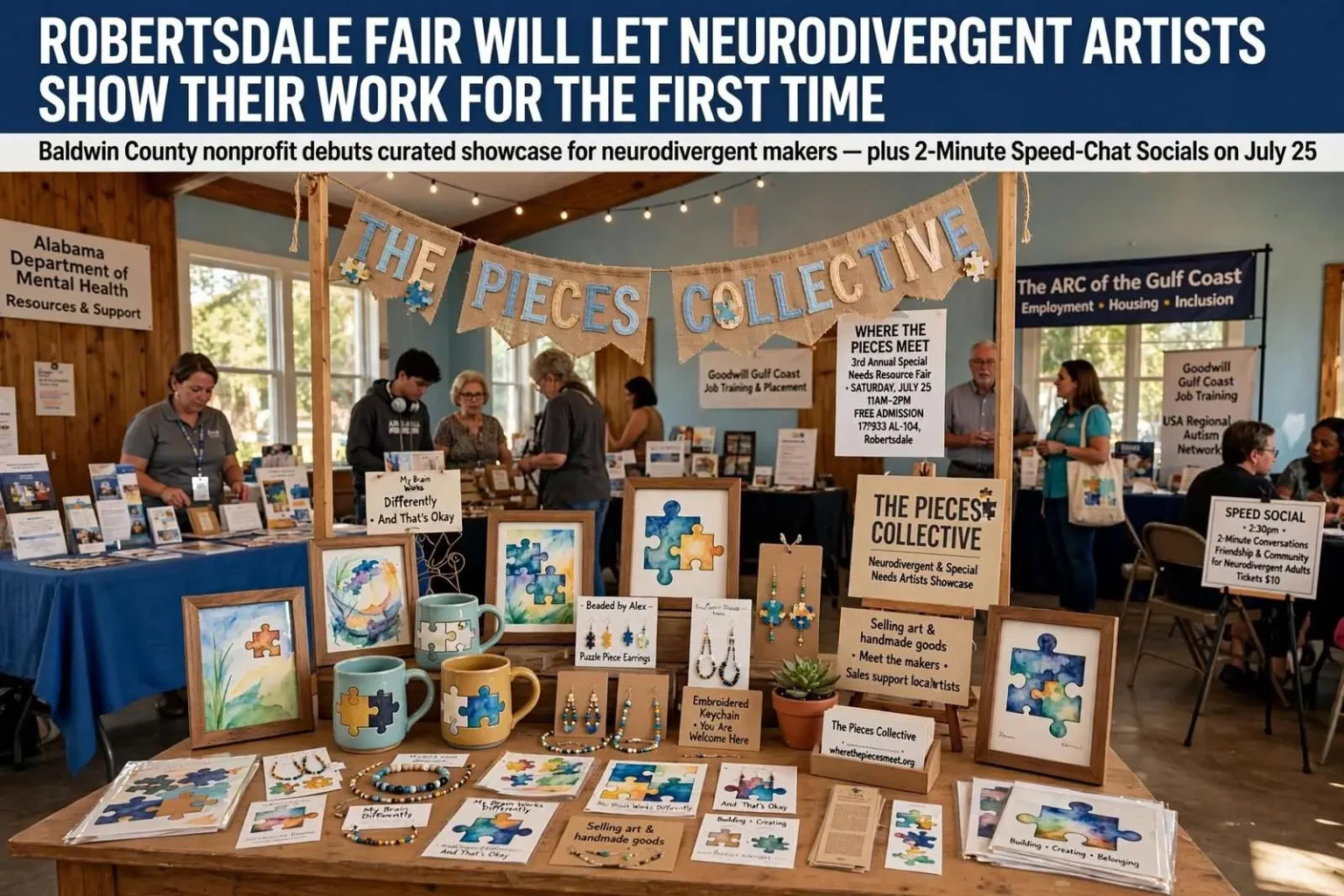
New this year is The Pieces Collective, a curated showcase spotlighting work made by local neurodivergent and special needs entrepreneurs, giving those artists and makers a dedicated space to sell and display their work rather than sharing a table among general vendors. The distinction is more than organizational. A curated showcase treats the vendors as the feature rather than an afterthought, and it gives visitors a clear place to find and buy from them directly.
For the entrepreneurs themselves, the showcase offers something hard to come by elsewhere: a room of customers, a table of their own and the experience of running a sale end to end. Disability advocates across the country have pushed for exactly these kinds of microenterprise opportunities, and Baldwin County families have increasingly organized them through markets, pop-ups and fairs like this one.
Two dozen organizations under one roof
Beyond the showcase, families will be able to meet with roughly two dozen partner organizations covering nearly every corner of the special needs support network in coastal Alabama, including the Alabama Department of Mental Health, the American Autism and Rehabilitation Center, The ARC of the Gulf Coast, Goodwill Gulf Coast, the Learning Disabilities Association of Alabama, Mobile Parks and Recreation, and the USA Regional Autism Network, among others.
The lineup is designed to save families the detective work that a diagnosis often sets off. A single morning can connect a parent with state services, therapy providers, vocational programs, advocacy groups and recreational opportunities that would otherwise take weeks of phone calls to sort out. For families new to the system, the fair functions as a first map of what exists and who to ask.
The state presence matters most for families at the beginning of that journey. Alabama’s Department of Mental Health administers services for people with intellectual disabilities and autism, and eligibility processes that start early can open doors to Waiver-funded supports years down the road. Having a state representative at a local table, rather than on the other end of a toll-free number, is part of the fair’s practical value.
Vocational groups round out the picture. Goodwill Gulf Coast’s programs move from job training to placement, and organizations like The ARC of the Gulf Coast advocate for employment, housing and community inclusion. The message underneath the whole room is consistent: support does not end at school, and adulthood on the spectrum or with a disability can include work, income and independence.
The speed social
Following the fair, the event shifts into a ticketed social event: a third annual “speed social” beginning at 2:30 p.m., built around two-minute conversations followed by finger foods and drinks, giving neurodivergent adults a low-pressure way to meet new people. Tickets are $10 through the Where the Pieces Meet website, and neurodivergent or special needs adults may bring one support person at no additional charge.
The speed-social format borrows from speed dating but softens it for its purpose: short, timed conversations remove the pressure of a long unstructured chat, while the rotation guarantees that no one is left standing at the edge of a room. Organizers say the structure is exactly what makes it work for adults who find open-ended socializing draining or intimidating.
Friendship and dating are longstanding gaps in the services landscape. Programs exist for education, therapy and employment, but few address the simple human need of neurodivergent adults to meet peers. Events like this one fill that space locally, and the fact that it has run three years suggests the demand is real.
Organizers say the pairing of a resource fair with a social mixer reflects the group’s broader mission: connecting families to services during the day, while giving neurodivergent adults their own space to build friendships and community once the vendor tables come down. The two halves serve two generations — parents gathering information in the morning, adults building their own connections in the afternoon.
Where the Pieces Meet Board President Emily Tisdale said the organization became an official nonprofit in September, a milestone that formalized years of volunteer work. “We were a local group for the past four years and finally realized that this isn’t stopping anytime soon,” Tisdale said. “It’s so exciting.”
The transition from a parent-led group to a recognized nonprofit changes what the organization can do. Nonprofit status opens the door to grants and tax-deductible donations, gives events like the resource fair an institutional backbone, and signals to partner organizations that the group will be around to build programs with year after year.
Tisdale said proceeds from speed social ticket sales help keep the group’s other events free, and will eventually help cover smaller costs at its monthly meetups, such as bowling shoes or movie tickets, so that cost does not stand in the way of participants attending. It is a modest budget philosophy with an outsized effect: the difference between a $5 pair of rental shoes and staying home.
Built with sensory needs in mind
The event is designed with sensory needs in mind. Only dog service animals are permitted due to allergies and sensitivities, and attendees are asked to check with people seated nearby before bringing one. Organizers ask participants to avoid loud noises, loud speaker volume on devices and flashing lights on fidgets, while headphones, quiet fidgets, sunglasses and hats are welcome.
Those rules read like a checklist of the environmental adjustments many autistic adults and people with sensory processing differences ask for in public spaces — predictable noise, no strobing, tolerance for adaptive tools. By stating them plainly in advance, the organizers remove the burden of individual negotiation and make clear who the event is built for.
The service animal policy reflects a practical balance. Service dogs are legitimate and necessary supports, but a crowded hall full of allergies and noise-sensitive attendees requires coordination. Asking handlers to check with nearby guests is the kind of etiquette that lets both needs coexist in the same room.
Families and organizers can reach Where the Pieces Meet through wherethepiecesmeet.org, by phone at (251) 279-0449, or by email for questions about the fair, the showcase or the speed social. “I really hope we can reach even more special needs families this year,” Tisdale said.
Why Robertsdale
Hosting the fair in Robertsdale keeps it close to the families it serves. The town sits in the middle of southern Baldwin County, reachable from Foley, Fairhope, Summerdale, Gulf Shores and the Mobile County line in a short drive — a consideration for parents who already spend hours each week shuttling between therapy appointments and school programs. Central venues like PZK Hall, with parking and a single large room, spare families the logistics that often keep them away from bigger-city events.
Baldwin County’s growth has brought more families into the special needs community, and the school system’s special education enrollment has grown with it. Parents here have organized around the same gaps families describe everywhere: long waitlists for services, few adult programs, and social opportunities for their children that thin out after high school. Groups like Where the Pieces Meet grew directly out of that organizing.
A different kind of resource fair
Resource fairs can feel like trade shows — brochures, folding tables and a quick handshake. This one is trying to be a gathering. The Collective showcase puts neurodivergent makers at the center of the room, the free afternoon admission keeps barriers low, and the speed social turns the day from an information exchange into a community event with a purpose beyond services.
The three-year arc tells its own story. A group that began as local families meeting informally now runs a resource fair, a curated entrepreneurship showcase and a standing social event, backed by two dozen partner organizations. The nonprofits and agencies that fill the tables return each year because the families show up, and the families show up because the event is built around their actual needs.
The July date also matters. Summer is the hardest stretch for special needs families, when school-year routines and services pause and the days get long. An air-conditioned hall, a free morning of resources and a structured afternoon social land at exactly the point on the calendar when families most need both.
For organizers, the hope is straightforward. Families will find a service they didn’t know existed. Vendors will sell their work to a room that came to see it. And neurodivergent adults will leave the speed social with a phone number or two in their pockets — the beginning, as Tisdale’s group sees it, of the friendships the whole day exists to build.