Alabama Coastal Projects in Foley, Dauphin Island and Wolf Bay Win $26 Million in Oil Spill Recovery Funds
Four coastal restoration projects across Mobile and Baldwin counties, including a major upgrade to the Dauphin Island Causeway, will share nearly $26 million in Deepwater Horizon settlement funding.
Four environmental restoration projects stretching from the headwaters of the Bon Secour River to the shoreline of Dauphin Island have been awarded nearly $26 million in new funding drawn from penalties paid after the 2010 Deepwater Horizon oil spill, state officials announced this week.
The money comes from the National Fish and Wildlife Foundation’s Gulf Environmental Benefit Fund, a program created to direct settlement dollars from the disaster toward projects that repair natural resources along the Gulf Coast and reduce the risk of future damage from storms and erosion.
The Gulf Environmental Benefit Fund was established in 2013 as part of the resolution of federal criminal charges against BP and Transocean stemming from the Macondo well blowout, which killed 11 workers and spilled millions of barrels of crude into the Gulf for 87 days in the spring and summer of 2010. The fund dedicates billions of dollars over 15 years to restoration in the five Gulf states, with Alabama’s share directed toward its 60-plus miles of coastline and the watersheds that feed it. The latest round brings the program’s total investment in Alabama to roughly $267 million across 38 projects since it began.
Alabama’s coastal restoration portfolio has grown into one of the most extensive in the region, spanning oyster reef construction, living shorelines, dune and marsh rebuilding, watershed planning and land conservation across Mobile and Baldwin counties. Money from the spill has flowed through several separate channels — the Gulf Environmental Benefit Fund, the RESTORE Act trust fund, Natural Resource Damage Assessment settlements and the Coastal Impact Assistance Program — each with its own rules and its own roster of projects, a patchwork that state officials have worked to align so that dollars reinforce rather than duplicate one another.
Governor Kay Ivey said the newly funded work builds on a decade of recovery efforts along the coast. State officials described the projects as part of a broader strategy that pairs habitat repair with practical storm protection for coastal communities, an approach that has guided funding decisions since the program’s earliest rounds.
Every project in this round was selected after review by the Alabama Department of Conservation and Natural Resources, which coordinates with NFWF on how settlement money is spent in the state. ADCNR Commissioner Chris Blankenship singled out the Dauphin Island Causeway project as an example of the kind of collaboration the program is designed to encourage, noting that it draws together multiple agencies to rebuild habitat while shoring up a route that connects the island to the mainland.
The causeway: the island’s only lifeline
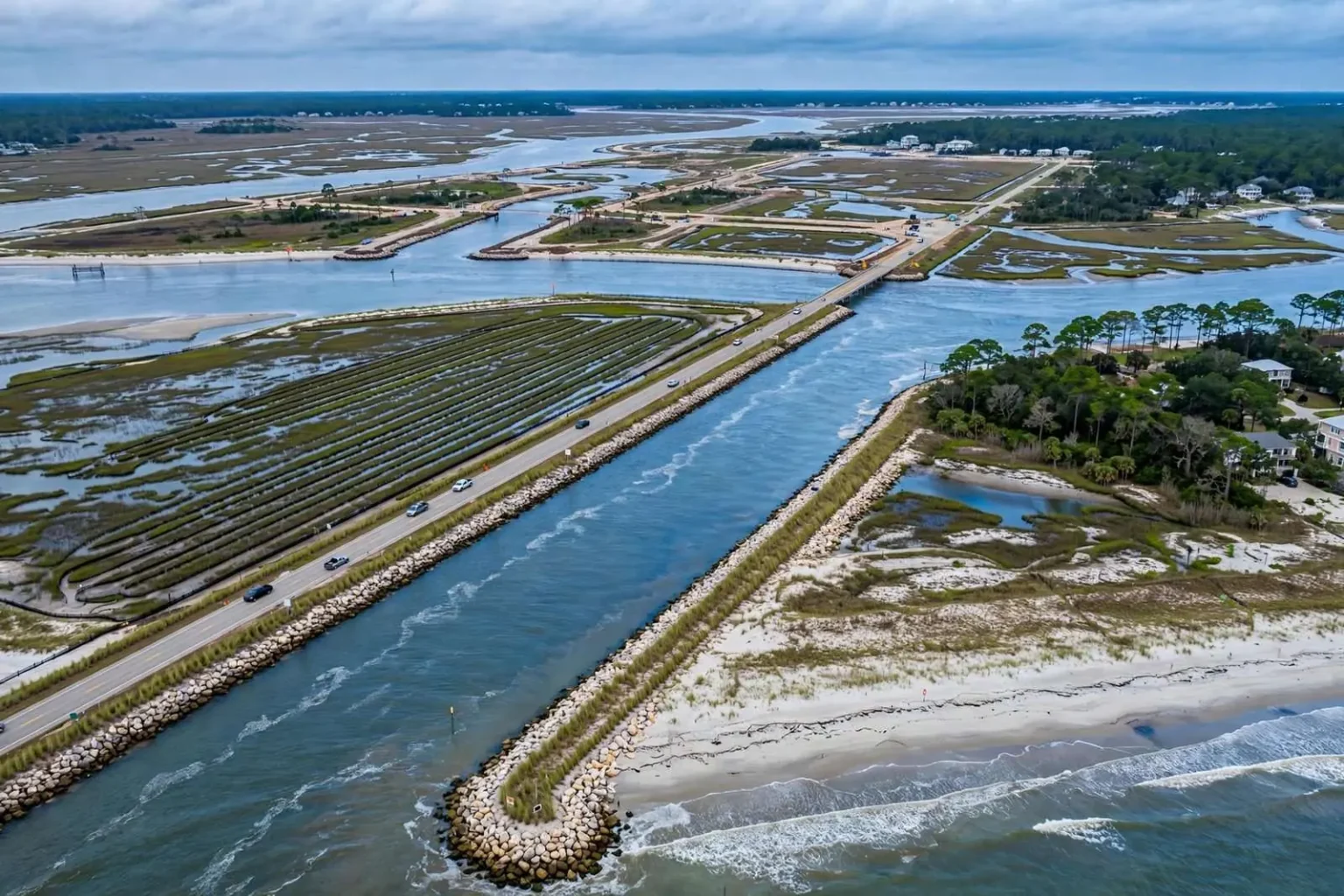
The largest award, just under $19 million, will fund the second phase of the Dauphin Island Causeway Shoreline and Habitat Restoration Project. The work will install a breakwater and build new intertidal marsh habitat to guard against erosion and storm damage along the causeway, which serves as the only road connecting south Mobile County to Dauphin Island.
That dependency is the heart of the project. The three-mile causeway across Mississippi Sound carries every vehicle that reaches the island — residents, school traffic, contractors, tourists and the emergency response that follows every major storm. During past hurricanes, wave attack on the causeway has severed the road for days or weeks at a stretch, cutting the island’s several hundred permanent residents off from the mainland and forcing repairs that take months. A hardened shoreline backed by marsh is intended to absorb wave energy before it reaches the road bed, extending the window during which the route stays passable as a storm approaches.
The first phase of the project, funded in April 2020 with more than $9.3 million, is already underway. Together, the two phases represent one of the larger single-infrastructure investments the Gulf spill money has made in Mobile County, and they reflect the program’s insistence that ecological work justify itself in practical, human terms.
An additional $4.9 million for the causeway work is coming through NFWF’s Emergency Coastal Resilience Fund, a separate pot of money created under the Supplemental Appropriations Act of 2019 that allows NFWF and NOAA to jointly award storm-resilience grants. Federal officials credited U.S. Senator Richard Shelby’s work in Congress for securing that funding stream.
The resilience fund was born of the 2018 disaster appropriations package that followed a year of record hurricanes, and it targets projects that reduce risk to lives, property and infrastructure in coastal counties. Pairing it with the Gulf Environmental Benefit Fund allows a single construction project to draw on two funding streams — an arrangement state officials say will let the causeway work move faster than either program alone would allow.
Rebuilding sand on the east end
On the east end of Dauphin Island, a $1.4 million award will pay for engineering, design and permitting work to restore nearly a mile of beach and dune habitat. The plan calls for placing an estimated 1.2 million cubic yards of sand along roughly 4,800 feet of shoreline, rebuilding about 35 acres of beach and dune habitat, with sand fencing and native plantings added to help hold the new sand in place.
The east end of Dauphin Island has been the most exposed piece of the town for years. The island is a low, narrow barrier whose eastern tip has repeatedly retreated under storm attack, and the beach and dunes there are the first line of defense for the town’s roads and homes. Dune systems matter out of proportion to their size: they trap blowing sand, absorb storm surge, and provide nesting habitat for beach-nesting birds and sea turtles, and once a dune field is stripped away, it rarely rebuilds itself. Engineering and permitting are the long pole in any beach nourishment project — sediment must be matched to the native beach, borrow areas located offshore, and state and federal environmental reviews completed before a single cubic yard moves.
The town of Dauphin Island completed an earlier phase of the same beach restoration effort in 2016 using Coastal Impact Assistance Program funds. The new design work carries that program forward at larger scale, and officials describe the sequencing as deliberate: engineering first, construction later, with funding sought as designs mature.
Bon Secour: filtering runoff before it reaches the bay
Two more awards target watershed problems near Foley that have been building for years as the area has grown. A $5.1 million grant will fund construction on the second phase of the Bon Secour River Headwaters Restoration project, which aims to stabilize about a mile of streambank and build a 70-acre wetland system just downstream from Foley to filter urban runoff before it reaches the lower Bon Secour River and Bon Secour Bay.
The project targets nutrients, sediment and debris that have been degrading water quality and harming fisheries downstream, and it addresses what planners identified as the top priority in the previously funded Bon Secour Watershed Management Plan.
Foley’s transformation explains the problem. Once a small farming crossroads, the city has grown into one of Baldwin County’s busiest retail and residential centers, with the shopping district around its beaches-bound highways generating impervious surfaces — roofs, parking lots, roads — that shed stormwater directly into the headwaters of the Bon Secour system. Flashy runoff scours streambanks, carries sediment and nutrients into the river, and eventually lands in Bon Secour Bay, where the river’s oyster beds and nursery habitats have felt the degradation. A constructed wetland works as a filter: stormwater slows, sediments settle, plants take up nutrients, and cleaner water continues downstream.
Bon Secour Bay’s seafood heritage gives the work more than ecological weight. The river and bay have supported commercial and recreational fishing families for generations, and the state’s oyster industry — already stressed by predation, salinity swings and storm damage — depends on the water quality that upstream restoration protects. Planners describe the headwaters work as an investment made at the top of the watershed to spare the bottom of it.
Wolf Creek and Wolf Bay
A separate $500,000 award will cover engineering and design for the first phase of the Wolf Creek Headwaters Restoration project, aimed at reducing sediment runoff into Wolf Bay, which is designated an Outstanding Alabama Water.
Wolf Creek’s headwaters have become the largest source of artificially elevated sediment flowing into the bay, driven largely by two decades of development around Foley. The design calls for roughly 7,000 linear feet of stream restoration and stabilization, 36 acres of riparian wetland restoration, and a new constructed wetland with floodplain enhancements intended to absorb stormwater and reduce erosion during future storm events.
Wolf Bay sits at the southern edge of Baldwin County’s growth corridor, its tributaries threading through subdivisions, golf courses and farm fields before opening onto the bay near the Intracoastal Waterway. The Outstanding Alabama Water designation is the state’s highest water-quality classification, a recognition that carries stricter protection standards, and the sediment running off construction sites and eroding banks has been quietly undermining it. Restoring the creek’s natural meanders, reconnecting its floodplain and rebuilding riparian wetlands slows the water down, lets sediment drop out before the bay, and gives the system the capacity to handle the next big storm.
Officials say the projects reflect a shift in how coastal restoration money is being spent in Alabama, with an increasing share going toward work that combines ecological repair with tangible flood and storm protection for nearby communities. More information on Deepwater Horizon-funded restoration work across the state is available through the Alabama Department of Conservation and Natural Resources.