Baldwin County Schools Clear Storm Debris, Test Bus Routes Ahead of Post-Sally Return to Class
Baldwin County Public Schools ran all 310 bus routes ahead of Wednesday's return to class, clearing storm debris and setting up designated stops in hard-hit areas like Spanish Fort's Saluda Ridge neighborhood after Hurricane Sally.
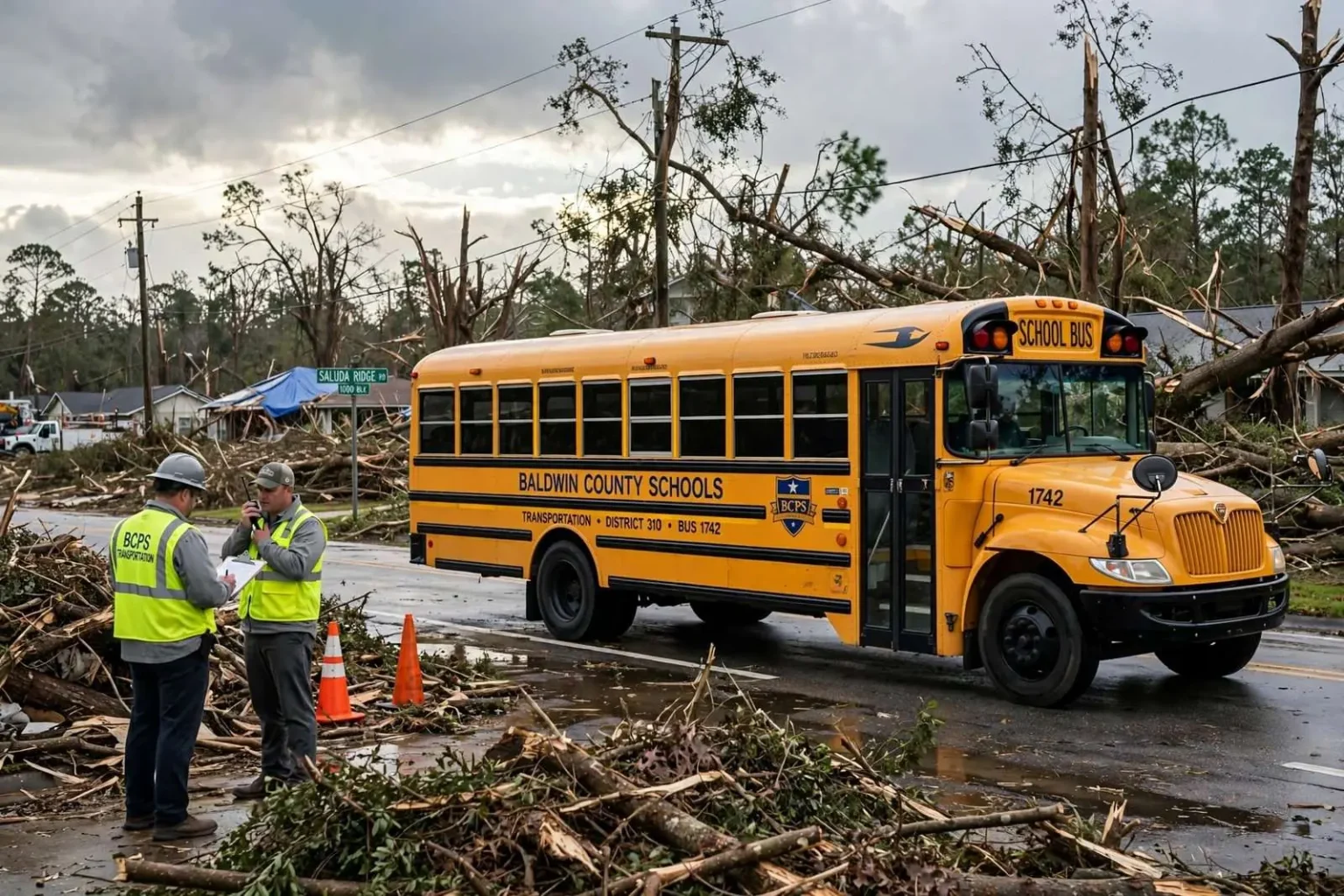
Baldwin County Public Schools spent the final days before reopening running every bus route in the district to make sure students could get to and from campus safely following Hurricane Sally, transportation officials said.
The effort covered hundreds of routes across one of the largest school districts in Alabama, stretching from the beaches of Gulf Shores and Orange Beach to the neighborhoods of Fairhope, Daphne and Spanish Fort along the eastern shore of Mobile Bay. Every mile of those routes crossed a landscape that had been reshaped by the storm, and transportation leaders wanted no surprises once students were aboard.
With classrooms cleared for the return to school, district leaders turned their attention to the roads themselves, sending drivers out in their assigned buses to retrace each route before students climbed aboard.
“We had our drivers drive their routes in their buses to make sure they could make their turns properly,” said Tony Pollard, the district’s transportation coordinator. “We have 310 drivers, so 310 routes run.”
The dry runs gave drivers a chance to see their routes as they now existed after the storm, not as they had been mapped at the start of the year. Downed limbs, debris piles and storm wreckage had altered familiar streets, and in some places the changes were significant enough that a route could not simply be driven from memory.
Clearing the roads before the buses rolled
The dry runs came after two days spent clearing debris left behind by Hurricane Sally, which knocked down trees and scattered wreckage along many of the county’s main roads. Crews worked to reopen those routes so drivers would not encounter blocked streets or hidden hazards once buses were loaded with students.
The debris clearing operation ranged across a county that is among the largest geographically in Alabama, and it involved school system crews working alongside municipal governments, county road departments and utility contractors who were themselves racing to restore power. Priority went to the arterial roads that carry bus traffic, with neighborhood streets cleared as access allowed.
Hidden hazards were among the biggest concerns during the dry runs. A branch hanging in a blind curve, a washed-out shoulder hidden by standing water or a debris pile blocking a turn were the kinds of obstacles drivers were instructed to note and report, so that the district could adjust routes or flag hazards before students ever rode the roads.
In some neighborhoods, the damage was severe enough that buses could not safely reach their usual stops. The district set up “designated stops” in those areas, including in the Saluda Ridge neighborhood of Spanish Fort, to keep students and drivers out of heavily damaged sections of road.
Transportation departments across the Gulf Coast have refined this playbook through repeated hurricanes, and Baldwin County’s version drew on lessons learned in storms past. The core principle is simple: a bus route that worked before a storm cannot be assumed to work after one, and the only reliable way to know is to drive it.
The verification effort required coordination with the district’s school leaders as well, since route changes can affect arrival and dismissal times at individual campuses. Principals were kept in the loop as stops moved and routes adjusted, so that the front offices greeting students on reopening day had accurate information about the buses that served their schools.
“A designated stop is an area we can’t really get into because of the heavy debris, so they’ve contacted parents with a new spot and said hey this is gonna be the drop-off time for the a.m. and the drop-off time for the p.m.,” Pollard said.
The designated stop system required direct outreach to affected families, since a changed pickup point is only useful if parents know about it before the first morning bus arrives. School staff worked through contact lists to reach families in the affected neighborhoods, and the district asked parents to verify the new arrangements before the reopening day.
Adjustments like these are a routine part of how school transportation systems absorb a storm’s impact, but the scale in Baldwin County was unusual. The district’s coverage area reaches from the Gulf beaches to the northern end of the county, and the storm’s damage was correspondingly uneven, with some routes untouched and others fundamentally disrupted.
District officials said the goal was to have every route verified and every family notified of any changes before the first buses rolled Wednesday morning, minimizing confusion on an already disrupted start to the school year.
Sally’s blow to the county
The transportation push mirrored broader recovery efforts across Baldwin County following Hurricane Sally, which made landfall in the region and left widespread damage to trees, power lines and roadways. The storm arrived along the Alabama coast with winds and flooding that left hundreds of thousands of utility customers without power and turned tree-lined streets into obstacle courses of downed limbs and uprooted trunks.
Sally’s slow movement compounded the damage, dumping prolonged rainfall across the region and pushing storm surge into coastal communities. The eastern shore communities along Mobile Bay, the beach towns at the county’s southern end and the inland neighborhoods in between all reported significant impacts, and the recovery stretched on for weeks as residents cleared debris and utilities repaired an infrastructure system battered across its breadth.
Schools found themselves at the intersection of that recovery, since reopening classrooms depends on power restored to campuses, roads cleared for buses and families settled enough to resume routines. The district’s decision to run every route before reopening reflected a recognition that the school system’s return to operation was itself a milestone in the county’s recovery, one that families across Baldwin County were counting on.
Baldwin County Public Schools serves tens of thousands of students across dozens of campuses, and a disruption of this scale touches nearly every community in the county. Getting buses back on the road meant getting parents back to work, restoring a sense of normalcy for children who had spent days amid storm damage, and signaling to the community that the county was moving forward.
Spanish Fort, where the Saluda Ridge adjustments were made, sits along the eastern shore of Mobile Bay and took some of the county’s most visible tree damage when the storm came through. Neighborhoods there experienced days without power, and the debris that lined residential streets in the storm’s aftermath remained a defining feature of the landscape as schools prepared to reopen.
The district’s communication effort extended to social media and automated messaging systems, which districts along the coast now use to push route changes and schedule updates directly to parents’ phones. Those tools proved essential in a recovery where conditions were changing daily and where families displaced by storm damage needed information wherever they could get it.
What drivers found on their routes
The route verification effort also produced a map of the storm’s damage as seen from a school bus window. Drivers reported conditions street by street, giving the district a picture of which neighborhoods had been hit hardest and where recovery remained incomplete, information that fed back into transportation planning for the weeks ahead.
Drivers were also watching for conditions that would slow their runs, from damaged traffic signals to narrowed streets where debris remained piled at the curb. Runs that normally took a set number of minutes could stretch longer in the aftermath, and the district planned schedules with that reality in mind so that students would not be left waiting at stops longer than necessary.
The verification runs doubled as a rehearsal for drivers themselves, many of whom had their own storm recovery underway at home. Getting behind the wheel and running a route gave drivers a structured return to routine, and the district’s leadership acknowledged that its transportation workforce was recovering alongside the students and families it serves.
Monitoring conditions in the weeks ahead
School officials have said they will continue to monitor conditions as the recovery proceeds, ready to adjust stops, routes and schedules if debris removal and utility work change the picture on the ground. Flexibility remains the operating principle in the weeks after a storm, with transportation departments across the Gulf Coast accustomed to revising plans as damaged areas come back online.
Parents with questions about specific stops or routes were directed to the district’s transportation office, which maintained updated information as conditions changed. The district also encouraged families to report hazards along their routes, adding hundreds of additional observers to the effort to keep the roads safe for the buses that would carry the county’s students through the recovery and beyond.
For the students who finally climbed aboard those buses on Wednesday morning, the dry runs that preceded them were invisible. What they saw instead was the ordinary sight of a yellow bus rounding the corner, an ordinary moment that, in the weeks after Hurricane Sally, took an extraordinary effort across Baldwin County to make possible.
The county’s recovery timeline remains long. Debris removal alone, measured in tons of vegetative and construction debris, was expected to continue for weeks after the schools reopened, and utility repairs in the hardest-hit areas stretched on as crews worked through damage lists street by street. The schools’ return marked one of the earlier milestones in a recovery that will play out for months.