Month-Long Closure Ahead: East 29th Avenue Shuts for Intersection Upgrades in Gulf Shores
East 29th Avenue in Gulf Shores will be fully closed from Highway 59 to The Track from Aug. 31 through Sept. 30 as the city completes intersection upgrades, with detours mapped for airport travelers.
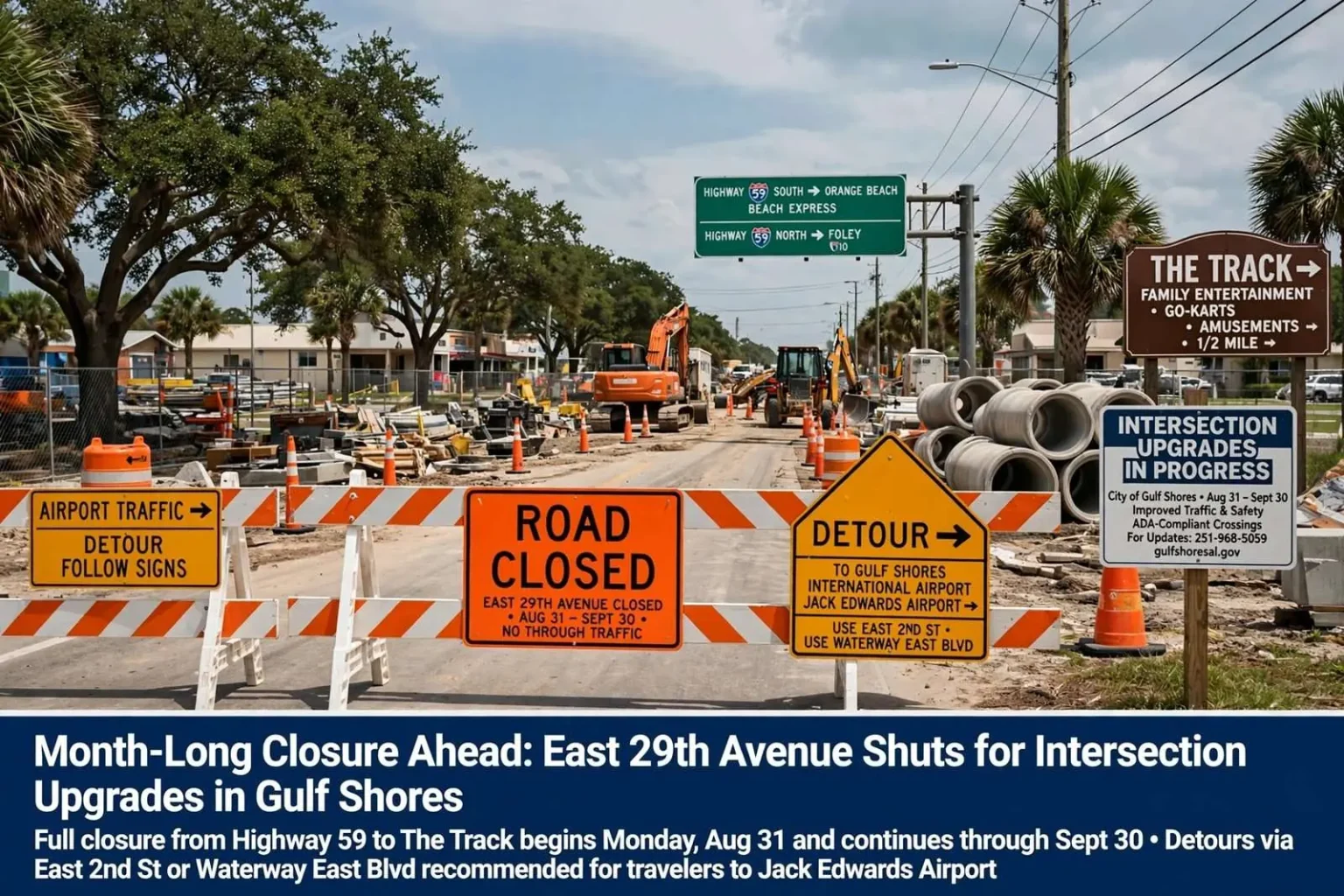
Drivers in Gulf Shores will want to build in some extra travel time this September. The City of Gulf Shores has announced a full closure of East 29th Avenue beginning Monday, August 31, with the work expected to continue through September 30. The closure stretches from the avenue’s intersection with Highway 59 to the entrance of The Track, putting a well-traveled stretch of local roadway off limits for a full month.
City officials describe the project as a set of planned intersection upgrades intended to improve traffic flow and safety in an area that juggles daily commuter traffic, airport travelers and visitors headed to amusement attractions along the Highway 59 corridor.
What the closure covers
East 29th Avenue will be fully closed from its intersection with Highway 59 to the entrance of The Track. That means no through traffic for the duration of the project, and drivers who regularly cut through the area — including residents, hotel guests and airport-bound travelers — will need to plan alternate routes while crews work. The city is asking drivers to plan accordingly and allow extra time when traveling in that part of Gulf Shores.
September brings a shift in local traffic patterns as the peak summer season winds down and school-year routines take over, but weekends can still bring heavy volumes to the entertainment corridor along Highway 59, where The Track and neighboring attractions draw families throughout the fall.
Getting to Gulf Shores International Airport
The closure lands squarely on a key approach to Gulf Shores International Airport, also known as Jack Edwards Airport. Travelers flying in or out during September should allow extra time and use the city’s recommended detours: East 2nd Street or Waterway East Boulevard. Both roads provide access to the airport while construction is underway, so a little route planning can spare travelers a last-minute scramble before a flight.
Work zones and patience
City officials are asking the public for caution and patience as the project moves forward, particularly near equipment and crews working along the closed stretch. Motorists passing through the wider area should watch for signage marking the closure and detour routes.
Questions and updates
The Gulf Shores City Engineering Office is available to answer questions about the closure at 251-968-5059. Updates on the project and other city road work are posted on the City of Gulf Shores website and the city’s Facebook page.
Why Intersection Upgrades Take a Month
A full closure lasting several weeks can seem like an extreme response to what looks, from the outside, like a single intersection. In practice, intersection upgrade projects typically involve far more work than resurfacing pavement or repainting lane lines. Crews often need to regrade the roadbed to improve drainage, install or relocate underground utility lines that sit beneath the intersection, add or lengthen turn lanes to reduce backups, upgrade traffic signal equipment and timing systems, and bring pedestrian infrastructure such as curb ramps and crosswalks into compliance with the Americans with Disabilities Act. Each of those elements has its own sequence — utility work generally has to happen before final paving, for instance, since tearing up a freshly paved surface to reach a pipe or conduit defeats the purpose of the closure. A full closure, rather than a lane-by-lane approach that keeps some traffic moving, is often the faster and safer option for this kind of work, since it allows crews to operate heavy equipment across the entire intersection footprint without the added complexity and safety risk of maintaining live traffic alongside an active work zone.
Municipalities also weigh timing carefully when scheduling projects like this one. Starting the closure just after Labor Day, as Gulf Shores has done, reflects a deliberate strategy common along the Alabama Gulf Coast: get disruptive construction work done in the shoulder season between the peak summer tourist crush and the holiday travel period, when local traffic volumes are lower and visiting travelers are fewer. A similar closure attempted in July, at the height of beach season, would create far more significant disruption for both residents and the seasonal visitor economy that drives much of Gulf Shores’ business activity.
A Fast-Growing Stretch of the Gulf Coast
The area around East 29th Avenue and Highway 59 sits at the heart of one of coastal Alabama’s busiest commercial corridors. Highway 59 functions as the primary north-south spine connecting Gulf Shores and Orange Beach to Foley and, ultimately, to Interstate 10 and the rest of the region, and it carries a mix of local commuter traffic, hotel and rental-property guests, and visitors headed to the amusement parks, restaurants and attractions that line the corridor. That mix creates congestion patterns that intensify sharply during the summer season and around major holidays, when the area’s population can swell many times over its year-round base as vacationers arrive for beach trips. Local and state transportation planners have invested heavily in the corridor over the years, widening sections of Highway 59, adding the Beach Express toll road as an alternate route to the interstate, and upgrading intersections throughout the beach cities to keep pace with growth that has made Baldwin County one of the fastest-growing counties in Alabama for more than a decade.
The Track, which anchors one end of the closure area, is a longtime family entertainment destination in Gulf Shores featuring go-kart racing and other attractions, and it draws a steady stream of visitors throughout the year, with particularly heavy traffic on weekends and during school breaks. Its proximity to the airport and to residential areas along East 29th Avenue makes the intersection one of the busier junctions in that part of the city, which is likely part of why it was selected for upgrades in the first place — a busier intersection generally means a greater safety and congestion payoff once improvements are complete.
Serving Gulf Shores International Airport
Gulf Shores International Airport, commonly known by its historic name Jack Edwards Airport, serves as the general aviation and commercial airport for the Gulf Shores and Orange Beach area. Like many smaller coastal and regional airports, it plays an important role for private and charter aviation, supporting everyone from local flight training operations to visitors arriving on private aircraft during the peak tourist season, alongside any scheduled commercial service the airport hosts. Reliable road access matters enormously for an airport’s operations and reputation, since travelers on a tight flight schedule have little tolerance for unexpected detours or delays on the way to a terminal. That is almost certainly why city officials moved quickly to publicize alternate routes — East 2nd Street and Waterway East Boulevard — well before the closure took effect, giving travelers time to adjust their plans instead of discovering the closure only when they arrived at a barricade.
Navigating Road Construction Season Along the Coast
Late summer and fall have become an informal construction season across Alabama’s beach communities, as cities and the Alabama Department of Transportation take advantage of the post-Labor Day lull to tackle paving, drainage and intersection projects that would be far more disruptive during peak season. Residents and regular visitors to Gulf Shores who follow local road work over multiple years will likely recognize the pattern: a project announced in late summer, a stated completion date in the fall, and a return to normal traffic patterns well before the following spring break and summer rush arrive. That cadence gives contractors a defined and predictable window to work in, while giving the city a strong incentive to hit its stated deadlines, since a project that runs long risks bumping into the next wave of seasonal traffic.
For residents and visitors navigating the closure, a few general practices tend to make the difference between a smooth detour and a frustrating one: checking a map or navigation app before setting out rather than relying on habit, building extra time into any trip to or from the airport, and paying close attention to posted work zone speed limits and signage, since construction zones are among the more common sites for traffic incidents precisely because drivers underestimate how much conditions have changed from their usual route. City officials’ request for patience near equipment and crews is a standard and important reminder in any active work zone, where the margin for driver error is considerably smaller than on an open road.
What Comes After Completion
Once the intersection reopens, the city will likely have a modestly reconfigured junction designed to handle traffic more efficiently than before — whether through improved signal timing, added turning capacity or better pedestrian access. Projects of this scale are rarely dramatic in their finished appearance, but the cumulative effect of steady, incremental intersection upgrades across a growing city like Gulf Shores is what keeps a road network functioning as population and tourism continue to climb. With the stated timeline pointing to a September 30 reopening, drivers can expect the disruption to be temporary, even if it arrives at an inconvenient moment for anyone who relies on East 29th Avenue as part of a daily routine.
How Cities Fund Local Intersection Projects
Intersection improvements on city-maintained roads like East 29th Avenue are typically funded through a combination of local capital improvement budgets, state and federal transportation grants, and, in growing communities, impact fees collected from new development that add strain to existing roadways. Small and mid-sized coastal cities often pursue state matching funds through the Alabama Department of Transportation for projects that improve safety on routes connecting to state highways such as Highway 59, since state and federal transportation dollars can stretch a local public works budget considerably further than city funds alone. Whatever the funding source, these projects generally go through a public bidding process in which contractors submit proposals and cost estimates, followed by council or commission approval before work can begin — a process that can take months of planning long before residents ever see a barricade or detour sign go up.