Fairhope Is About to Vote on Zoning Changes That Could Reshape What Gets Built Where
Fairhope officials are set to vote this month on zoning ordinance changes that could reshape development rules in the fast-growing Baldwin County city.
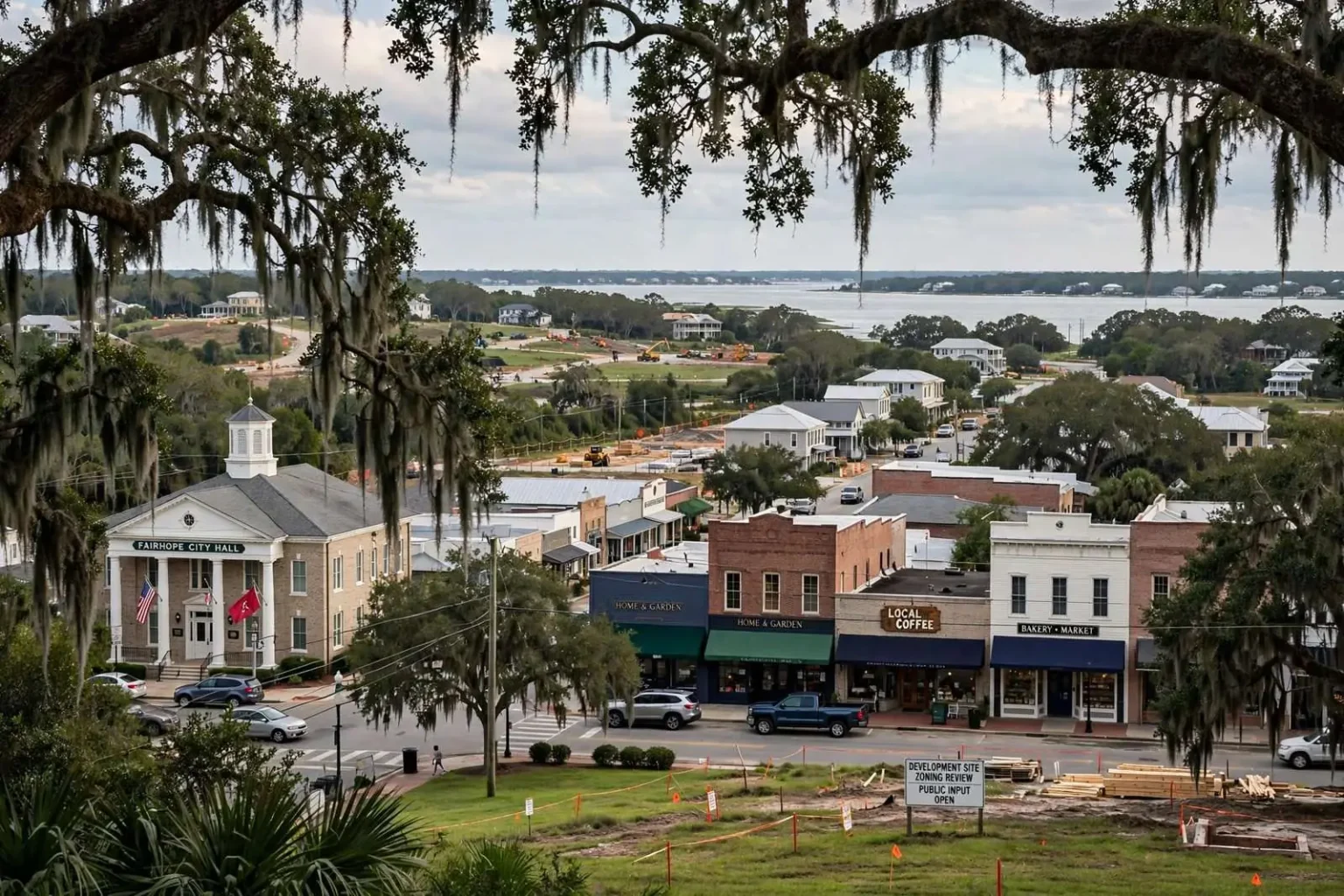
Fairhope officials are preparing to vote this month on changes to the city’s zoning ordinance, a decision that could reshape development rules across the fast-growing Baldwin County city. The upcoming vote comes as Fairhope, like many fast-growing Baldwin County communities, works to balance continued development interest against concerns from existing residents about density, traffic and strain on infrastructure. City officials have not detailed the full scope of the proposed changes publicly, though the vote is expected this month, giving residents a limited window to weigh in before the ordinance changes take effect.
Zoning is the legal framework a city uses to decide what can be built where, and it touches nearly every major question a growing municipality faces. Ordinances of this kind typically address allowable building density, setback requirements, land-use categories and how new development interacts with existing neighborhoods. When those rules are rewritten, the effects ripple outward well beyond the parcels that are most directly targeted, because the underlying standards apply citywide until they are amended.
Why the Vote Matters
Zoning changes of this kind often draw significant public interest precisely because they can affect property values and development potential for landowners across the city, not just in the specific areas most directly targeted by a given change. A homeowner in an established neighborhood, a commercial property owner along a growing corridor and a landowner holding acreage on the outskirts all have a stake in how the new standards are written. Density limits influence how many homes can go on a tract, setback rules shape how close structures can sit to property lines, and land-use categories determine whether a parcel can host retail, offices, industrial activity or housing.
Because of that breadth, zoning rewrites tend to attract comment from builders and landowners on one side who want flexibility to meet demand, and from neighborhood residents on the other who want protections for the character of the places they already live. Fairhope’s vote lands squarely in the middle of that ongoing conversation.
Growth Pressure on the Eastern Shore
Fairhope has faced sustained growth pressure in recent years as Baldwin County’s population continues to expand. Baldwin County has been among the fastest-growing counties in Alabama for years, drawing new residents with its coastal setting, schools and quality of life, and Fairhope sits at the center of that migration along the Eastern Shore of Mobile Bay alongside Daphne and Spanish Fort. That growth has shown up in new subdivisions, expanded commercial corridors and steadily increasing traffic on roads such U.S. Highway 98 and State Highway 181, which carry much of the city’s north-south travel.
The pressure is felt most acutely in the daily details of city life. School enrollment has climbed with the population, emergency services and utilities have had to keep pace with new rooftops, and long-time residents have repeatedly voiced concern about the scale and pace of new construction relative to the small-town character that made the city attractive in the first place. The zoning ordinance is one of the primary tools the city has for managing that tension, which is why the pending vote carries weight well beyond city hall.
What the Changes Could Address
While officials have not detailed the full scope of the proposed changes publicly, zoning ordinance updates typically address a predictable set of issues, and all of them are live questions in Fairhope. Allowable building density is usually the most contested item, since it governs how many dwelling units can be placed on a given acre and therefore how large a new subdivision can become. Setback requirements determine how far homes, businesses and parking must sit from streets and neighboring lots, shaping the look and feel of new development and providing buffers between incompatible uses.
Land-use categories are another core element. The zoning map and text together sort every parcel into districts — residential, commercial, industrial, mixed-use and agricultural categories among them — and any reworking of those categories can open some land to new uses while closing others. Finally, modern ordinances increasingly address how new development interacts with existing neighborhoods, covering matters such as transitions between commercial and residential districts, buffers and screening, access management onto major roads, and standards intended to keep new construction compatible in scale with what is already standing nearby.
In Fairhope’s case, each of those issues maps onto a real, local conversation. The city has seen substantial residential construction in recent years, debate over the pace of development on its outskirts, and recurring questions about traffic, drainage and the capacity of roads and utilities to absorb continued building. How the ordinance addresses those matters will influence development patterns for years to come.
Zoning decisions also tend to move slowly and be revisited rarely, which raises the stakes of each update: the standards adopted now will frame every planning commission and city council development debate for the foreseeable future, long after the current growth cycle has peaked or shifted.
The Public’s Limited Window
Because the vote is expected this month, residents have a limited window to weigh in before the ordinance changes take effect. Zoning changes in Alabama municipalities generally move through a public process: proposed amendments are considered by the city’s planning commission, which holds a public hearing and forwards a recommendation to the city council, and the council then acts on the measure, often after its own reading and hearing steps. Residents who want a voice in the outcome typically need to follow the city’s posted agendas, attend the relevant meetings or submit comments through the channels the city provides.
Civic participation at that stage matters because zoning text amendments, unlike individual rezoning petitions for a single parcel, set rules that apply across the city. Comments raised early in the process have a better chance of shaping the final language than objections raised after the vote has occurred. For landowners in particular, the period before adoption is the opportunity to ask how the new standards would treat their specific property and what, if anything, changes for existing structures and uses.
How Baldwin County Communities Are Grappling With Growth
Fairhope is not alone in revisiting its development rules. Communities across Baldwin County — including Daphne, Spanish Fort, Gulf Shores, Foley, Robertsdale and Loxley — have updated comprehensive plans, zoning ordinances and subdivision regulations in recent years as the county’s population has climbed. The growth corridor along the Interstate 10 and Highway 98 spines has transformed formerly rural land into subdivisions and commercial centers, and each municipality has approached the challenge through its own mix of planning tools, impact studies and land-use debates.
The shared experience across the county has been that zoning decisions are where abstract growth becomes concrete. A change in density rules in one city can push development pressure toward neighboring jurisdictions, and developers frequently weigh the differing requirements of Eastern Shore communities when deciding where to build. Fairhope’s decision this month will therefore be watched not only by its own residents but also by builders, landowners and officials across the region.
What It Means for Landowners
For property owners, the practical stakes of a zoning rewrite come down to what can be done with land and structures after the rules change. Existing uses that are allowed under the old ordinance are generally protected as legal nonconforming uses if a new ordinance makes them disallowed, but that protection comes with limits — significant expansions or rebuilding after destruction can be restricted. Landowners hoping to subdivide, build or redevelop will be working under the new standards, and those standards can determine whether a project pencils out at all.
Residents and landowners with questions about how the proposed changes would affect a specific parcel generally have options short of waiting for the vote: contacting the city’s planning department for guidance, reviewing the proposed text when it is made available, and speaking during the public comment portions of scheduled meetings. Because officials have not detailed the full scope of the changes publicly, direct engagement with city staff and meetings remains the most reliable way for affected owners to learn what is coming.
What Comes Next
The vote is expected this month, after which any adopted changes would take effect under the city’s standard ordinance procedures. Until then, the ordinance on the books remains the governing standard for development in Fairhope. Whether the final product leans toward tighter controls on density and larger buffers for existing neighborhoods, or toward greater flexibility for builders responding to housing demand, will become clear when the council acts.
What is already clear is the context in which the decision is being made: a coastal city with enduring appeal, a county growing faster than nearly any other in Alabama, and a resident base that has made clear it wants a say in what gets built where. The zoning ordinance rewrite is the next chapter in that ongoing negotiation between growth and character in one of the Gulf Coast’s most desirable small cities.