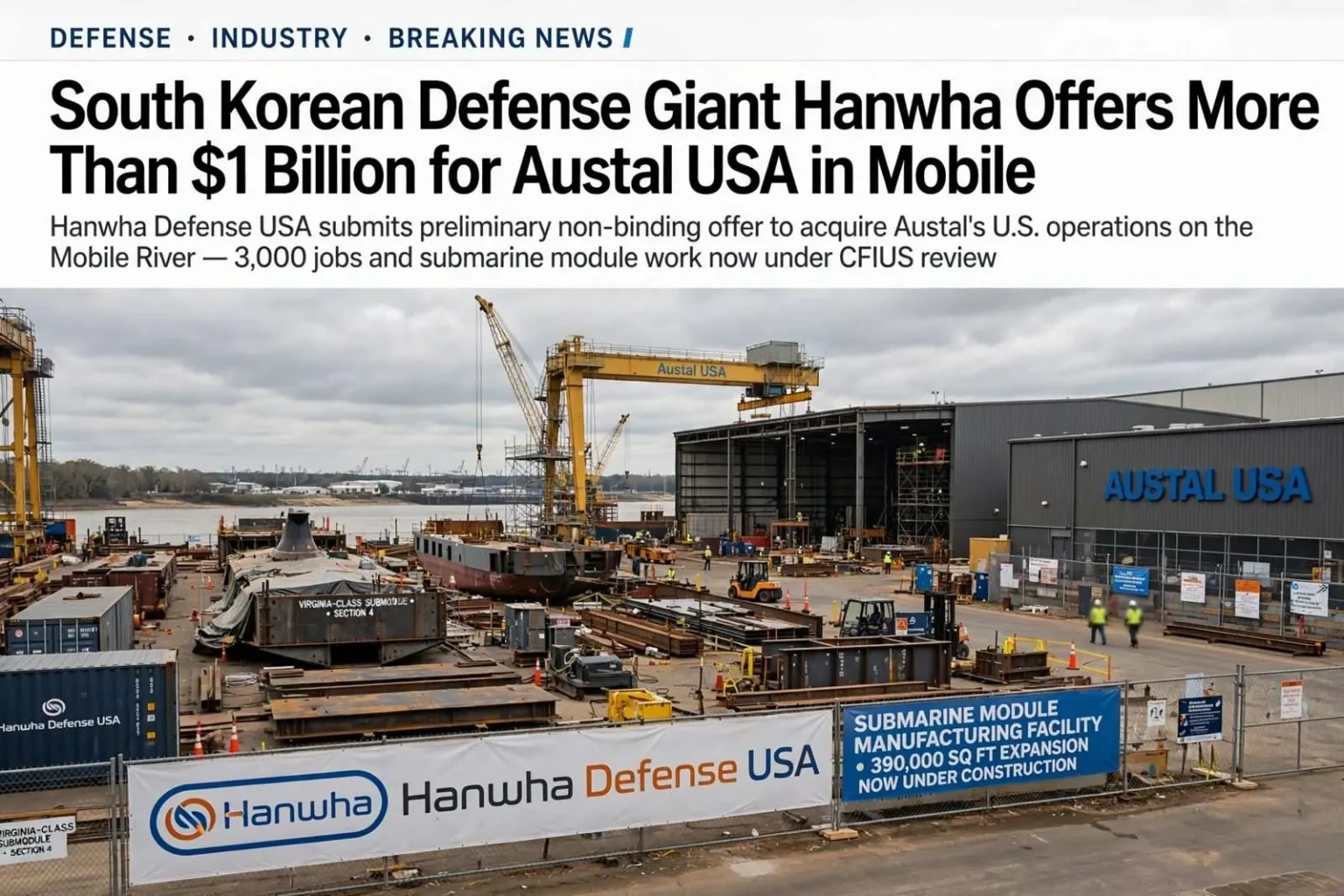
MOBILE, Ala. — South Korean defense conglomerate Hanwha has made a preliminary offer of more than $1 billion to acquire Austal USA, the Mobile River shipbuilder that employs roughly 3,000 people and builds vessels for the U.S. Navy and Coast Guard. Hanwha Defense USA, a subsidiary of Hanwha Aerospace headquartered in Arlington, Virginia, submitted a preliminary, non-binding proposal valuing Austal’s U.S. business between $1.05 billion and $1.2 billion on a cash-and-debt-free basis, according to disclosures Austal made to shareholders Tuesday, Aug. 11.
The deal would be structured through the acquisition of Austal USA’s holding entities or a similar arrangement, and would cover Austal USA’s Mobile operations, its Navy and Coast Guard vessel contracts, and its submarine module work — while Austal retains its core Australia, Philippines and Vietnam operations. In effect, the Australian parent would sell its American shipyard and walk away from the United States, leaving one of Mobile’s largest industrial employers under new foreign ownership.
“Hanwha Defense USA has made a preliminary, non-binding offer to acquire Austal’s U.S. business,” Hanwha Defense USA spokesman James Hewitt said in a statement. “Any deal will be contingent on due diligence that permits a thorough evaluation of Austal USA’s operations and financials, including newly disclosed information. Hanwha has made it a priority to significantly contribute to revitalizing American shipbuilding and is exploring a range of options to expand our footprint in the United States.”
What Austal USA builds in Mobile
Austal USA operates about 1.5 million square feet of indoor manufacturing space in Mobile and has expanded into steel shipbuilding and submarine work, including modules supporting the Virginia- and Columbia-class submarine programs. The company is also building a new 390,000-square-foot submarine module manufacturing facility in Mobile. The yard began as the U.S. outpost of an Australian aluminum-hull specialist, building the Navy’s Independence-class littoral combat ships and the Spearhead-class expeditionary fast transports, and it spent the last decade diversifying into steel — the material of the Navy’s large combatants and the nuclear submarine industrial base.
That diversification is what makes the yard strategically valuable and its ownership question politically sensitive. Virginia-class attack submarines and Columbia-class ballistic missile submarines are the most consequential programs in American naval shipbuilding, and module fabrication for them is concentrated in a handful of yards. A facility on the Mobile River that feeds that industrial base is not an ordinary manufacturing asset, and any change of ownership draws scrutiny from Washington as well as from shareholders.
Austal’s board has given Hanwha a four-week window, beginning Tuesday, to conduct due diligence, engage with the Department of War and the Navy and Coast Guard, and, if required, Australia’s Department of Defense, while progressing transaction documents. The engagement with three defense ministries in a four-week window shows how closely the sale of this yard is held by the governments on both sides of the Pacific: the Navy and Coast Guard must be satisfied that their programs, and the security arrangements around them, survive the change of hands.
Why Austal is selling
The offer follows a sharp downturn in Austal’s financial outlook. The company disclosed it now expects a roughly $113 million loss for 2026, reversing earlier guidance of about $110 million in earnings, after talks with the Department of War over relief on troubled Navy steel-vessel contracts — including the Towing, Salvage and Rescue Ship, the Auxiliary Floating Dry Dock Medium and Landing Craft Utility programs — did not produce the accelerated relief Austal USA sought.
The troubled programs are the price of the yard’s rapid expansion into steel. Fixed-price Navy contracts taken on to establish the steel business ran into cost growth, and the negotiation over who absorbs those losses — the shipbuilder or the government — has defined Austal’s financial position. Without accelerated relief, the U.S. business became a drag large enough that the parent company’s board began looking at the exit that Hanwha’s offer now proposes.
For Mobile, the trouble at the parent level does not translate directly into trouble at the yard. The contracts, the workforce and the Navy’s demand for the products remain. But a prolonged uncertainty over ownership is its own risk: hiring slows, suppliers hedge, and the pipeline of decisions that a shipyard makes years in advance gets made more cautiously while the sale is pending.
Hanwha’s long pursuit
Hanwha has pursued Austal before. In 2024, Austal rejected a roughly $662 million offer from Hanwha Ocean for its entire Australian parent company, citing uncertainty that U.S. and Australian regulators would approve foreign ownership of a contractor with sensitive naval work. Hanwha subsequently acquired a minority stake in Austal, which Australian regulators later allowed to grow to as much as 19.9% under strict national-security conditions.
The new proposal targets only Austal’s U.S. operations — a structure designed to answer the objections that sank the earlier approach. Buying the U.S. business rather than the Australian parent concentrates the review in Washington, where the strategic logic is different: the United States is actively seeking foreign investment in shipbuilding, and South Korea’s yards are among the most productive in the world.
Hanwha has also been expanding elsewhere in American shipbuilding, having acquired Philly Shipyard for $100 million in 2024 and announced a $5 billion plan to expand it. The Philadelphia acquisition gave Hanwha a foothold on the Delaware River and a stated commitment to commercial and government shipbuilding in American yards; Mobile would give it a second major yard, an existing Navy and Coast Guard contract book, and a place in the submarine industrial base that Philadelphia does not have.
The context is the U.S. maritime industrial strategy. American shipbuilding capacity has contracted for decades while the Navy’s requirements have grown, and policymakers in both parties have looked to allied foreign investment — Korean and Japanese yards foremost — as a way to add capacity quickly. Hanwha’s American expansion is the largest private expression of that strategy to date.
The regulatory road ahead
Any transaction would still require negotiation and likely face significant regulatory review, including from the Committee on Foreign Investment in the United States, the Defense Counterintelligence and Security Agency, and under the Hart-Scott-Rodino Antitrust Improvements Act, given Austal USA’s work on sensitive Navy programs.
CFIUS review examines whether a foreign acquirer poses a national security risk, and a yard that builds submarine modules sits at the most sensitive end of that analysis: clearances, controlled technical data, facility security and the governance arrangements needed to wall off classified work from foreign influence. The Defense Counterintelligence and Security Agency administers the facility clearances under which classified work is performed, and a change of foreign ownership typically requires renegotiated security arrangements before the work can continue. Hart-Scott-Rodino adds the standard antitrust review, which in this case turns on whether Hanwha’s combined American holdings — Philadelphia plus Mobile — raise competition concerns in any single market for naval construction.
The four-week due diligence window is only the beginning of that process. A deal of this profile, spanning two allied governments and the most sensitive shipbuilding programs in the U.S. inventory, could take many months from agreement to closing, and the parties have disclosed no timetable beyond the initial window.
What it means for Mobile
Austal USA is one of the anchors of Mobile’s industrial economy. Roughly 3,000 people work at the yard on the Mobile River, and thousands more across the region depend on its contracts — suppliers, trades, and the web of services that a major shipyard draws. The yard’s growth over two decades helped remake the riverfront south of downtown, and its pivot from aluminum fast transports to steel submarines pulled a new generation of welders, engineers and tradespeople into the region’s workforce.
The Mobile Area Chamber of Commerce said it does not comment on the ownership of “individual member companies” but noted Austal USA “has been a valued part of the Mobile business community for many years,” adding that its focus “remains on supporting the workforce and economic strength of this region.” The measured statement reflects the chamber’s position: it wants the yard busy and the workforce intact, and it takes no side on who the owner is.
For the workforce, the relevant questions are the ones a change of ownership always raises: whether the new parent funds the yard’s growth or harvests it, whether the submarine facility expansion continues on schedule, and whether the contract book — the Navy and Coast Guard programs already in the yard — is executed under the same management. Hanwha’s public posture, in its spokesman’s statement, is investment: a commitment to “revitalizing American shipbuilding” and expanding its U.S. footprint. Its Philadelphia record — a $100 million acquisition followed by a $5 billion expansion plan — is the evidence Mobile workers and officials will use to judge that posture.
The city has been through ownership transitions at its riverfront industries before, and it knows the pattern: the announcement, the diligence, the regulatory review, and then the operating record that tells the real story. What is different this time is the scale of the buyer’s ambition and the strategic moment — an American government actively inviting allied capital into shipbuilding, an Australian parent ready to exit, and a Mobile yard whose submarine work has made it more important to the U.S. Navy than at any point since it opened.
Between the preliminary offer and any closing stand a four-week diligence window, three defense ministries, CFIUS, DCSA, antitrust review and the negotiation of a final agreement. Mobile’s stake in that process is concrete: 3,000 jobs, 1.5 million square feet of manufacturing space, and the direction of one of the region’s defining industries for the next generation.