Coast Guard Sector Mobile Sends Teams to Reopen Gulf Ports After Hurricane Isaias
Coast Guard Sector Mobile has deployed navigation, port assessment and communications teams after Hurricane Isaias. Gulfport and Pascagoula are open, Mobile is in recovery with restrictions, and Pensacola and Destin remain closed.
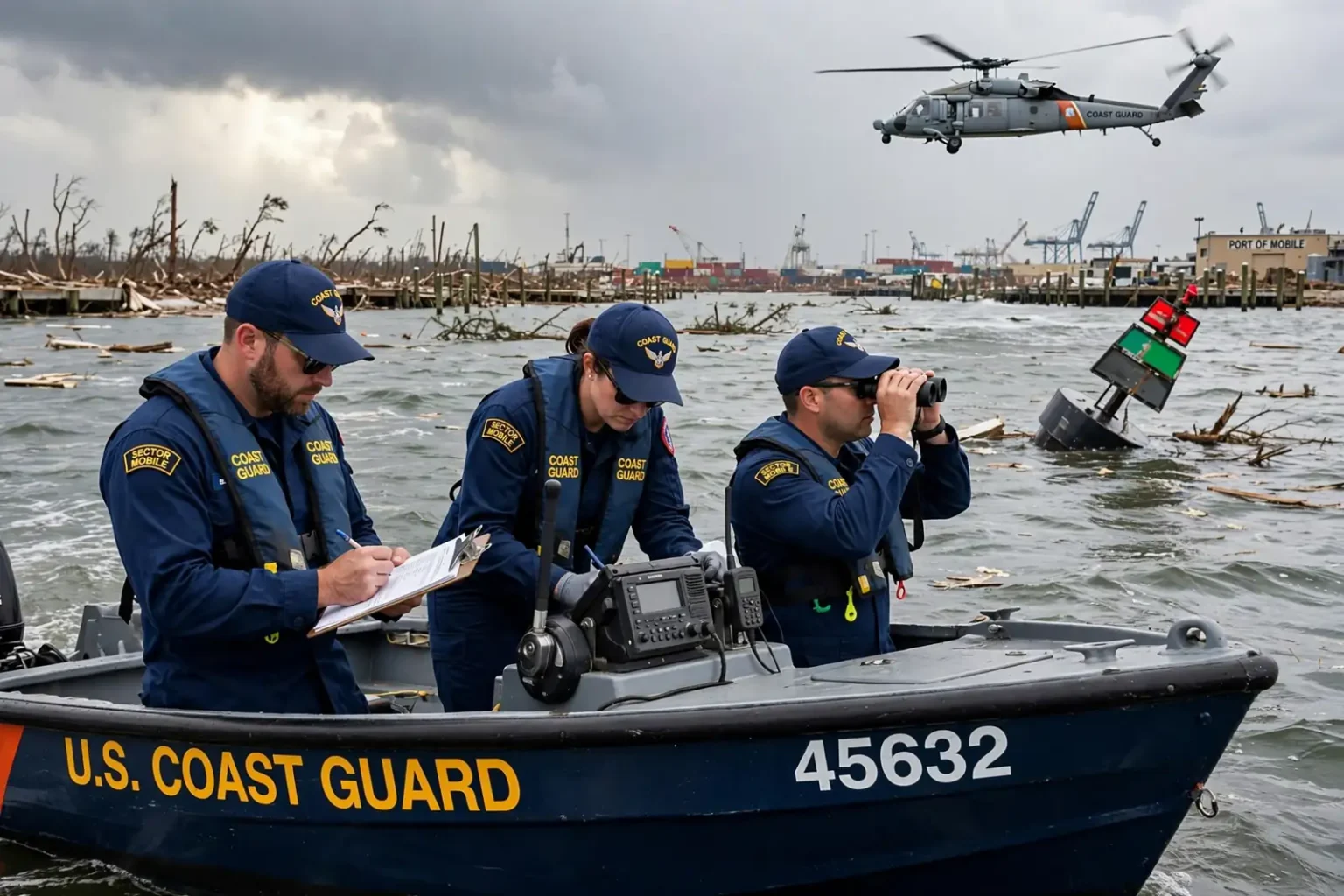
Coast Guard Sector Mobile has sent assessment, navigation and communications teams across the northern Gulf Coast to inspect ports, check channel markers and restore radio coverage after Hurricane Isaias, with the goal of reopening waterways and getting maritime commerce moving again as quickly as conditions allow.
As of Saturday, Oct. 10, the Coast Guard reported a mixed picture across the region. Some ports were already back to normal operations less than a day after the storm came ashore, while others, including the Port of Mobile, were in recovery mode with restrictions still in place. Ports closest to where Isaias made landfall remained closed to most vessel traffic while crews looked for hazards.
“Our priority is to safely reopen the port and restore the flow of maritime commerce as quickly as conditions allow,” said Capt. Mike Vega, commanding officer of Coast Guard Sector Mobile.
Where the Gulf Coast ports stand
Isaias made landfall Friday evening, Oct. 9, in northwest Florida near Destin, according to the National Hurricane Center, which reported the storm came ashore at about 8:30 p.m. as a Category 2 hurricane after carrying Category 3 strength through much of the day. Mobile and Baldwin counties sat west of the center, in the path of strong winds, heavy rain and storm surge.
The Coast Guard’s Saturday update listed the status of the major ports in the affected area:
- Back open, Port Condition Normal: Gulfport and Pascagoula, Miss.
- In recovery mode with some restrictions: Mobile, Panama City and Port St. Joe.
- Still in Port Condition Zulu, vessel traffic restricted: Destin and Pensacola, Fla.
The pattern tracks the storm’s path. The Mississippi ports, farthest west of landfall, were able to return to normal first. Pensacola and Destin, nearest the point where Isaias came ashore, remained under the most restrictive condition while Coast Guard personnel assessed the storm’s impacts and searched for potential hazards to navigation.
The Coast Guard noted that Port Condition Zulu and waterway restrictions remain in effect for many ports in the area, and it urged mariners to monitor official Coast Guard communications and the applicable Captain of the Port directives for updates on restrictions and reopenings.
Teams spread across the region
The Coast Guard has deployed multiple specialized teams throughout the affected area to support port recovery. According to the service, they include:
- Seven aids to navigation verification teams checking the condition and reliability of buoys, beacons and other navigational markers so vessels can safely transit affected waterways.
- Five port assessment teams evaluating waterfront facilities and critical maritime infrastructure for storm-related damage.
- Five communications teams working to restore communications in affected areas. They are supported by a deployable command center truck and a Rescue 21 Remote Fixed Facility, a portable installation used to reestablish VHF radio coverage.
In the air, Coast Guard aircrews are conducting aerial assessments of the region using MH-60 Jayhawk helicopters and HC-144 Ocean Sentry fixed-wing aircraft. Flights give responders a broad view of shorelines, channels and waterfront facilities that would take boat crews far longer to survey from the water.
The Coast Guard said it continues to coordinate with federal, state, local and maritime industry partners to assess port conditions and support the safe restoration of maritime operations.
Why waterways cannot reopen right away
A hurricane can change a harbor in ways that are not visible from the dock. Storm surge and strong currents can shift sediment in shipping channels, leaving shallower spots where a deep-draft ship could run aground. Buoys can be dragged off station, damaged or sunk, and fixed markers can be knocked down. Debris such as wrecked boats, docks, trees and shipping containers can end up in the water, sometimes just below the surface.
That is why the aids to navigation teams are central to the recovery. Ship pilots and captains rely on those markers to stay in the narrow, dredged channels that lead from the Gulf into ports such as Mobile. Until the Coast Guard confirms the markers are where they belong and working properly, letting large vessels move through could put crews, cargo and the waterway itself at risk. A grounded or disabled ship can block a channel for days.
The port assessment teams look at the other side of the equation: whether piers, terminals and other waterfront infrastructure are safe to use. Even if a channel is clear, a damaged berth or facility can limit what kind of operations can resume.
Restoring the radio safety net
The communications work is just as important for recreational boaters and commercial fishermen as it is for large ships. Rescue 21 is the Coast Guard’s system for monitoring and responding to VHF marine radio distress calls along the coast, including calls on Channel 16, the international hailing and distress channel. When towers or equipment are damaged or lose power in a storm, gaps can open in that coverage.
The portable Remote Fixed Facility deployed after Isaias is meant to fill those gaps while permanent sites are repaired. The deployable command center truck gives responders a mobile base for communications in areas where normal infrastructure has been disrupted.
For boaters, the practical message is simple: a working VHF radio remains one of the most important pieces of safety equipment on the water, but in the days after a hurricane, coverage may not be as complete as usual. Anyone heading out should file a float plan with someone on shore and carry backup means of calling for help.
What port conditions mean
The Coast Guard uses a series of port conditions to manage ship traffic before and after a storm. The levels are tied to how soon gale-force winds are expected:
- Whiskey: gale-force winds possible within 72 hours. Ports generally remain open while operators review heavy-weather plans.
- X-Ray: gale-force winds expected within 48 hours. Preparations intensify and many oceangoing vessels plan to leave.
- Yankee: gale-force winds expected within 24 hours. Traffic restrictions take effect, and vessels may enter only with Coast Guard permission.
- Zulu: gale-force winds expected within 12 hours. Ports are generally closed to inbound and outbound traffic until the Coast Guard reopens them.
After a storm, the Captain of the Port decides when a port can step back toward normal operations. Reopening often happens in stages, with restrictions such as daylight-only transits, draft limits or one-way traffic in certain areas until surveys are complete. A port in “recovery mode with some restrictions,” as Mobile was on Saturday, has begun that process but has not yet returned fully to normal.
The Port of Mobile before the storm
The Port of Mobile began winding down operations ahead of Isaias. The Alabama Port Authority suspended vessel operations at its public berths at midday Thursday, Oct. 8, so ships could depart safely, and ended terminal operations that evening. At the time, the port was operating under Port Condition Yankee, which restricts vessel traffic and requires Coast Guard permission to enter.
Moving ships out before a hurricane protects crews, vessels and port infrastructure from the risk of broken moorings and collisions with piers during high winds and surge. It also means that once the Coast Guard clears the channel, ships waiting offshore can return and cargo can begin flowing again.
The Port of Mobile is Alabama’s only deepwater seaport and a major economic engine for the state and the Mobile Bay region. Containers, coal, steel, forest products and other cargo move through its terminals, connecting Alabama manufacturers, farmers and mines with markets overseas. Every day the port is closed or restricted can delay shipments, which is why restoring safe access is a top priority for the Coast Guard and its partners.
Thanks for heeding warnings
Vega credited the public and the maritime industry for taking the storm seriously.
“Our crews are working across the affected region to assess critical infrastructure, restore communications and identify hazards to navigation,” Vega said. “I also want to thank the public and our maritime partners for heeding storm warnings and taking the necessary precautions ahead of Hurricane Isaias. Their preparation and willingness to put safety first helped reduce risks on the water and allowed our crews to focus on recovery efforts as soon as conditions permitted.”
Coast Guard Sector Mobile is responsible for a large stretch of the northern Gulf Coast and its inland waterways, which is why the Isaias recovery effort reaches from the Mississippi ports to the Florida Panhandle.
What mariners and boaters should do now
Commercial operators and recreational boaters alike should expect conditions on the water to be different from what they were before the storm. General safety guidance after a hurricane includes:
- Check port status first. Follow official Coast Guard communications, marine safety information bulletins and Captain of the Port directives before getting underway.
- Do not assume markers are in place. Buoys and day markers may be missing, damaged or out of position until verification teams finish their work.
- Watch for debris. Floating and submerged objects, including trees, dock pieces and sunken vessels, can damage hulls and propellers.
- Expect shoaling. Familiar channels and creek mouths may have shifted, especially in shallow areas of Mobile Bay and Mississippi Sound.
- Report hazards. Mariners who see a missing marker, a sunken or adrift vessel, or a pollution sheen should report it to the Coast Guard.
- Stay off the water if you do not need to be there. Fewer boats on the water makes it easier for response crews to do their jobs safely.
Boat owners whose vessels broke loose, sank or were damaged during the storm should contact their insurance company and local authorities, and report any fuel or oil leaks so they can be addressed before they spread.
Looking ahead
The Coast Guard did not give a timeline for lifting the remaining restrictions at Mobile or for reopening Pensacola and Destin, saying only that it is working to reopen ports as quickly as conditions permit. Status updates will come through official Coast Guard channels and Captain of the Port directives as assessments are completed.
For South Alabama, the reopening of the Port of Mobile’s channel will be one of the clearest signs that the region’s economy is getting back on its feet after Isaias, joining the work underway on roads, power lines and public facilities across Mobile and Baldwin counties.