Fairhope Sailing Duo Brings Home Gold From Special Olympics World Games
A unified sailing team trained at Fairhope Yacht Club won gold at the 2015 Special Olympics World Games in Los Angeles.
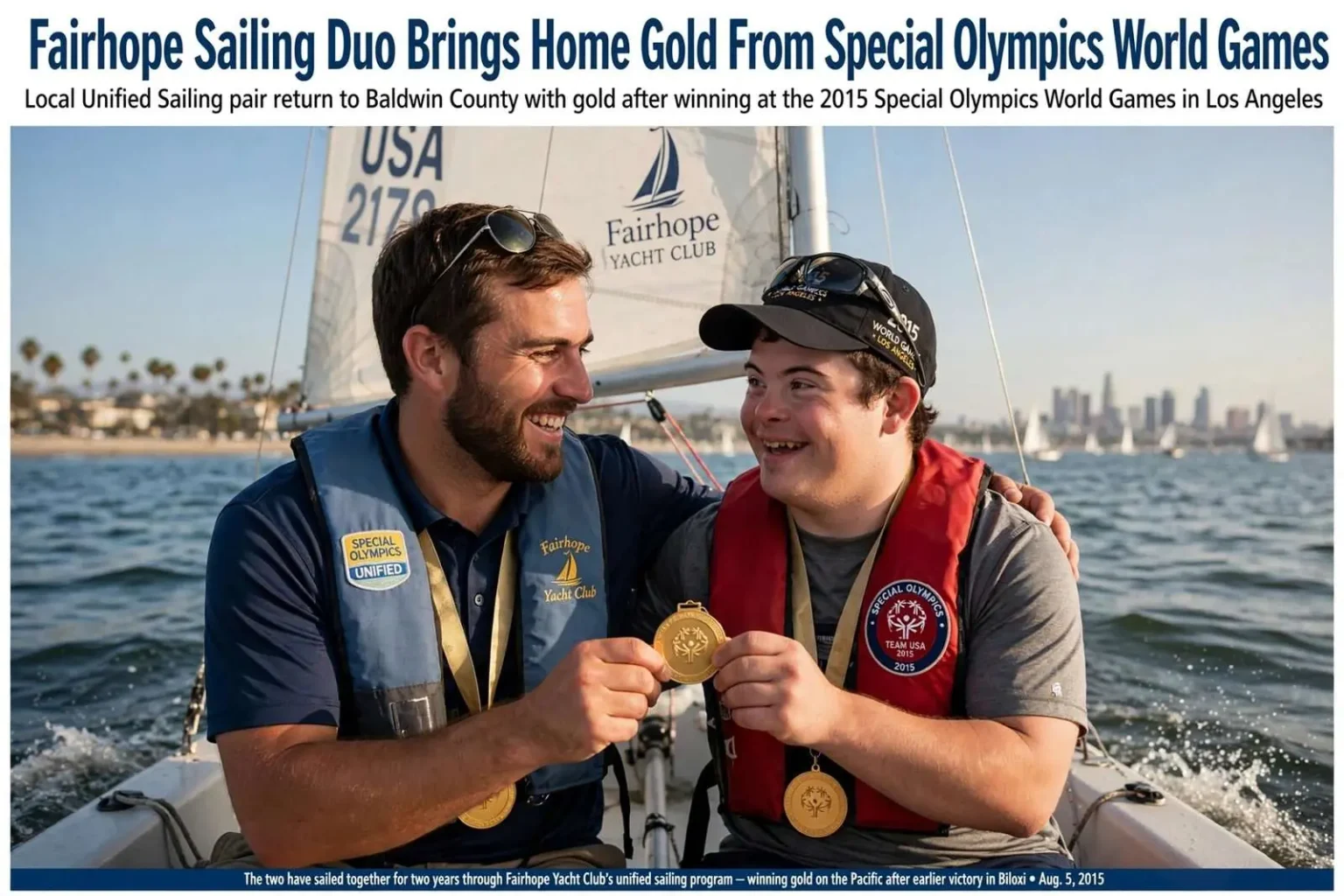
A sailing duo who trained together at the Fairhope Yacht Club returned home to Baldwin County with a gold medal after competing at the 2015 Special Olympics World Games in Los Angeles. The two have sailed together for roughly two years through a unified sailing program based in Fairhope, and they were one of just five U.S. sailing teams selected to compete at the international games, which ran from late July into early August.
They earned their spot at the World Games the hard way, by winning gold the previous year at a regional qualifying competition in Biloxi, Mississippi. That victory placed them among a small handful of American crews chosen to represent the country in their sport, a selection that put the Eastern Shore sailing community on a stage that reached around the world.
The unified sailing partner, who works as an X-ray technician in a Mobile hospital emergency room in his day job, said the experience of competing alongside his teammate meant more to him than the medal itself. He described the partnership as a genuine joy, saying the chance to compete together and watch his teammate succeed felt like giving a meaningful gift.
His teammate, reflecting on the accomplishment shortly after returning from Los Angeles, spoke with obvious pride and excitement about the achievement, saying he loved the competition, the people and the overall experience of representing his community on an international stage.
During the week of competition, the pair said they largely tuned out the field of competitors and focused on their own performance, checking standings occasionally but concentrating mainly on racing their best each day. Conditions were not always smooth. At one point during the competition, their boat capsized, an experience they were able to laugh about afterward as part of what made the week memorable.
On the final day of competition, a coach reminded the team that simply staying upright in their boat would be enough to secure the gold medal, advice that proved accurate as the pair held on to capture the top prize. Sailing medals are often decided as much by composure as by speed, and the duo’s ability to keep the boat steady while others pressed too hard carried them through to the podium.
How Unified Sailing Works
Unified sports are the centerpiece of Special Olympics competition around the world. The model pairs Special Olympics athletes, who have intellectual disabilities, with partners without them, and the two train, compete and win or lose as a single team. In sailing, that structure is a natural fit: a two-person boat demands constant communication, shared judgment about wind and weather, and a division of duties on the water that makes either teammate’s contribution essential.
The Fairhope program that produced the championship duo operates out of the Fairhope Yacht Club, which has long been a center of sailing life on Mobile Bay. The bay’s wide open water, steady afternoon sea breezes and protected launching areas make it one of the Gulf Coast’s most reliable places to learn and race small sailboats, and the club’s junior and adult programs have introduced generations of Eastern Shore residents to the sport. Opening its docks to Special Olympics athletes has extended that tradition to competitors who might otherwise never set foot on a race course.
For the unified partner, the role is not that of a helper but of a teammate under the rules of competition. Both crew members are scored as one entry, and a crew only reaches the medal stand when both perform. Partners often say the experience changes how they see competition itself, because the measure of success is the growth of the athlete beside them rather than a standings sheet. The partnership that developed between the Fairhope pair over two years of practice sessions clearly showed in the way they handled adversity mid-regatta, recovering from a capsize and racing on without letting the mishap unravel their week.
From Biloxi to Los Angeles
The road to the World Games began with regional competition, and the Gulf Coast qualifying regatta in Biloxi gave the duo their first championship. Regional and state-level Special Olympics events feed into a selection process that identifies the strongest American crews for international competition, and earning a berth is rare. With only five U.S. sailing teams selected for the 2015 games, the Fairhope duo’s qualification alone was an achievement most athletes in any sport never experience.
The World Games bring together thousands of athletes from more than 150 nations every four years, alternating between summer and winter editions, and the 2015 summer games in Los Angeles were among the largest sporting events held in the United States that year. Competition spans dozens of sports, from track and swimming to bowling, powerlifting and sailing, and the games’ opening ceremonies fill a major stadium. For athletes, the week is as much a cultural exchange as a championship, with delegations trading pins, cheering for one another and forming friendships that outlast the closing ceremony.
Navigating a race course on the Pacific coast presented its own adjustment for a Gulf Coast crew. Wind, current and sea state differ from one body of water to the next, and competitors must read conditions quickly. The Fairhope pair’s background racing on Mobile Bay, where afternoon breezes and shifting channels demand constant attention, gave them a foundation they carried across the country to California waters.
A Resume That Extends Beyond the Water
The Special Olympics athlete’s competitive résumé extends well beyond sailing. He also bowls, competes as a powerlifter, and represented the U.S. as a Special Olympics athlete in competition before, a breadth of involvement that reflects how the organization builds lifelong athletes across many sports. Bowling and powerlifting are among the most popular Special Olympics sports in Alabama, offering year-round training and competition close to home, while sailing opportunities are scarcer and depend on dedicated programs and partners at waterfront communities like Fairhope.
That breadth matters because Special Olympics is structured around continuous participation rather than a single peak. Athletes train through local programs, advance through area and state competitions, and the most dedicated can progress to national and international selection. Each level requires the same discipline any competitive athlete knows: regular practice, physical conditioning, and the mental steadiness to perform when it counts.
Special Olympics on the Gulf Coast
Alabama’s Special Olympics program serves thousands of athletes across the state through local programs that offer training and competition in a wide range of sports. On the Gulf Coast, events in bowling, track and field, basketball, softball and aquatics draw participants from Baldwin and Mobile counties and beyond, supported by volunteers, coaches, families and local businesses. The organization’s mission reaches past the playing field, promoting inclusion in schools and workplaces and giving athletes a network that extends into every part of their lives.
Unified programs like the one in Fairhope are a growing part of that mission. By training side by side, athletes and partners break down barriers that can isolate people with intellectual disabilities, and communities that host unified teams often see those relationships spill into classrooms, churches and civic groups. The Fairhope duo’s world championship offers local programs a visible example of where participation can lead, and success at the international level tends to energize fundraising, recruitment and volunteer turnout back home.
Sailing remains a small sport within Special Olympics compared with bowling or track, which makes a program like Fairhope’s particularly valuable. Running a sailing program requires boats, safety craft, trained volunteers willing to take athletes on the water, and a club willing to share its facilities. Few communities on the Gulf Coast can assemble that combination, and the ones that do give their athletes access to a sport that builds confidence, watermanship and teamwork in equal measure.
The Meaning of a Medal for Fairhope
News of the gold medal made the rounds quickly through Baldwin County, where pride in local athletes runs strong and world-class achievements by hometown competitors are celebrated at every level, from civic clubs to school announcements. For the yacht club and the unified program’s volunteers, the medal is validation of years of quiet work — Saturday practices, safety drills, equipment upkeep and the patient effort of matching athletes with partners and teaching two people to move as one crew.
The victory also carries a message for families weighing whether to enroll a son or daughter in Special Olympics competition. The pathway from a first practice to an international podium is real, and it runs through exactly the kind of local program that operates in Fairhope. Athletes who begin with learn-to-sail sessions on Mobile Bay can, with years of commitment and the right partner beside them, end up racing the best crews in the world.
For the two teammates, the return home from Los Angeles closed one chapter while opening others. The partnership will continue on the bay, where practices resume with the same rhythm that carried them to gold: rig the boat, talk through the plan, watch the wind, and race. Their coach’s final-day advice — stay upright, sail your race — is as good a summary as any of how they won, and it is likely to echo through the Fairhope program for years as new athletes learn the sport that sent two of their own to the top of the world.
Why the Partnership Mattered Most
In interviews after their return, both members of the team returned again and again to the same theme: the medal mattered, but the partnership mattered more. The unified partner’s description of watching his teammate succeed as a meaningful gift captures what draws many partners into Special Olympics in the first place and what keeps them involved long after a particular season ends. The athlete’s pride in representing his community on an international stage reflected the other half of that exchange — the confidence and recognition that competition gives athletes in their hometowns.
That mutual benefit is by design. Special Olympics unified programs are built so that everyone on the water trains the same way, faces the same conditions and is measured by the same standards. A partner cannot carry a crew to victory, and an athlete is never a passenger. In sailing, where a capsize tests both crew members equally, the format produces genuine equality of effort, and the Fairhope duo’s week in Los Angeles — capsized at one point, laughing about it later, steady when it counted — showed exactly why the model works.
The duo’s story now becomes part of the history of both the Fairhope Yacht Club and Alabama’s Special Olympics community, joining the list of moments when athletes from small Gulf Coast towns competed — and won — against the world. For the sailing community on Mobile Bay, the gold medal is proof that the bay’s programs can develop world-class crews. For Special Olympics athletes across the region, it is proof that the podium is reachable. And for two teammates from Fairhope, it is a shared memory of a week in Los Angeles when everything they practiced for came together on the water.