Molly’s Patrol: Inside Orange Beach’s Surf Rescue Program and the Legacy Behind Its Name
Orange Beach's lifeguard division, known as Molly's Patrol, has grown from a two-person Parks and Recreation effort into a USLA-certified Beach Safety Division honoring the memory of 15-year-old Molly Bryant.
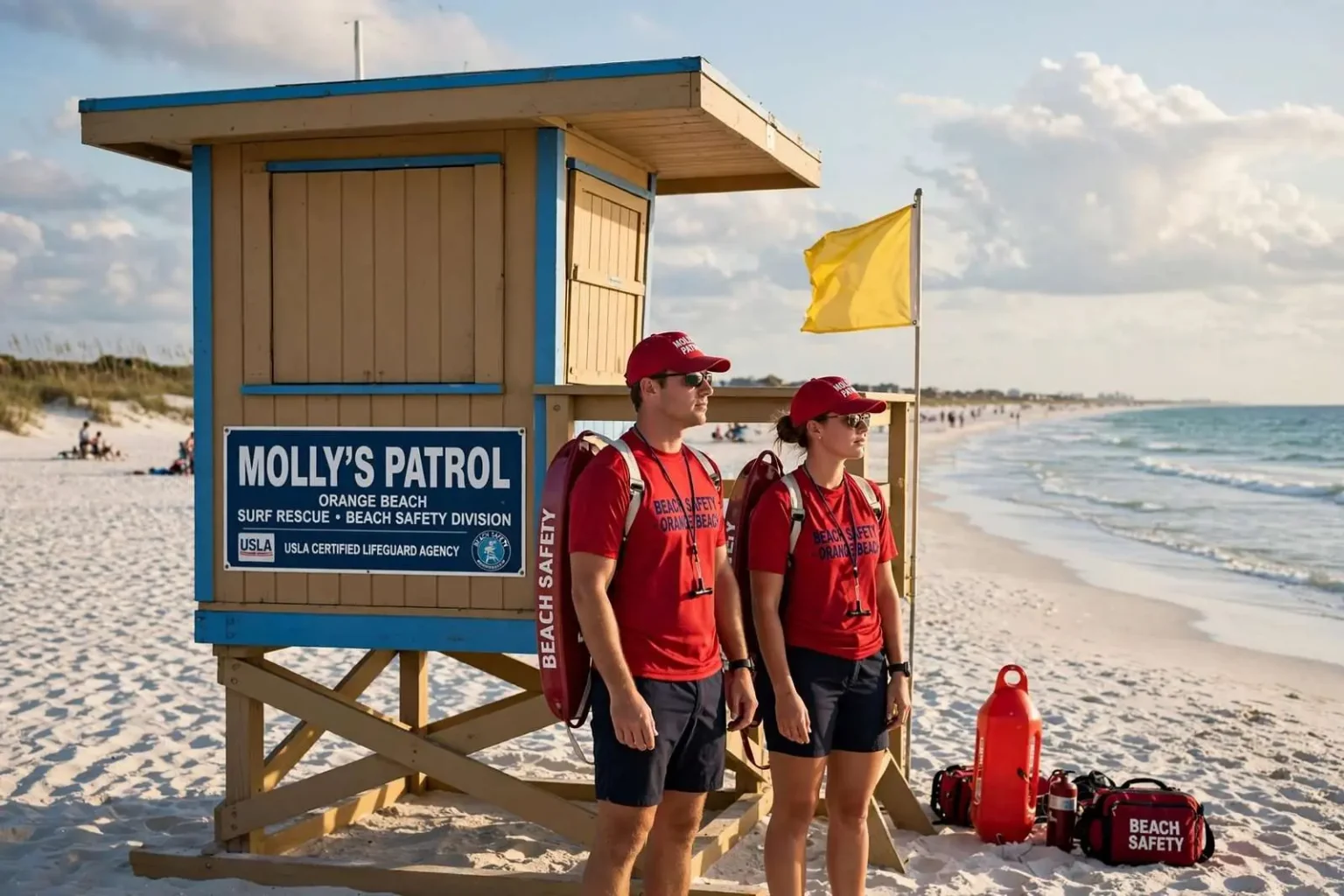
Every summer, thousands of visitors flock to Orange Beach’s sugar-white sand, and every one of them is, whether they realize it or not, under the watch of a lifeguard program with a name that carries deep meaning: Molly’s Patrol. The city’s Beach Safety Division has grown over nearly two decades from a small seasonal effort into a nationally certified lifeguard agency, and its name honors a 15-year-old girl whose death in the Gulf’s waters more than two decades ago continues to shape how the city protects the millions who visit its beaches each year.
From Parks and Recreation to a Certified Lifeguard Agency
Surf Rescue in Orange Beach traces its roots to 2008, when it began under the city’s Parks and Recreation Department with daily patrols consisting of just two lifeguards covering seven and a half miles of coastline. Those early patrols combined direct water rescue capability with an educational mission, teaching beachgoers about the hazards hiding beneath the Gulf’s often deceptively calm-looking surface.
The program took a significant step forward on January 1, 2012, when Surf Rescue moved from Parks and Recreation into the Orange Beach Fire Department, and the city formally created its Beach Safety Division. That reorganization reflected a broader recognition that beach rescue operations function much like other emergency response services, requiring the same kind of training, equipment standards, and command structure that fire and rescue departments rely on for other emergencies.
Since that transition, the division has grown substantially. Today, Orange Beach’s Beach Safety Division operates as a Certified Lifeguard Agency under the United States Lifesaving Association, or USLA, the national nonprofit organization that sets training and operational standards for open-water lifeguard agencies across the country. That certification places Orange Beach’s program within a network of agencies held to rigorous, standardized benchmarks for rescue readiness, training, and equipment — a notable achievement for a beach safety division that began with just two guards patrolling on foot.
A Seasonal Force With Year-Round Planning
The division’s current staff includes 33 employees: six full-time positions — a Beach Safety Chief, two Beach Safety Supervisors, and three Open Water Lifeguard Specialists — along with three part-time Beach Safety Supervisors and 24 temporary or seasonal Beach Safety Lifeguards who staff the towers during the busiest months of the year.
Lifeguards operate on a seasonal schedule that runs from March 1 through October 31, with staffing and hours calibrated to match seasonal crowd levels. From March through May, lifeguards are on duty from 10 a.m. to 6 p.m. During the peak season, from Memorial Day through Labor Day, coverage extends from 10 a.m. to 8 p.m., with a reduced staffing level covering the beach from 6 p.m. until sunset. From September through the end of October, hours return to the 10 a.m. to 6 p.m. window. From November through February, the division does not staff lifeguard towers, though it maintains limited patrols and response capability. All of those hours are subject to change based on weather conditions, a necessary caveat along a stretch of coastline where thunderstorms, high surf, and tropical systems can develop quickly during warmer months.
Understanding Rip Currents — the Gulf’s Hidden Hazard
Much of the division’s public safety messaging centers on rip currents, the powerful, narrow channels of water that flow away from shore and are responsible for the vast majority of surf rescues along Gulf Coast beaches. Rip currents can form even on days that look calm from the sand, making them one of the most misunderstood hazards facing beachgoers. Lifeguards use color-coded flag warnings, posted at beach access points, to communicate daily conditions to visitors, and staff at any lifeguard tower can answer questions about current conditions or beach regulations for anyone unsure about the day’s hazard level.
To help residents and visitors stay informed even when they are not at the beach, the city offers a text alert system: texting ALBEACHES to 888777 delivers daily beach conditions and flag-warning updates, while texting ALERTBALDWIN to the same number provides broader weather alerts and warnings for the local area. Both services can be canceled at any time by texting STOP.
Training the Next Generation Through the Junior Lifeguard Program
Beyond its rescue operations, Orange Beach Surf Rescue runs a Junior Lifeguard Program most summers, typically offering three sessions with registration handled online. The program is designed to teach participants foundational water safety skills, including how rip currents form, how to identify them from shore, and how to escape one if caught in its pull, alongside instruction in CPR, physical fitness, and teamwork.
Junior Guards take part in daily physical conditioning through running, swimming, and games, and by the end of the program are expected to leave with a higher level of water confidence and improved swimming ability. Each participant receives a rash guard, hat, bracelet, and a completion certificate, and is asked to bring running shoes, a swimsuit, goggles, a towel, and lunch and snacks each day. The program is held at the Orange Beach Aquatics Center, located at 4853 Wilson Boulevard in Orange Beach.
The Story Behind the Name
The patrol’s name traces back to July 2003, when Molly Bryant, then 15 years old, was swimming in the Gulf with a group of friends during a youth church trip to the Gulf Coast when she was caught in a rip current and drowned. By all accounts, Molly had spent much of her final summer in service to others, including a mission trip to San Francisco where she ministered to and fed homeless children — an experience that friends and family said helped shape her desire to devote her life to children’s ministry.
In the years since her death, Molly’s family — Tommy and Rebecca Bryant — has worked to turn grief into action, supporting efforts to strengthen beach and water safety standards along the Alabama Gulf Coast. Their advocacy and generosity helped give the city’s Surf Rescue program its name: Molly’s Patrol, established in Molly Bryant’s memory to further educate beachgoers about the hidden dangers of rip currents and other hazards common to open-water beaches.
City officials describe beach safety as a responsibility shared by the entire community, particularly given how central the beach is to both residents’ quality of life and the tourism economy that sustains much of Orange Beach and the surrounding area. Anyone with questions about current beach conditions can reach the Beach Safety Supervisor at 251-979-8645 or the Surf/Beach Condition Info Line at 251-981-SURF; in an emergency, officials urge beachgoers to call 9-1-1 immediately. The City of Orange Beach is located at 4099 Orange Beach Boulevard.
Why Rip Currents Are So Dangerous
According to the United States Lifesaving Association, rip currents are responsible for the vast majority of beach rescues performed by USLA-affiliated lifeguard agencies nationwide each year, and they remain one of the leading causes of drowning deaths at surf beaches in the United States. Rip currents form when water pushed toward shore by breaking waves finds a channel — often near sandbars, piers, or jetties — through which it can rush back out to sea, creating a current strong enough to pull even experienced swimmers away from shore.
Safety experts consistently advise that swimmers caught in a rip current avoid fighting directly against the pull back to shore, since the current is typically far stronger than a person’s ability to swim against it. Instead, the recommended response is to swim parallel to the shoreline until free of the current’s pull, then swim back to land at an angle, or to simply float and signal for help if swimming out of the current is not possible. This guidance forms the core of the water-safety curriculum Orange Beach lifeguards teach both to Junior Guard participants and to the general public through beach signage and lifeguard tower conversations.
\n
Tourism, Safety, and the Gulf Coast Economy
\n
Beach safety carries outsized economic stakes for a community like Orange Beach, where tourism forms the backbone of the local economy. Millions of visitors travel to the Alabama Gulf Coast each year specifically for its beaches, and maintaining a strong public safety reputation is central to sustaining that visitor confidence over time. A well-regarded, USLA-certified lifeguard program is not just a public safety measure — it is also part of the broader value proposition local tourism officials use to market Orange Beach and the surrounding area to families choosing among competing Gulf Coast destinations.
\n
That economic dimension helps explain why the city has continued investing in the Beach Safety Division’s growth since its founding, expanding from a two-person patrol in 2008 to a 33-person, nationally certified operation today. For a relatively small municipal government, sustaining that level of staffing and training investment year after year reflects a deliberate prioritization of beach safety infrastructure as core, rather than optional, municipal spending.
Reading the Flags: A Nationwide Warning System
The color-coded flag system Orange Beach lifeguards use each day is part of a warning framework adopted broadly by beach communities along the Gulf and Atlantic coasts, designed to give visitors an at-a-glance read on water conditions without requiring them to seek out a lifeguard for every question. Generally, a green flag signals calm conditions with a low hazard, yellow indicates moderate surf or currents that call for caution, and a single red flag warns of high hazard conditions, including strong surf or currents, that make swimming considerably more dangerous. A double red flag typically signals that the water is closed to public entry altogether, often due to dangerous rip currents, severe weather, or, in some coastal jurisdictions, environmental hazards. Because rip current strength can change over the course of a single day as tides, wind direction, and swell patterns shift, flag conditions are reassessed regularly rather than set once each morning, which is part of why officials encourage beachgoers to check conditions at a staffed tower or through the city’s text alert system rather than relying on flags they may have seen earlier in the day or heard about secondhand. The National Weather Service also issues rip current outlooks for Gulf Coast beaches during the warmer months, providing an additional forecasting layer that local beach safety agencies like Orange Beach’s factor into staffing and flag decisions, particularly ahead of tropical systems or persistent onshore wind events that can elevate rip current risk even under otherwise sunny skies.