ALDOT Meeting With Planning Organizations to Update Mobile River Bridge Project
ALDOT is meeting with Mobile and Eastern Shore planning organizations to update the Mobile River Bridge project, including a proposed truck toll.
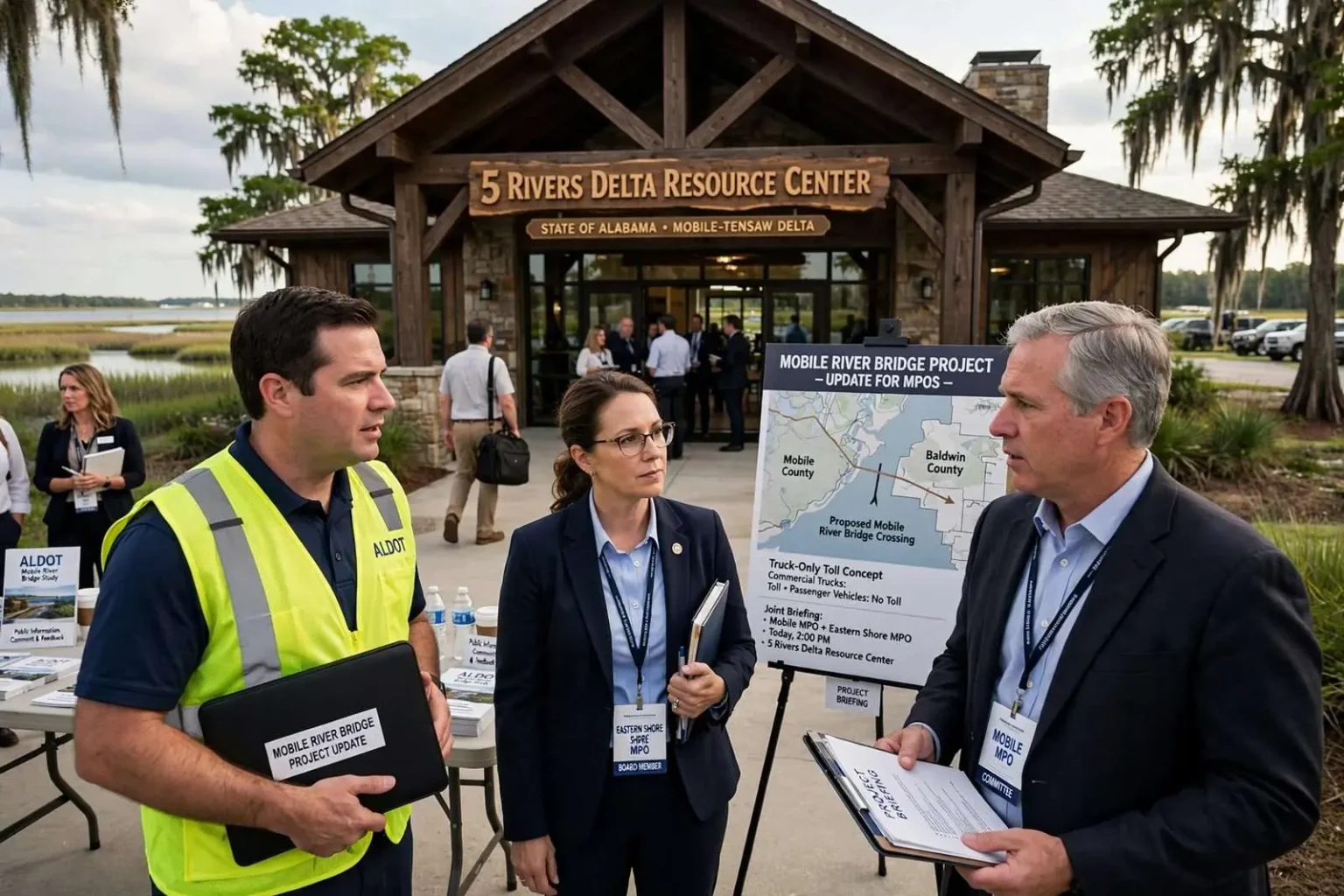
The Alabama Department of Transportation is meeting with members of the Metropolitan Planning Organizations on both sides of Mobile Bay to provide an update on the proposed Mobile River Bridge project. The meeting is scheduled for 2 p.m. at the 5 Rivers Delta Resource Center in Spanish Fort, a state facility on the Mobile-Tensaw delta along the Baldwin County side of the bay that has become a regular gathering point for regional planning discussions.
ALDOT will brief members of both the Mobile Metropolitan Planning Organization and the Eastern Shore Metropolitan Planning Organization on the current status of the bridge project. The joint briefing reflects the way the proposed crossing affects both counties at once: the bridge and its approach routes would carry traffic between Mobile County and Baldwin County, meaning that residents, commuters, and freight haulers on either side of the bay have a direct stake in how the project moves forward.
Metropolitan Planning Organizations, or MPOs, have played an increasingly prominent role in the bridge saga. These federally mandated regional bodies are responsible for transportation planning in urbanized areas, and federal transportation dollars generally cannot be spent on major projects without a place in the long-range plans an MPO adopts. That gives the MPO boards — made up of local elected officials from the cities and counties they represent — significant leverage over which projects advance and on what terms, even though the state department of transportation builds and owns the major highways themselves.
A pivotal role in the toll fight
It was the Eastern Shore MPO that helped defeat ALDOT’s proposed toll over the Mobile River two years ago, when public opposition to tolling forced the project to be shelved. The episode became a defining moment in the project’s decades-long history: after years of study and design work, the prospect of tolls on the new bridge — and on the existing tunnel corridor used by drivers who wanted to avoid it — drew fierce resistance from commuters and elected officials on both sides of the bay.
The opposition coalesced around a simple concern: that a tolled crossing would impose a daily tax on thousands of workers who commute between Baldwin County and Mobile, where many of the region’s jobs, hospitals, and services are concentrated. Baldwin County’s population has grown rapidly for decades, and the vast majority of those new residents still cross the bay for work, school, and shopping. Public meetings drew large, vocal crowds, and the Eastern Shore MPO’s reluctance to endorse the tolling plan effectively stalled the project’s path forward at the time.
Earlier this year, local leaders unveiled a new proposal that would create a truck-only toll over the Mobile River to help reduce traffic congestion. Under that concept, passenger vehicles would cross free of charge, while commercial trucks — which place the heaviest wear on highways and make up a substantial share of the traffic through the tunnel corridor — would pay a toll to use the new crossing. Proponents argued the approach could finance construction without taxing everyday commuters, addressing the objection that sank the earlier plan.
The truck-only concept was shaped, in part, by the region’s role as a freight hub. The Port of Mobile has grown into one of the fastest-growing deepwater ports in the country, and the Montgomery-to-Mobile interstate corridor, along with I-10 itself, moves enormous volumes of freight through the city daily. Every one of those trucks funnels through the same two tunnel crossings that local commuters use, and separating some of that freight traffic onto a new span has been framed as a way to relieve the bottleneck while sharing the cost with the users who place the greatest demands on the system.
Why the bottleneck persists
Because the meeting is billed as an informational update, no formal action is expected. MPO members will hear the current status of the project and have the opportunity to ask questions, but no votes on funding, design, or endorsement are on the agenda. Updates of this kind are a routine part of the planning process, in which ALDOT keeps regional planning bodies informed as studies, environmental work, and financing discussions progress behind the scenes.
The need for a solution, however, is not in dispute among local officials. Traffic congestion between Mobile and Baldwin counties remains a pressing concern, particularly during summer weekends when I-10 gridlock is at its worst. Beach-bound traffic funneling toward the Baldwin County coastal communities stacks up for miles on summer Friday afternoons and Sunday evenings, turning a crossing that takes minutes in mid-morning into an ordeal that can stretch past an hour when vacation traffic peaks.
The daily commute presents a different but equally stubborn problem. The George C. Wallace Tunnel and the older Bankhead Tunnel, which carry I-10 and surface traffic beneath the Mobile River, are narrow two-lane bores that cannot be widened, and their entrance ramps weave together with downtown Mobile’s street grid. Crashes, routine maintenance, and even minor incidents can back traffic up for miles on either side of the river, and the tunnels’ capacity has long since fallen behind the region’s growth.
The Mobile River Bridge project has been discussed for decades as a way to relieve the chronic bottleneck on I-10 through the Mobile tunnel corridor. Study concepts over the years have envisioned a large new crossing south of downtown — with clearance high enough for the port’s tall ships and cargo vessels to pass beneath — paired with a rebuilt interchange connecting the new span to I-10 on both sides of the bay. The vision has persisted through changing administrations and shifting funding landscapes because the underlying problem has never gone away: every vehicle moving between I-10 eastbound and westbound must pass through the same constrained river crossing.
Cost has always been the central obstacle. A bridge of the scale envisioned — one of the tallest structures in the region, with long approaches over wetlands and working waterfronts — carries a price tag in the billions of dollars, far beyond what Alabama’s routine road and bridge funding can cover. That reality is what pushed planners toward tolling in the first place, and it is why the question of how to pay for the bridge remains intertwined with the question of whether to build it at all.
The project’s future design, financing, and tolling structure continue to be key points of debate among state and local officials. Under the truck-only concept, questions remain about how much revenue a truck-only toll would actually generate, whether federal grants or loans could cover the remainder, and how a new span would connect to the existing highway network without adding congestion to local streets. Each of those questions affects the project’s standing in the MPOs’ long-range transportation plans, which is why updates to the MPO boards matter even when no vote is taken.
The federal planning framework gives the two MPOs formal standing in those decisions. Major projects using federal highway funds must appear in a metropolitan area’s approved long-range plan and its shorter-term transportation improvement program, and both documents are adopted by the MPO policy boards. In practical terms, that means ALDOT cannot simply impose a project on the region — it must maintain the support of the local officials who sit on those boards, a dynamic that has shaped the Mobile River Bridge saga from its earliest chapters.
For the officials gathered at 5 Rivers, the meeting offered a chance to measure how far the project has come since the tolling plan collapsed and how much work remains. The 5 Rivers Delta Resource Center, perched at the mouth of the Mobile-Tensaw delta where the rivers meet Mobile Bay, sits in plain view of the landscape any new crossing would transform — a reminder that the decision is not just an accounting exercise but one about the future shape of the region’s economy and environment.
Residents who want to follow the project’s progress can track the MPOs’ meeting agendas, which are published in advance, along with ALDOT’s public information materials for the Mobile River Bridge study. As the truck-only toll proposal moves through evaluation, further briefings and public comment opportunities are expected before any final decisions are made. For now, the two planning bodies on either side of the bay remain the key arenas where the bridge’s future will be argued — and Friday’s update session gave both of them a fresh look at where the decades-old project stands.
The stakes extend well beyond the two counties that touch the bay. I-10 is one of the nation’s primary east-west corridors, linking Florida’s population centers to the rest of the Gulf South, and every through-traveler crossing the region funnels through Mobile’s tunnel bottleneck. Freight interests along the Gulf Coast, from the Port of Mobile to the distribution centers that ring it, have a direct interest in a crossing that keeps freight moving reliably. That wider significance is part of why the project has attracted attention — and potential federal funding interest — beyond what a typical local congestion relief effort would draw.