Spanish Fort’s New $7.8 Million Community Center Nears Long-Awaited Opening
After construction delays, Spanish Fort's new community center, city hall and first public library are expected to open under budget this fall.
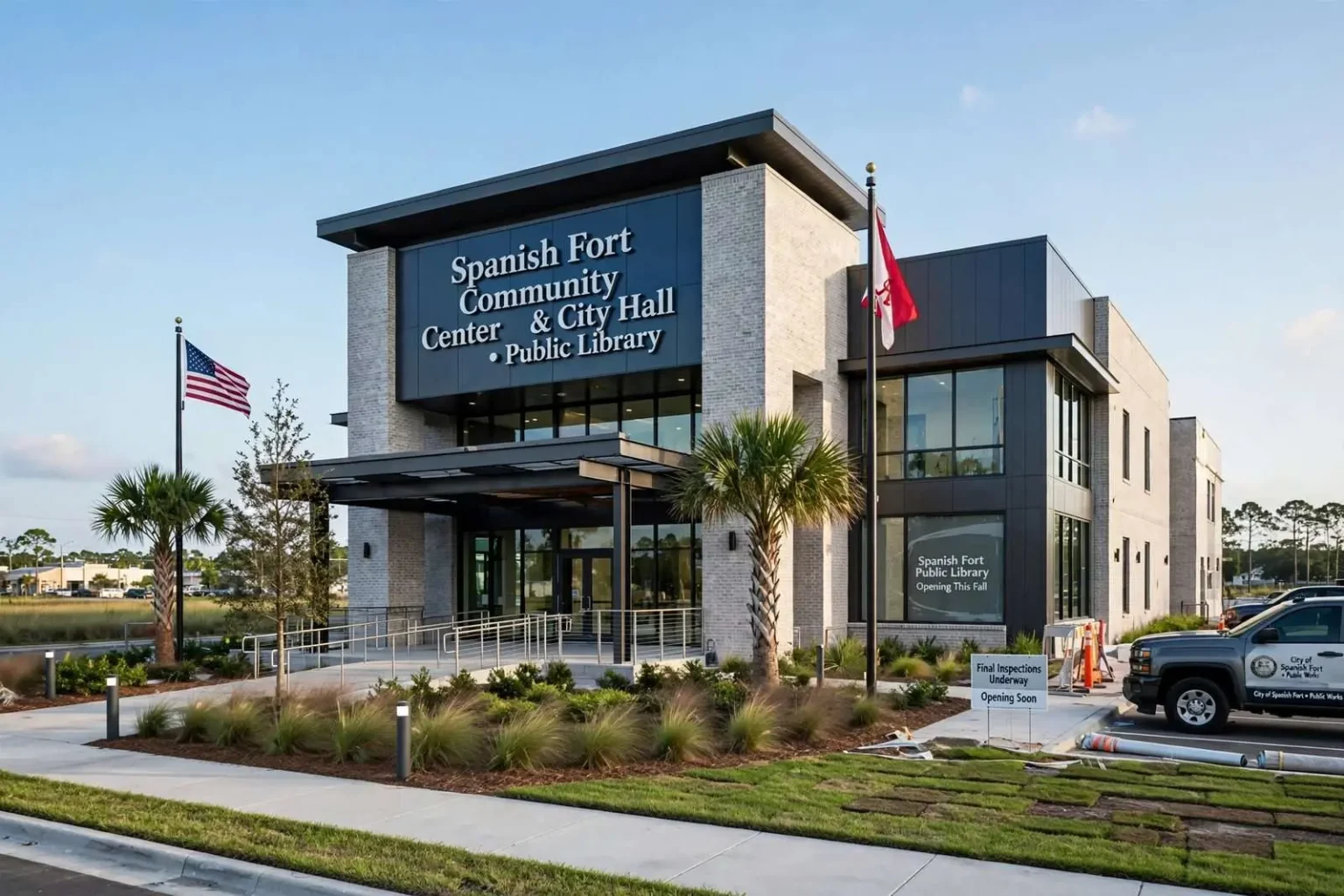
After more than a year of construction delays, Spanish Fort’s new $7.8 million community center and city hall complex is finally nearing completion, with city leaders now targeting a grand opening this fall. Mayor Mike McMillan pushed back on comparisons between the project and Mobile’s much larger and more expensive GulfQuest maritime museum, which faced similar construction setbacks.
The comparison was inevitable in local circles. GulfQuest, the maritime museum built on Mobile’s riverfront, became a cautionary tale across the Gulf Coast after years of delays and cost growth turned its opening into a running civic saga. Spanish Fort’s project, though far smaller in scale, accumulated its own history of subcontractor problems, weather interruptions and sliding timelines, and residents had begun to wonder aloud whether the city would ever see the building finished. McMillan’s argument was straightforward: both projects hit turbulence, but only one of them is finishing under budget.
While both projects experienced lengthy delays, multiple contractor change orders and uncertain opening timelines, McMillan noted the Spanish Fort project is on track to come in under its original budget, unlike the far costlier GulfQuest development. Inspections were scheduled to determine remaining punch-list items, with officials hopeful a certificate of occupancy could be issued within days.
The punch-list stage is the last mile of any construction project, and it is where buildings finally reveal their readiness. Inspectors walk the facility checking fire suppression systems, electrical work, accessibility features and the hundreds of small items — door hardware, trim, fixtures — that must be completed before a municipality can legally occupy the space. For Spanish Fort, a city of roughly 8,000 residents on the Eastern Shore of Mobile Bay, the inspections represented the final hurdle for a project that has dominated the city’s capital planning for years.
The Spanish Fort City Council planned to hold its first meeting inside the new 35,000-square-foot facility in September, with the city’s first-ever public library expected to open around the same time. McMillan set his sights on an October grand opening ceremony, timed symbolically to mark the anniversary of the city’s first council being seated more than two decades earlier.
Originally expected to open roughly a year earlier, the project was slowed by subcontractor issues, wet weather and challenging terrain. Despite those setbacks, the final cost is expected to land nearly $500,000 below original estimates, thanks to savings on furniture costs, library shelving folded into the overall project budget, and lower-than-expected construction interest expenses.
The savings story is unusual enough in municipal construction that city officials repeated it at nearly every update. Furniture packages often balloon on public projects because decisions about chairs, tables and office systems are postponed until the building is nearly done, forcing rushed purchases. By negotiating those items early and folding library shelving — which would otherwise be a separate procurement with its own markup — into the general contract, the city trimmed costs without cutting scope. Lower construction interest also reflected disciplined sequencing: the city drew bond proceeds as needed rather than borrowing the full amount up front, reducing the interest that accumulated during construction.
City officials emphasized a conservative financing approach, opting for a 15-year bond to repay the project rather than the 30-year notes many municipalities use for large construction projects. Annual repayment is expected to run around $420,000, with the debt retired well within the standard repayment window used by comparable government projects.
The choice of a 15-year bond carries real consequences for the city’s balance sheet. Thirty-year notes lower annual payments and free up operating cash in the short run, but they roughly double the total interest paid over the life of the debt and obligate future councils to service obligations for a generation. A 15-year schedule demands more from the annual budget — roughly $420,000 a year in this case — but retires the debt while the building is still young. For a growing city on the Eastern Shore, where sales and property tax collections have trended upward with the population, officials judged the faster payoff the wiser course.
The centerpiece of the new complex will be Spanish Fort’s first public library, a milestone for a city that has never had one of its own. Until now, residents of Spanish Fort who wanted a public library have driven to Daphne or elsewhere in Baldwin County, since the county’s library system grew up around older municipalities before Spanish Fort’s rapid residential expansion. A library inside the community center gives the city an anchor institution — a place for children’s programming, job searches, senior activities and study space — within the same walls as city hall.
How the City Grew Into the Project
Spanish Fort’s transformation helps explain why the complex matters so much to the city. Incorporated in its modern form in the 1990s, the city grew explosively in the following two decades as suburban development spread along Highway 31 and the Eastern Shore corridor, adding shopping centers, subdivisions and thousands of new residents. For most of that growth, the city operated out of modest quarters with limited public amenities. A combined city hall, community center and library represents the city’s arrival as a full-service municipality, capable of housing its government and serving its residents’ civic life under one roof.
The site itself sits in the heart of the city’s commercial corridor, making the facility accessible to residents across Spanish Fort. The community center portion is designed to host public meetings, civic events, receptions and the everyday gatherings — club meetings, birthday parties, exercise classes — that give a city of Spanish Fort’s size its social infrastructure. City officials have described the building as the most significant public investment in the city’s short history, and the council’s decision to pair it with the first library doubled its civic weight.
Delays, But a Different Ending
The construction troubles that slowed the project were the kind familiar to anyone who builds in south Alabama. Subcontractors who win bids sometimes fail to perform, forcing general contractors to find replacements and negotiate change orders that push schedules. The Gulf Coast’s climate adds its own hazards: sustained wet weather can stall earthwork and exterior finishes for weeks, and the region’s sandy, clay-laced terrain posed drainage and foundation challenges that had to be engineered around. Each issue was managed without letting the budget slip, a fact McMillan clearly wants recorded in the public mind as the city moves past the frustrations of the past year.
The contrast with GulfQuest’s trajectory was the subtext of every officials’ comment. The Mobile museum’s troubles — change orders, financing gaps and an opening pushed back repeatedly — cost millions beyond early estimates and tested public patience. Spanish Fort’s smaller project weathered similar storms and still came in below budget, and city leaders hope the distinction will stand as evidence that the city manages its money the way residents expect: conservatively, transparently and with an eye on the long term.
What Opens This Fall
When the doors open, residents will find a 35,000-square-foot complex built to serve the city for decades. The council will conduct its business in a proper chamber rather than borrowed space, staff will work in offices designed for the city’s actual operations, and the library will offer Baldwin County’s newest collection of books, media and public computing. The October grand opening, timed to the anniversary of the city’s first council, gives the milestone a historical frame: a city seated more than two decades ago finally opening the civic home its growth has long demanded. After a year of delays, punch lists and inspections, the fall calendar now counts down to the date Spanish Fort’s residents have been waiting for.
The library’s arrival also fits into a wider expansion of library service across Baldwin County, one of the fastest-growing counties in Alabama. The county’s population growth has stretched every public service, and libraries have been among the most visible pressure points, with existing branches in older cities reporting heavy usage from new residents. Spanish Fort’s decision to build its own facility rather than wait for county expansion reflects both the city’s fiscal independence — supported by its own sales tax base from the commercial corridor — and the priority its residents placed on having library service within city limits.
City hall’s move into the complex consolidates operations that had been scattered for years. Municipal employees who once worked from aging quarters will share a building designed around the city’s actual needs, from the council chamber to administrative offices to space for public meetings. Consolidation carries practical benefits beyond convenience: shared utilities, shared security and shared parking reduce operating costs over the life of the building, and a single public entrance makes city services easier for residents to navigate. For a city that has never had purpose-built municipal space, the efficiency gains compound every year the building operates.
Community leaders have also pointed to the project’s symbolism for the Eastern Shore as a whole. Along the corridor from Daphne through Spanish Fort to Fairhope, municipalities have invested in civic infrastructure as their populations have swelled, and each new facility raises expectations for the next. Spanish Fort’s complex — completed under budget and on a conservative financing plan — sets a benchmark its neighbors will be measured against. If the certificate of occupancy arrives in the coming days as officials hope, the city will spend its fall settling into a building that is part workspace, part library and part statement about what a small, fast-growing Gulf Coast city can accomplish when it manages its money carefully.