Fairhope Road Closures Scheduled for Sept. 2-3 Along Nichols Avenue for Utility Work
Two road closures are scheduled in Fairhope on Sept. 2 and 3 for utility maintenance work. Residents are advised to plan alternate routes.
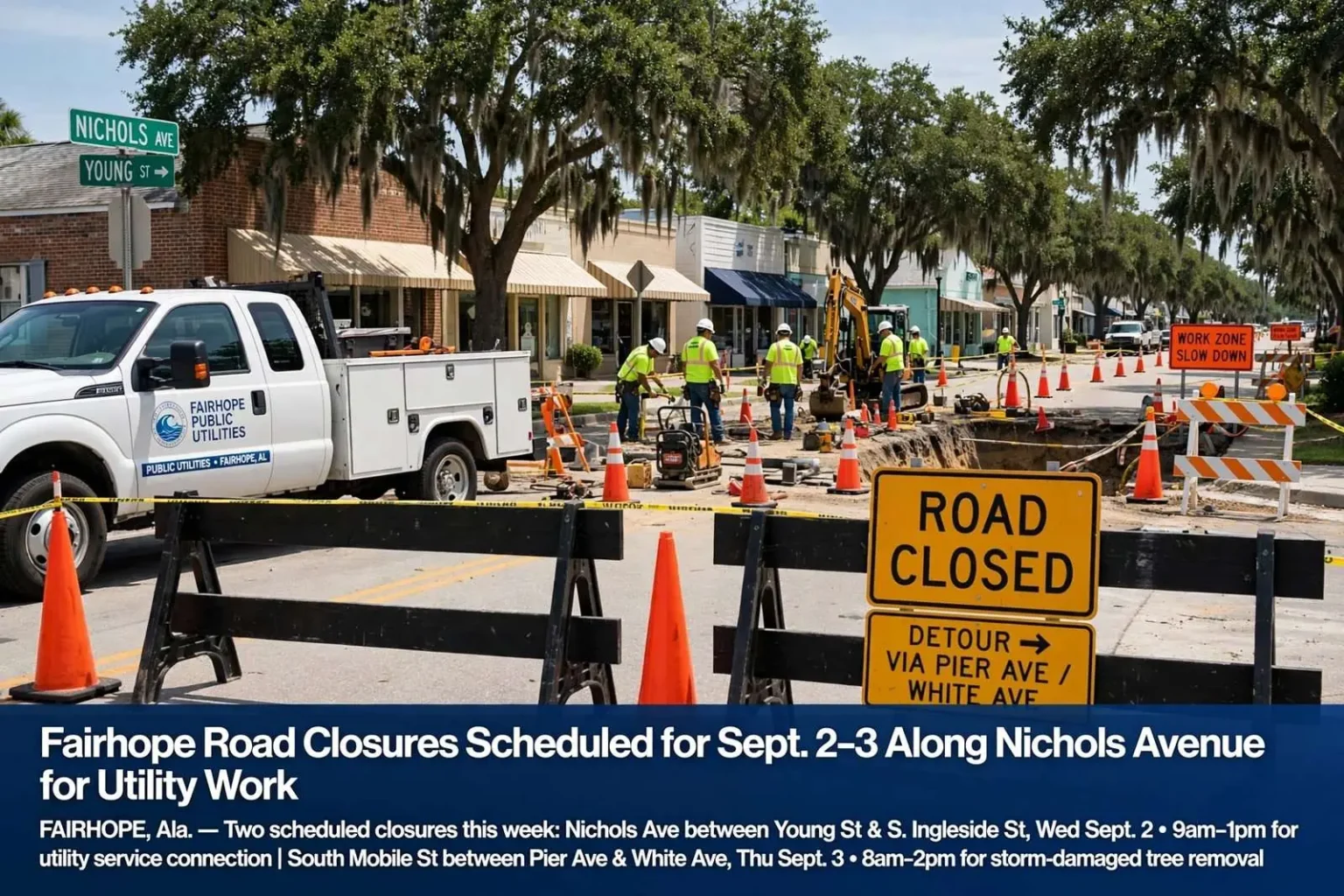
FAIRHOPE, Ala. — Drivers in Fairhope should expect two separate road closures this week as utility crews carry out a residential service connection and remove storm-damaged trees, according to Fairhope Public Utilities.
The first closure affects Nichols Avenue, which will be shut down between Young Street and South Ingleside Street from 9 a.m. to 1 p.m. Wednesday, Sept. 2, while crews complete a residential utility service connection. The second closure will affect South Mobile Street between Pier Avenue and White Avenue from 8 a.m. to 2 p.m. Thursday, Sept. 3, while crews remove multiple storm-damaged trees from the area.
Detour Routes and Pedestrian Access
During both closures, traffic will be detoured using Pier Avenue, Nichols Avenue and White Avenue, according to the utility. The sidewalk in the work area will also be closed for the duration of each project, meaning pedestrians in the affected blocks will need to find alternate routes as well.
Fairhope Public Utilities is asking drivers to plan ahead, follow posted detour signs, and use caution around crews working in these areas. The utility has not indicated that either closure is expected to extend beyond its scheduled window, though weather and the complexity of the work can sometimes affect how long a crew needs to be on site.
Why the Work Is Happening
The Nichols Avenue closure is tied to a residential utility service connection, the kind of work municipal utilities routinely perform when a property needs a new or upgraded tie-in to water, sewer, or electric lines. That work often requires digging in or near the roadway itself, which is why crews need the street closed to through traffic rather than simply working around passing vehicles.
The South Mobile Street closure is being driven by a different need: the removal of multiple storm-damaged trees. Coastal Alabama sees frequent tropical weather, high winds, and heavy rain, all of which can leave trees compromised well after a storm has passed. Trees weakened by wind or saturated soil can pose an ongoing hazard to drivers, pedestrians, and nearby property if they are not removed, which is why utilities and public works crews often prioritize this kind of cleanup even weeks or months after the weather event that caused the damage.
How Municipal Utilities Plan Road Closures
Road closures like the ones scheduled for Nichols Avenue and South Mobile Street are a routine part of how local utilities maintain and expand infrastructure. Before a closure goes into effect, utility staff typically evaluate the scope of the work, estimate how long it will take, and identify a detour route that keeps traffic moving through the area with as little disruption as possible. Closures are generally scheduled for daytime hours on weekdays, both to take advantage of natural light and because that is when utility crews and equipment are most readily available.
Coordinating a closure also usually involves notifying affected residents and businesses in advance, posting detour signage, and in some cases coordinating with local law enforcement or public works departments to help manage traffic flow. For work that involves digging near underground lines, crews are also required to have utility lines marked in advance to avoid accidentally striking gas, water, sewer, or electrical infrastructure that is not the target of the work itself.
Short, well-defined closure windows like the ones announced for this week are generally preferred over open-ended closures because they allow residents to plan around the disruption rather than face uncertainty about when a street will reopen. That is part of why the city and utility provided specific start and end times rather than a general closure notice.
Staying Safe Around Work Zones
Traffic safety officials and utility companies routinely urge drivers to slow down, stay alert, and avoid distractions when approaching any active work zone, whether it involves a utility crew, a paving project, or storm cleanup. Work zones often place crew members and equipment close to the edge of a travel lane or directly in a roadway, and workers on foot are especially vulnerable to distracted or speeding drivers.
Common safety guidance for navigating work zones includes reducing speed well before reaching the posted work area, following detour signs rather than attempting to cut through a closed section of roadway, watching for flaggers or temporary signals directing traffic, and leaving extra following distance in case vehicles ahead need to stop or slow suddenly. Drivers are also generally advised to avoid using cell phones or other distractions while passing through a marked work zone, since even a brief lapse in attention can be dangerous when workers and equipment are operating close to traffic.
For pedestrians affected by a sidewalk closure, safety guidance typically recommends using the marked detour rather than walking in an active roadway or around barricades, since work zones can involve open trenches, heavy equipment, or overhead hazards from tree removal that are not always obvious from a distance.
Fairhope Public Utilities and Local Infrastructure
Fairhope is one of a relatively small number of Alabama cities that operates its own municipal utility system, providing electric, water, sewer, gas, and other services directly to residents rather than relying solely on private utility companies. Municipally owned utilities like Fairhope’s are typically responsible for maintaining the full range of local infrastructure, from underground water and sewer lines to the electric grid, which means their crews handle everything from routine service connections to emergency storm response.
That structure gives the city more direct control over how and when maintenance work is scheduled, but it also means the utility is directly responsible for tasks that in other cities might be split among several different providers, including hazard mitigation work like removing storm-damaged trees near roadways and utility lines. Regular maintenance of this kind, while sometimes disruptive in the short term, is generally aimed at preventing more serious outages, hazards, or infrastructure failures later on.
As Fairhope has continued to grow, demand on its water, sewer, and electric systems has grown as well, making routine maintenance and new service connections a consistent part of the utility’s workload. City officials have generally framed short-term closures like these as a necessary tradeoff for keeping the broader system reliable, particularly heading into a season when storms can add unplanned repair work on top of already-scheduled projects.
Storm Season and Tree-Related Hazards
The South Mobile Street closure, driven by storm-damaged tree removal, reflects a recurring challenge for coastal Alabama communities during the late-summer and fall storm season. Tropical systems moving through the Gulf can bring sustained high winds and heavy, prolonged rainfall that saturates soil around tree root systems, leaving trees structurally weakened even when they remain standing after a storm passes. In many cases, the visible damage from a storm, downed limbs, snapped trunks, uprooted trees, is addressed quickly, but a broader assessment of which remaining trees pose an ongoing risk can take considerably longer.
Utilities and public works crews generally prioritize tree removal near roadways, sidewalks, and overhead power lines because a tree that falls unexpectedly in those areas can cause traffic accidents, power outages, or injury. Removing a compromised tree in a controlled, planned manner, with a road closure to keep both the public and the work crew safe, is standard practice for this kind of hazard mitigation. It typically involves specialized equipment and trained arborists or line crews working in tandem, particularly when a tree is close enough to power lines or other infrastructure that its removal could otherwise create a secondary hazard.
Keeping Up With Local Closure Notices
Municipal utilities like Fairhope Public Utilities typically rely on a mix of public notices, social media updates, and local news coverage to inform residents about upcoming closures. Because closures like these are often driven by work orders that come together on relatively short notice, especially storm-related cleanup, residents who travel frequently through affected corridors are generally encouraged to check for updates in the days leading up to a scheduled closure rather than assuming a previously announced schedule remains unchanged.
For residents who rely on Nichols Avenue or South Mobile Street for their daily commute, school drop-off, or business deliveries, planning an alternate route in advance, rather than waiting to encounter a closed street, can help avoid delays during the posted closure windows. Local businesses along or near the affected corridors may also see brief disruptions to customer traffic during the closure periods, which is part of why utilities generally try to keep such closures as short and clearly defined as possible.
What Drivers Should Know
Residents who regularly travel through the Nichols Avenue or South Mobile Street corridors this week should plan to use the posted detour route via Pier Avenue, Nichols Avenue and White Avenue, or consider an alternate route entirely during the posted closure windows. Both closures are scheduled to last several hours rather than a full day, and the utility has indicated the work should be completed within each posted window barring unforeseen complications.
Fairhope Public Utilities has encouraged residents to reach out directly with questions about either project or about the detour routes in place during the closures. As with any temporary road closure, conditions can shift based on how the work progresses, so drivers in the area are advised to watch for updated signage in the event either project runs longer than currently scheduled.