Coastal Alabama Community College President Gary Branch Announces Retirement After 37 Years
Coastal Alabama Community College President Gary Branch, who has led the Bay Minette-based school since 1981, announced his retirement this week, citing health concerns after 37 years at the helm.
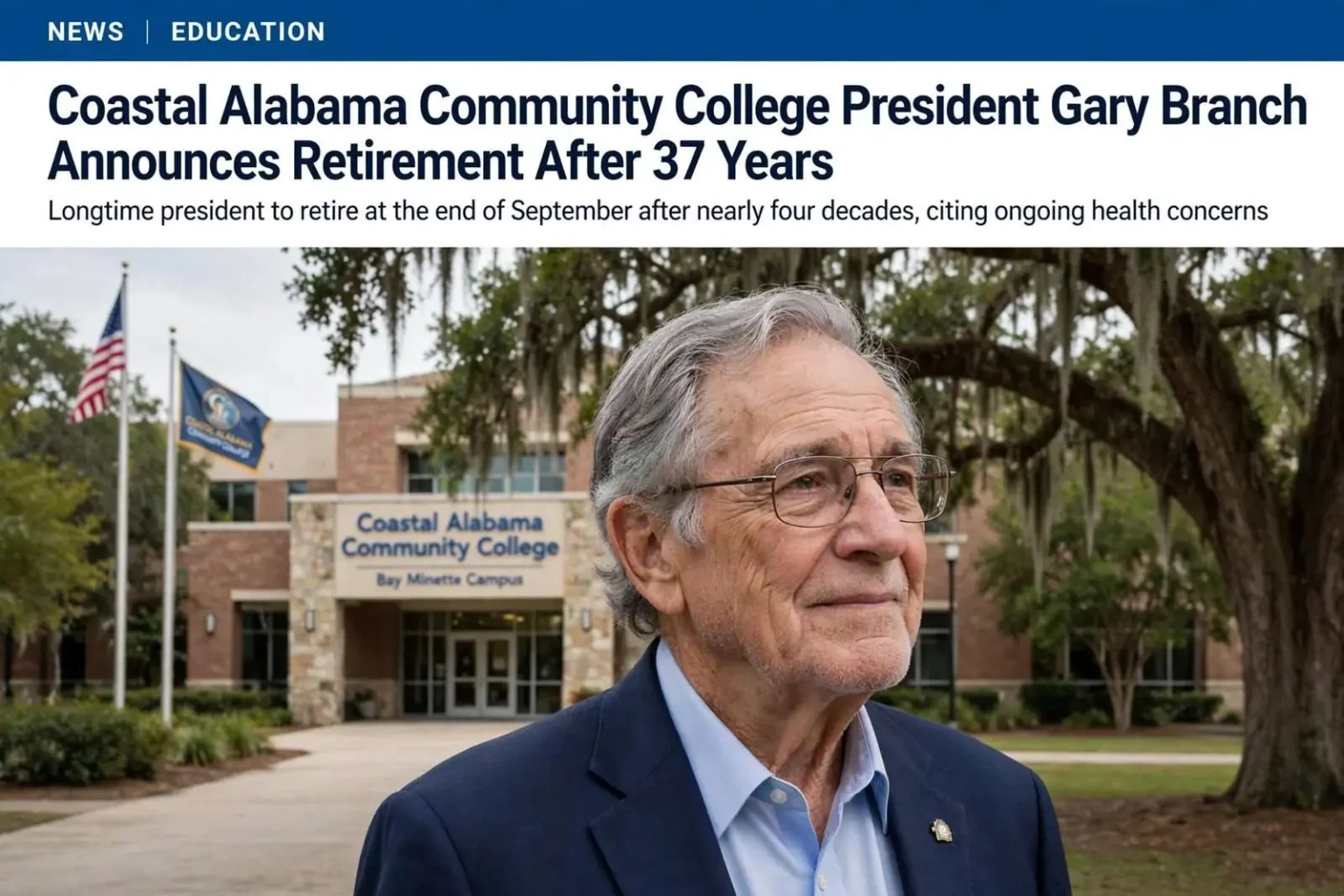
Gary Branch, the longtime president of Coastal Alabama Community College, has announced he will step down at the end of September, citing ongoing health concerns after nearly four decades leading the Baldwin County-based school. Branch, who will turn 76 later this year, delivered the news in an emotional address to college employees, telling them that the phrase “I love students” sums up the legacy he hopes to leave behind.
Branch’s tenure is believed to be one of the longest of any sitting community college president in the country. He took the helm in 1981, when the institution was known as Faulkner State Junior College and operated a single campus in Bay Minette. Under his leadership, the school grew into Coastal Alabama Community College, now spanning 10 campuses and 16 instructional sites across Southwest Alabama, with enrollment climbing from roughly 1,100 students to nearly 8,000. Few American higher-education executives have led a single institution through so much growth, and fewer still have done it at the same school for 37 years.
From one campus to a regional network
Much of that growth came through the addition of campuses in Fairhope and Gulf Shores, expansions that brought higher education access closer to fast-growing communities along the Eastern Shore and the Baldwin County coast. When Branch arrived in 1981, Baldwin County students who wanted more than the Bay Minette campus offered often faced long drives; by the end of his tenure, the college was operating full-service facilities within a short commute of Fairhope’s downtown, the Gulf Shores beach communities and the populations that boomed along both corridors.
The current footprint of the college is also the product of a major consolidation that merged Faulkner State with Alabama Southern Community College and Jefferson Davis Community College into a single institution, a process Branch oversaw in the college’s most recent chapter. The merger stitched together institutions spread across southwest and south-central Alabama — from the Mississippi line to the Black Belt — under one administration, one accreditation and one set of academic policies. Consolidations of that scale are rare in American community colleges, and the one Branch managed became a case study in how to combine missions, faculties and communities that had never before shared a name.
Branch has said the merger, while complex, was not the hardest part of his final years on the job. “The past two years have been the most difficult of my life,” he told employees, “not because of the consolidation, but because of the health issues that I’ve had.” He has undergone three major surgeries in recent years, with the possibility of another in the coming months, and said his doctors and family had urged him to scale back his responsibilities. The admission was characteristic of the directness employees described: the president who had told them for decades to take care of themselves was finally taking that advice.
An early decision that defined a presidency
Reflecting on his career, Branch pointed to one of his earliest decisions as president as emblematic of the institution he wanted to build. Shortly after taking office in 1981, he ordered the removal of a Confederate flag that had been prominently displayed behind the desk in the president’s office. “I wanted this institution to be a place where every student felt welcome,” he said of the decision — a move that predates by decades the national conversations that would eventually surround such symbols, and one that set a tone for a college whose campuses serve student bodies drawn from rural, urban and coastal communities alike.
Branch also guided the college through a serious financial crisis early in his presidency, a period he has described as one of the most precarious in the school’s history. The young president inherited budgets that threatened the institution’s basic operations, and the lessons of that struggle — lean administration, diversified programming and disciplined planning — became fixtures of his management style. Colleagues say that experience shaped his approach to budgeting and long-term planning for decades afterward, helping steady an institution that has since become a fixture of workforce training and higher education access across the region.
Under Branch, the college’s workforce mission grew alongside its transfer programs. The campuses along the Gulf Coast positioned the institution to train workers for the region’s expanding industrial and service economy — aviation and manufacturing along the I-10 corridor, healthcare up and down the Eastern Shore, hospitality in the beach communities — while the smaller rural sites inherited from Alabama Southern and Jefferson Davis kept two-year education within reach of towns that had no other access to it. Faculty and staff often describe the college’s identity as exactly that double commitment: close enough to home for a first-generation student, sophisticated enough to feed the region’s employers.
Branch’s announcement also closes one of the longest chapters of institutional leadership in the Alabama Community College System. During his time at the helm the college weathered changing funding formulas, the growth of dual-enrollment programs that now put high school students on community college campuses across the state, and the technological transformation of instruction itself. The Bay Minette campus where he started remains the institution’s home, but the idea of “the college” — as employees still call it — now stretches across a swath of Alabama larger than several states.
The farewell
At his retirement announcement, Branch downplayed his own role in the college’s growth, crediting faculty and staff for the institution’s success. “I give you the support that you need, the encouragement that you need,” he said. “I don’t do it, you do it. I’m so proud that I had the wisdom and the ability to offer you a career.”
Addressing employees for what is likely the last time before he steps down, Branch expressed confidence that faculty and staff would extend the same loyalty and dedication to whoever succeeds him. “I know you will because I’ve experienced that,” he said. “So to whoever it is who follows me, I can just say that I’m leaving this college in a whole lot better shape than it was in when I arrived. This is considered to be one of the crown jewels in our system because of the things we do together.”
Employees who attended the announcement described an emotional room. The president who had hired many of them — in some cases, their parents before them — was saying goodbye, and the applause that followed his remarks carried the weight of careers built under his tenure. In an era when community college presidencies commonly last five to seven years, the idea of an institution whose staff largely grew up under one leader is itself a piece of Alabama higher-education history coming to a close.
What comes next
College officials have not yet announced a timeline for naming Branch’s successor. Under the Alabama Community College System’s governance structure, presidential searches are conducted with the involvement of the system chancellor’s office, with input from campus constituents, and the final appointment rests with the system’s leadership. The next president will inherit a merged institution still working through the long-term integration of its inherited campuses, an enrollment recovery in a state where community college headcounts have faced pressure, and a workforce-training portfolio that Gulf Coast economic developers regard as central to the region’s competitiveness.
The succession question carries particular weight because of the college’s geographic spread. A president now must govern campuses and sites separated by hundreds of miles, from Bay Minette to communities along the Tombigbee River, and balance the distinct needs of Baldwin County’s fast-growing suburban populations with those of the Black Belt counties the merger brought under the college’s wing. Whoever follows will be filling shoes measured, in many respects, by 37 years of accumulated trust.
Health concerns, Branch indicated, leave him no comfortable alternative to stepping aside now. After three major surgeries and the prospect of another, he told employees that continuing to carry the responsibilities of the presidency would be unfair both to his family and to an institution that needs a leader at full strength. Those who have worked with him describe the decision as consistent with the man: a president who asks a great deal of others but never less of himself.
Branch’s retirement, effective at the end of September, closes out a 37-year run that spans more than half his life and reshaped higher education access throughout Southwest Alabama. From a single Bay Minette campus serving about 1,100 students to a 10-campus, 16-site institution serving nearly 8,000, the college that grew up under Gary Branch now stands as one of the largest community college systems in the state — and, by his own telling, a place built on a single conviction: that he loved students, and that the institution should make them feel it every day.