Labaron Philon Returns to Baker High School, Tells Young Campers to ‘Dare to Dream’
Mobile native and Philadelphia 76ers guard Labaron Philon returned to Baker High School for his Philon Skillz Camp, encouraging young campers to chase their own basketball dreams.
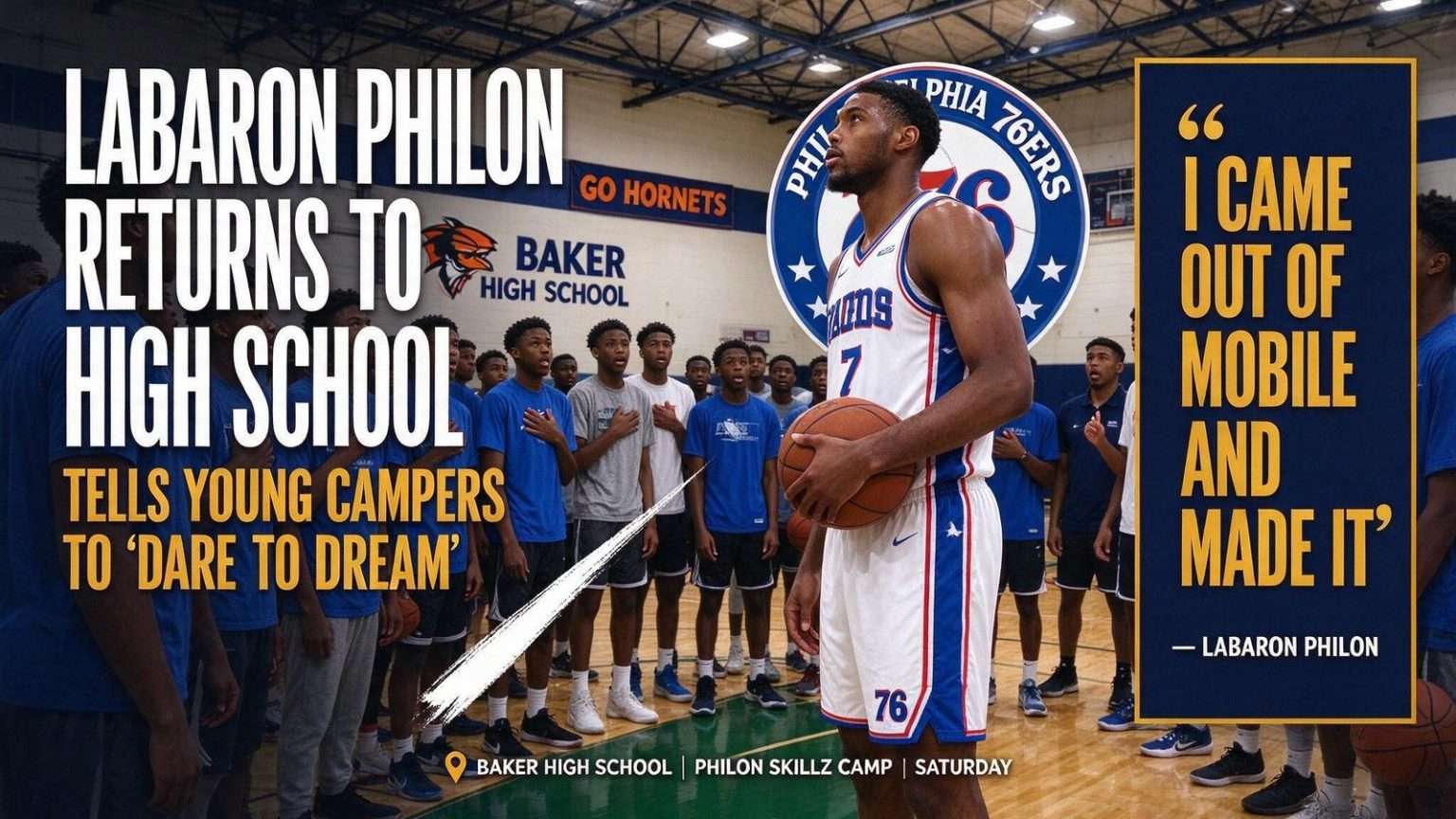
Labaron Philon returned home Saturday to the gym at Baker High School for the Philon Skillz Camp, walking back into the same building where his own basketball journey began as a rising freshman dreaming of a professional career. Six years later, Philon is a teammate of LeBron James and fellow superstars Jaylen Brown, Joel Embiid, and Tyrese Maxey on the Philadelphia 76ers — and his message to the young campers gathered at Baker was simple: dare to dream like he did.
“I Came Out of Mobile and Made It”
“I want everyone to know their dreams can come true,” the first-round NBA draft pick told campers. “I came out of Mobile and made it, so you can, too. But you have to be a professional in everything you do.”
That message — treating even the smallest details of preparation like a professional — has been instilled in Philon since his earliest days at Baker High School, according to head coach David Armstrong, who helped run this weekend’s two days of camps alongside Philon. “I knew pretty quickly how good he could be, so I started trying to treat him like he was going to be special,” Armstrong said. “I wanted to make sure he knew that if he wanted to do this for a career it was going to be more than being just an ordinary high school student and basketball player.”
Armstrong described a standard of accountability that shaped Philon well before scouts and draft boards ever took notice. “He was held to a standard and made sure he did everything the right way. He learned how to be a leader,” Armstrong said. “So, it’s great for these kids to be around him and see what kind of person and worker he is.”
From Baker High School to the NBA Draft
Philon was selected No. 22 overall in the most recent NBA Draft, capping a two-year college career at Alabama during which he earned First Team All-SEC honors. That draft slot places Philon squarely in the late-lottery-to-mid-first-round range, a range that has produced its share of NBA rotation players and, occasionally, breakout stars — and one that came with the added twist of Philon landing on a roster that added James and Brown after Philon himself had already been drafted, suddenly surrounding the rookie with three future Hall of Fame-caliber talents in James, Brown, and Embiid.
For a young player entering the league, few landing spots carry more immediate pressure — and more immediate opportunity to learn — than a roster stacked with players of that caliber. Rookies drafted into situations with established stars often face a steep adjustment in playing time and role, but also gain access to a level of daily mentorship and habits that can accelerate their development in ways a rebuilding roster typically cannot offer.
Getting Comfortable Among Superstars
Philon said he has already moved past any sense of being starstruck by his new teammates, crediting an earlier connection to James through youth basketball circles. “I’ve met LeBron before from being around his kids at basketball tournaments,” Philon said. “Being in the NBA, first of all, was a dream of mine. But to be able to play with a lot of superstars was second on my list. I’m just embracing it and learning from what they’ve been through and what they have to teach me.”
Philon also described settling comfortably into his new city and role heading into his rookie season. “I live in Philly and the people there are already showing me love everywhere I go,” Philon said. “My role on the team is going to be really simple. I don’t have to do as much. We’ve got a lot of great guys. I just have to be me and make the right basketball plays.”
Giving Back to the Community That Raised Him
The Philon Skillz Camp itself reflects a common thread among athletes who reach the professional ranks from smaller markets like Mobile: a deliberate effort to return home and invest directly in the next generation of local talent, rather than simply becoming a distant success story. By hosting the camp at Baker High School — the same gym where Armstrong first began treating him like a future professional — Philon created a direct, tangible link between his own path and the aspirations of the kids now filling that same gym.
The Philon Skillz Camp continued Sunday for campers ages 6 to 12, giving a broader age range of young athletes in the Mobile area a chance to train under, and hear directly from, a hometown player now playing at the highest level of professional basketball. For a city that has produced its share of athletic talent across multiple sports, Philon’s camp offers a rare, direct pipeline between an NBA locker room and the gym floor where a Mobile kid’s own basketball dream first took shape.
Mobile’s Track Record of Producing Basketball Talent
Philon’s path from Baker High School to a first-round NBA selection adds to a lineage of basketball talent to emerge from the Mobile area over the years, a track record local coaches and youth programs often point to when encouraging young players to commit to serious, disciplined training from an early age. Stories like Philon’s — a hometown player rising through high school ball, into a productive college career, and ultimately into the NBA — carry particular weight in mid-sized markets like Mobile, where opportunities to see a homegrown athlete reach the highest level of a sport are less frequent than in major metropolitan areas with larger talent pools and more extensive basketball infrastructure.
Philon’s two-year college career at Alabama, capped by a First Team All-SEC selection, situated him within one of the most competitive conferences in college basketball, a proving ground that NBA scouts weigh heavily precisely because of the level of competition SEC programs face on a nightly basis during conference play. That trajectory — a productive, relatively short college career followed by a first-round selection — has become an increasingly common path for elite prospects in the modern one-and-done and two-and-done era of college basketball recruiting.
\n
Camps as a Bridge Between Generations
\n
Youth skills camps hosted by professional athletes, like Philon’s weekend camp at Baker High School, serve a function beyond basic basketball instruction: they give young campers direct exposure to what disciplined, professional-level preparation actually looks like, delivered by someone who walked the same hallways and played on the same gym floor not many years earlier. That proximity — a current NBA player training kids ages 6 to 12 in the same building where his own coach first started treating him “like he was going to be special” — creates a uniquely credible message about what’s possible for a young athlete willing to put in the work, reinforced by a messenger the campers can see themselves in far more easily than a distant NBA star with no connection to their community.
Alabama’s Rise as an NBA Pipeline
Philon’s path to the NBA ran through a University of Alabama program that has, over the past several seasons, built a reputation as one of college basketball’s most reliable pipelines to the professional ranks. Under head coach Nate Oats, the Crimson Tide have embraced an aggressive, three-point-heavy, up-tempo style that has consistently produced NCAA Tournament appearances and a steady stream of NBA draft picks, giving Alabama a level of pro basketball relevance that stands in contrast to the program’s football-dominated athletic department. That style of play — heavy ball movement, spacing, and pace — has also proven attractive to NBA scouts, since it asks college players to operate in ways that translate more directly to professional offensive schemes than more traditional, half-court-oriented college systems. For a player like Philon, spending two seasons inside that system against SEC competition gave him a level of exposure and in-game evaluation that few college conferences can match, since SEC basketball has itself grown into one of the deepest conferences in the country in recent years, sending a large number of players into the draft in back-to-back cycles.
Understanding the Modern NBA Draft Path
Being selected 22nd overall places Philon at the back end of the first round, a slot that under the NBA’s rookie salary scale still guarantees a multi-year contract, unlike second-round picks, who typically must negotiate non-guaranteed deals and fight for a roster spot each offseason. Late first-round picks occupy a particular niche in NBA roster-building: teams drafting in that range are frequently either playoff or championship-caliber clubs picking near the bottom of the first round, or teams that have traded into that slot specifically targeting a player they believe was undervalued relative to where the broader league projected him. The 76ers, a franchise that has spent recent seasons built around former MVP Joel Embiid and has continued adding proven stars to its roster, represent the former scenario — a team drafting for immediate depth and long-term development rather than a rebuilding club prioritizing a rookie’s minutes above all else. That context helps explain why Philon described his own role as deliberately modest heading into his first season, since young players entering a roster with championship aspirations typically earn playing time gradually by proving reliability in a smaller role before being trusted with an expanded one.
How Youth Skills Camps Fit Into Grassroots Basketball
Camps like the one Philon hosted at Baker High School occupy a distinct place within the broader ecosystem of youth basketball development that has grown increasingly organized and competitive over the past two decades. Beyond school and recreational league programs, many young players today progress through AAU and travel basketball circuits, private skills training, and camps hosted by current or former college and professional players, all layered on top of traditional high school basketball. A camp led directly by a hometown NBA player carries particular value within that ecosystem because it offers young athletes something most travel-circuit training cannot: a direct, credible link to a specific, familiar path from their own community to professional basketball, delivered by someone who can speak firsthand to the daily habits — treating even small details like a professional, as Philon put it — that separate players who advance from those who plateau. For families in a mid-sized market like Mobile, where opportunities to train directly under an active NBA player are relatively rare compared with larger basketball hotbeds, camps like this one can function as both skills instruction and a tangible source of motivation for campers who may not otherwise picture a realistic path from their own gym to the league.