Prichard Crews Respond to Water Main Break in Eight Mile Area
The Prichard Water Works & Sewer Board sent crews to address a water main break in the Eight Mile area that left some residents with low pressure or a temporary service stoppage.
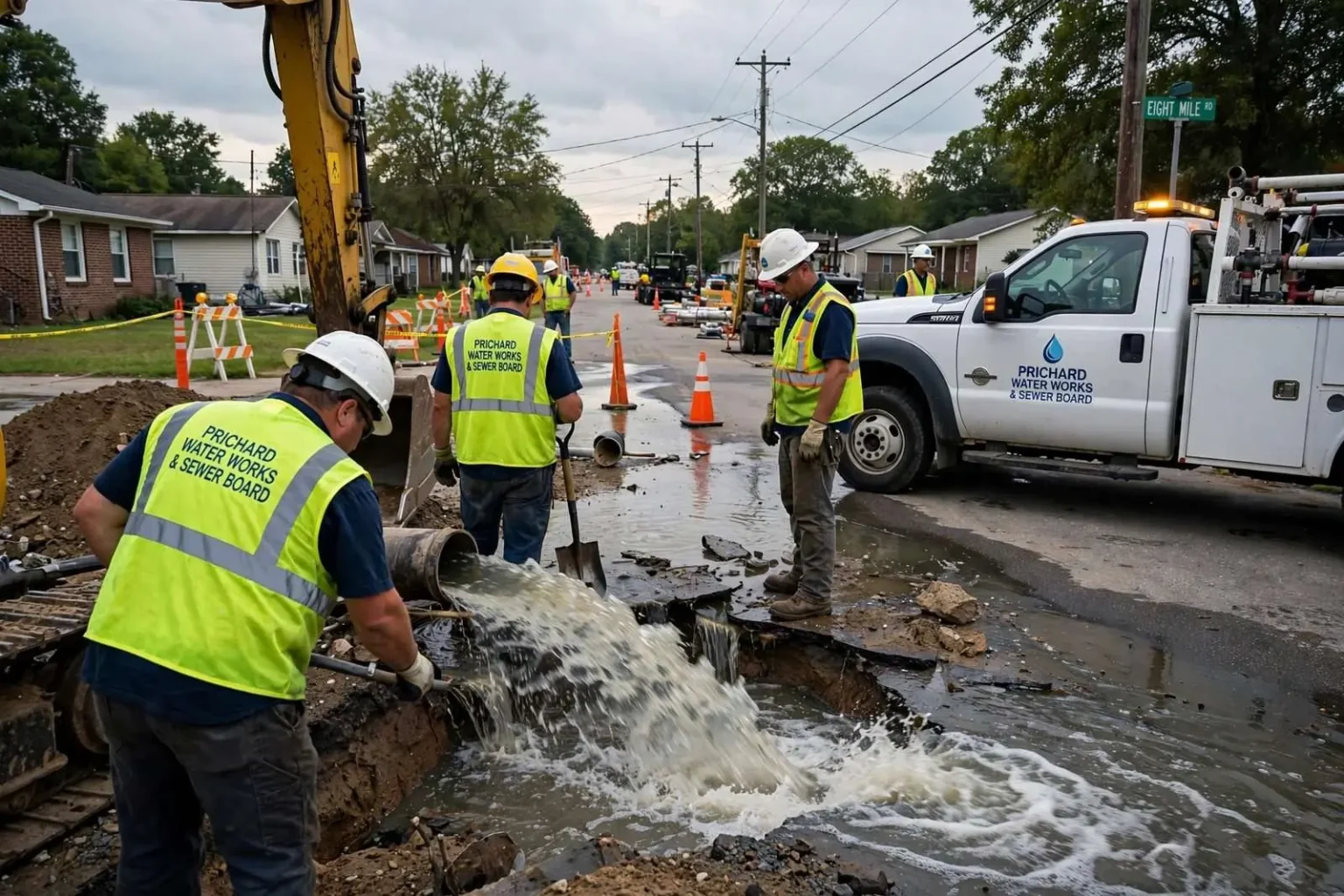
The City of Prichard says crews responded Friday afternoon to a water main break in the Eight Mile area, an incident that left some residents in the surrounding neighborhood with reduced water pressure or a temporary interruption in service while repairs were made.
What Happened
According to a Facebook post from the Prichard Public Services Department, the water main break occurred Friday afternoon, Aug. 28, in the Eight Mile area. The Prichard Water Works & Sewer Board responded to reports of water pouring from the main and dispatched crews to address the break, a standard emergency response protocol for a system component whose failure can quickly waste large volumes of treated water and disrupt service to surrounding customers.
Officials said residents in the affected areas could experience low water pressure or a temporary stoppage in service until crews completed repairs. Utilities typically issue that kind of advisory both to manage customer expectations and to provide practical guidance, since a sudden pressure drop can sometimes be mistaken by residents for a separate plumbing issue within their own homes rather than a system-wide utility problem.
Why Water Main Breaks Happen
Water main breaks are a common challenge for municipal utilities managing aging underground pipe networks, particularly in older sections of a city’s distribution system. Common causes include pipe corrosion that develops over decades of use, shifting soil conditions, temperature fluctuations that cause pipes to expand and contract, and simple material fatigue in pipes that have exceeded their intended service life. In many American cities, including smaller municipalities like Prichard, significant portions of underground water infrastructure predate modern pipe materials and installation standards, making certain sections of a system more prone to failure than newer infrastructure elsewhere in the same network.
When a break occurs, the affected section of pipe typically must be isolated by closing valves upstream and downstream of the failure point before crews can excavate, repair or replace the damaged section, and restore service. That isolation process is often what causes the low-pressure or no-water conditions that nearby residents experience during a repair, even in homes located some distance from the actual break site, since water pressure throughout a distribution system depends on maintaining continuous flow through interconnected mains.
A Recurring Challenge for the Utility
The Prichard Water Works & Sewer Board has faced scrutiny in the past over aging infrastructure and service reliability, a challenge shared by many municipal utilities serving longstanding residential neighborhoods with pipe networks that have not been fully modernized. Individual main breaks like the one reported in the Eight Mile area are typically addressed as isolated repairs, but utilities managing older systems often use the frequency and location of such breaks to help prioritize longer-term capital improvement and pipe replacement planning.
The utility has not indicated whether the Eight Mile break was linked to any broader section of aging pipe requiring more extensive future work, or whether it was treated as an isolated repair. Residents experiencing ongoing water pressure or service issues following the incident are encouraged to contact the Prichard Water Works & Sewer Board directly for updates on system status in their specific area.
The National Water Infrastructure Funding Gap
Prichard’s water main break reflects a challenge shared by aging water systems across the country: a substantial portion of America’s underground drinking water infrastructure was installed many decades ago and has now reached or exceeded its intended service life. The American Society of Civil Engineers has repeatedly highlighted the country’s water infrastructure funding gap in its national infrastructure report cards, noting that many municipal water systems, particularly in smaller and financially constrained communities, lack the capital resources to proactively replace aging pipe networks before individual segments begin to fail.
Federal programs, including the Environmental Protection Agency’s Drinking Water State Revolving Fund and additional funding made available through recent infrastructure legislation, have aimed to help close that gap by offering low-interest loans and, in some cases, grants to municipal utilities for water system upgrades. Smaller utilities like Prichard’s often compete for a limited pool of that funding alongside larger systems, a dynamic that can slow the pace at which any single community is able to fund comprehensive pipe replacement rather than continuing to respond to individual breaks as they occur.
\n
What Comes After a Break Is Fixed
\n
Once crews complete a repair like the one addressing Friday’s break in the Eight Mile area, utilities typically follow up with water quality testing in the affected zone before lifting any precautionary advisories, since a sudden loss of pressure can occasionally allow contaminants to enter a water system through the depressurized section of pipe. That kind of follow-up testing is standard practice among municipal water utilities nationally, reflecting both regulatory requirements and a basic public health safeguard following any significant main break, even one addressed relatively quickly by response crews.
The Eight Mile Community
Eight Mile is a longstanding community straddling the boundary between the city of Prichard and unincorporated Mobile County, taking its name from its historical distance marker along the old road leading north out of Mobile. Like much of the Prichard area, Eight Mile developed largely in the mid-twentieth century as a residential community serving workers connected to Mobile’s industrial and shipping economy, which means a significant share of its underground utility infrastructure, including water mains, dates to that same era of rapid postwar residential growth. That timing matters directly for the kind of incident reported Friday: water mains and other buried infrastructure installed during the 1950s and 1960s residential boom across the Mobile area are now well past the middle of their expected service life, placing communities like Eight Mile among the areas where legacy pipe segments are statistically more likely to fail as materials continue to age and corrode underground.
Regulatory Oversight of Alabama’s Water Systems
Public water systems in Alabama, including the Prichard Water Works & Sewer Board, operate under the regulatory oversight of the Alabama Department of Environmental Management, which enforces both state and federal drinking water standards under the Safe Drinking Water Act. That oversight includes requirements for how utilities respond to service disruptions like main breaks, particularly around water quality testing and public notification when a system experiences a loss of pressure that could compromise water safety. Utilities are generally required to notify ADEM of significant system disruptions and, depending on the nature and duration of a pressure loss, may be required to issue a precautionary boil-water notice to affected customers until follow-up bacteriological testing confirms the water remains safe to drink without additional treatment. Whether an incident like Friday’s break in the Eight Mile area rose to the level of triggering that kind of formal advisory, as opposed to a routine repair addressed quickly enough to avoid a sustained pressure loss, generally depends on factors including how long the affected section remained depressurized and how quickly repair crews were able to isolate and fix the failed segment.
How Utilities Physically Repair a Water Main
The physical process of repairing a water main break has changed relatively little in its basic outline even as materials and equipment have improved over the decades. Crews must first locate the exact point of failure, often using a combination of visual inspection of surfacing water, listening equipment that can detect the sound of pressurized water escaping underground, and consultation of utility maps showing the pipe network’s layout. Once located, workers close valves on either side of the damaged section to stop the flow of water, excavate to expose the pipe, and either patch the failure point with a repair clamp for smaller breaks or cut out and replace the damaged section entirely for more severe failures. Older water systems frequently still contain segments of cast iron pipe, a material widely used through the mid-twentieth century that is prone to corrosion-driven failure over time, while modern replacements typically use ductile iron or PVC piping engineered for longer service life and greater resistance to the soil conditions that contribute to pipe failure. In cases where a break reveals that a broader section of aging pipe is in poor condition, utilities sometimes use the opportunity to replace a larger stretch of main rather than performing a narrow spot repair, reducing the likelihood of a repeat failure in the same vicinity in the near future.
Communicating With Residents During a Service Disruption
The Prichard Public Services Department’s use of Facebook to notify residents about Friday’s break reflects how municipal utilities increasingly rely on social media as a primary channel for real-time service updates, supplementing or in some cases replacing older methods like local news alerts or utility hotlines. That shift has generally made it easier for utilities to reach affected customers quickly, though it also means residents without regular social media access — including many older residents who may be the least equipped to independently diagnose a sudden pressure drop as a system-wide issue rather than a problem within their own home — can sometimes miss those updates. Utilities managing service disruptions typically aim to provide residents with three basic pieces of information: the general area affected, an estimated repair timeline where one can be reasonably given, and guidance on what symptoms residents should expect, such as low pressure or a full stoppage, so that customers experiencing those conditions do not need to separately call in to confirm what is already a known, actively managed problem.
The Cost of Deferred Pipe Replacement
Municipal utilities across the country generally face a similar financial calculation when deciding how aggressively to replace aging pipe networks before individual segments fail: proactive replacement is expensive and requires substantial upfront capital, while reactive repair of individual breaks as they occur is cheaper in the short term but tends to become more frequent and more disruptive as a system’s overall infrastructure continues to age. Utilities serving smaller or financially constrained municipalities, a category that includes many communities in the greater Mobile area, often find themselves defaulting toward the reactive approach simply because dedicating the capital needed for comprehensive pipe replacement can strain budgets already stretched thin by other municipal service demands. That dynamic tends to produce a familiar pattern nationally: individual main breaks are addressed promptly and effectively when they occur, keeping any single disruption relatively brief, even as the underlying rate of breaks across an aging system gradually increases over time until a utility secures the funding needed to replace the oldest and most failure-prone sections of its network before they reach the end of their usable service life.