Greer’s Ace Hardware, Greer’s Spirits Plan Clears Mobile Planning Commission
The Mobile Planning Commission approved a subdivision on Oct. 15 for a Greer's Ace Hardware and Greer's Spirits project near Greer's St. Louis Market downtown, with more zoning requests set for Nov. 5.
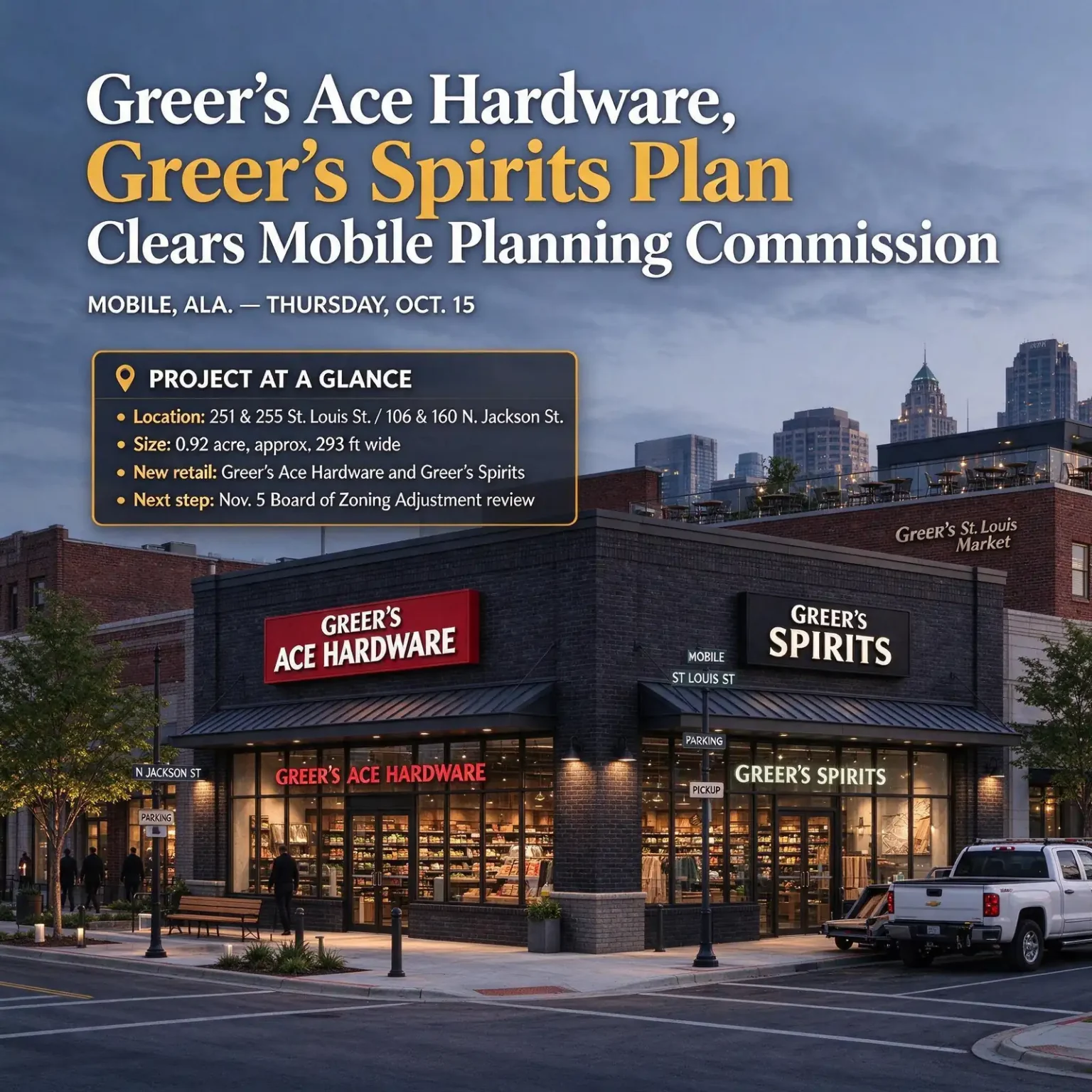
MOBILE, Ala. — Plans for a Greer’s Ace Hardware and a separate Greer’s Spirits store in downtown Mobile took a significant step forward Thursday, Oct. 15, when the Mobile Planning Commission approved a subdivision of property along St. Louis and North Jackson streets, next to Greer’s St. Louis Market.
The approval combines several existing lots into a single parcel, clearing the way for a project that would renovate existing commercial property and bring two new retail businesses to the block. It follows an earlier green light from the city’s Board of Zoning Adjustment and sets up additional reviews in November.
For downtown residents and workers, the project could add hardware and spirits shopping within walking distance of an existing grocery store, while reshaping a corner of the city’s northern downtown with new landscaping, seating and pedestrian improvements.
What the Planning Commission Approved
At its Thursday, Oct. 15 meeting, the Planning Commission approved combining three existing lots into one parcel measuring 0.92 acre. The consolidated property covers 251 and 255 St. Louis Street and 106 and 160 North Jackson Street.
Subdivision approval is a routine but necessary step for many redevelopment projects. Combining lots into one parcel allows a property owner to plan buildings, parking and driveways across the entire site rather than working within older lot lines.
Commissioners also waived requirements that would have called for additional property dedication at two street corners. Such dedications are sometimes required so a city can widen corners or rights-of-way, and the waiver allows the project to proceed without giving up that land.
A Closer Look at the Greer’s Project
The development centers on two new businesses: a Greer’s Ace Hardware store and a separate Greer’s Spirits store. Both would sit near Greer’s St. Louis Market, the downtown grocery store the company operates on St. Louis Street.
Beyond the new stores, the plans call for transforming the surrounding site. Proposed improvements include:
- Renovation of existing commercial property on the site
- Two additional retail businesses, the hardware store and the spirits store
- Landscaped areas with trees and seating
- Pedestrian amenities intended to make the site more walkable
- Improved vehicle circulation and parking
- Customer and contractor pickup areas, including access for vehicles pulling trailers
The pickup provisions are a notable feature for a downtown hardware store. Contractors and do-it-yourself customers often need to load lumber, equipment or bulk materials, and designing the site to accommodate vehicles with trailers is meant to make those trips practical in a dense urban setting.
The Project at a Glance
- Location: 251 and 255 St. Louis Street and 106 and 160 North Jackson Street, downtown Mobile
- Site size: 0.92 acre after three lots are combined, approximately 293 feet wide
- New businesses: Greer’s Ace Hardware and Greer’s Spirits
- Driveways: three curb cuts, two on North Jackson Street and one on St. Louis Street
- Approvals so far: Board of Zoning Adjustment variances on Oct. 1; Planning Commission subdivision approval on Oct. 15
- Still pending: sign and building-material requests before the Board of Zoning Adjustment on Nov. 5, plus design review and construction permits
Earlier Zoning Approvals
The Planning Commission vote was not the project’s first hurdle. On Oct. 1, the Mobile Board of Zoning Adjustment approved variances for a wider-than-usual lot and additional driveway entrances.
Those variances allow the consolidated property to measure approximately 293 feet wide. They also permit three curb cuts, which are the driveway openings where vehicles enter and leave a property from the street. Two of the curb cuts will be on North Jackson Street and one will be on St. Louis Street.
As a condition, the developer must coordinate the location of those curb cuts with the city’s St. Louis Street reconstruction project. That coordination is intended to make sure driveways for the new development line up with the street improvements the city is carrying out along the corridor.
How Mobile’s Review Boards Divide the Work
Development projects in Mobile often pass through more than one city board, and each handles a different kind of request. The Planning Commission reviews matters such as subdivisions, which determine how land is divided or combined into lots, along with related requirements like right-of-way dedications.
The Board of Zoning Adjustment, by contrast, hears requests for variances, which are exceptions to specific requirements of the city’s zoning rules. A variance is typically sought when a property owner wants to do something the standard rules would not otherwise allow, such as building a wider lot frontage or adding more driveways than usual.
That division explains why the Greer’s project has appeared before both bodies. The lot consolidation and corner dedication waivers went to the Planning Commission, while the lot width, curb cuts, signs and building material requests fall to the Board of Zoning Adjustment.
Public notice is part of both processes. Requests are listed on published agendas, and property owners and residents have the opportunity to speak for or against items when they come up for a vote.
Historic District Status
The property sits within the Automobile Alley Historic District, a federally recognized district listed on the National Register of Historic Places. The district was added to the National Register in 2016, and its boundaries were enlarged in 2023.
The site lies outside the city’s locally regulated historic districts, however. Because of that distinction, the project does not need approval from Mobile’s Architectural Review Board, which reviews exterior changes to properties within the city’s local historic districts.
The difference between the two designations is important for property owners. A National Register listing recognizes a district’s historic significance but generally does not by itself restrict what a private owner can do with a building, while local historic districts carry design review requirements set by the city.
Greer’s Roots in Downtown Mobile
Greer’s is a Mobile-based, family-owned grocery company with more than a century in business. The company opened Greer’s St. Louis Market on Aug. 20, 2021, bringing a full-service grocery store back to downtown a few blocks from the site of the company’s original store.
The St. Louis Market includes groceries, prepared foods, a bakery and coffee shop, along with a rooftop area overlooking the Mobile skyline. The new hardware and spirits stores would extend the company’s presence on the block, placing the grocery, hardware and spirits businesses close together in the same part of downtown.
Ace Hardware operates as a retailer-owned cooperative, meaning stores carrying the Ace name are generally owned and run by independent local businesses rather than by a national corporate chain. A Greer’s Ace Hardware would follow that model, pairing a locally owned company with a nationally recognized hardware brand.
Retail liquor sales in Alabama are regulated by the Alabama Alcoholic Beverage Control Board, which licenses privately owned package stores. The city approvals so far address the property and site design rather than the licensing that governs how the businesses will operate.
What the Project Could Mean for Downtown
Downtown Mobile is home to residents living in apartments and renovated buildings, along with workers and visitors who spend their days in the city center. For those residents, the ability to buy groceries, hardware supplies and spirits in one area could reduce the need to drive to suburban shopping centers for everyday errands.
The site design also addresses how people would get around. The plans pair parking and improved vehicle circulation with pedestrian amenities, trees and seating, an approach intended to serve both shoppers who drive and those who walk from nearby homes and offices.
At the same time, the project’s location along St. Louis Street means it will take shape alongside the city’s reconstruction of that roadway. The requirement that curb cuts be coordinated with the street project is meant to ensure the private development and public improvements fit together once both are complete.
What’s Next for the Project
Two more requests are scheduled to go before the Board of Zoning Adjustment at its Thursday, Nov. 5 meeting:
- Corner signs: permission for two diagonal corner signs
- Building material: a variance allowing wire mesh to be used as a building material at 251 St. Louis Street
Even with those requests decided, the project will still need additional design review and construction permits before work can begin. No construction start date or opening date has been announced.
Shoppers at Greer’s St. Louis Market should not expect immediate changes. The approvals granted so far deal with how the property is divided, how wide the lot may be and where driveways may go, and the remaining reviews and permits will need to be completed before any construction work on the new stores begins.
Residents who want to follow the project or comment on the upcoming requests can watch for the Board of Zoning Adjustment’s Nov. 5 agenda through the City of Mobile. Board meetings are open to the public, and agendas list the addresses and requests that will be considered.
For now, the approvals bring Greer’s a step closer to expanding its downtown retail footprint, turning a cluster of separate lots along St. Louis and North Jackson streets into a single site planned for shopping, parking and public space.