Alabama Grocery Sales Tax Now 2%, but Gulf Shores, Orange Beach Shoppers Still Pay 8%
Alabama has cut its state grocery tax from 4% to 2%, but local county and city taxes keep the rate at 8% in Gulf Shores and Orange Beach. Here's how the tax works and what it means for education funding.
GULF SHORES, Ala. — The Alabama grocery sales tax has been cut in half over the past three years, but shoppers in Gulf Shores and Orange Beach still pay an 8% combined rate on food at the register. That gap between the state’s progress and what local families actually see on their receipts sits at the center of a debate that has become a fixture of Alabama political campaigns and election advertising this fall.
Candidates across the state have promised relief on everyday food purchases for years. Yet the tax has proven remarkably durable, largely because of where the money goes: Alabama’s Education Trust Fund, the budget that pays for the state’s public schools, colleges and universities.
Understanding why the grocery tax exists, how Alabama compares with the rest of the country and how the local rate breaks down at checkout helps explain why full repeal remains such a difficult promise to keep.
Why Alabama Taxes Groceries in the First Place
Alabama leans heavily on sales taxes because its property tax rates rank among the lowest in the nation. With relatively little revenue coming from property, the state has long relied on taxing retail purchases, including basic grocery items, to pay for essential public services.
The state’s general sales tax dates to 1937, during the Great Depression, when lawmakers created it to provide dedicated funding for public education. Groceries were part of the tax base from the very beginning, and the law never included a baseline exemption for food.
That design choice was deliberate. Food purchases stay relatively steady whether the economy is booming or slumping, so taxing groceries at the full general rate gave Alabama schools a consistent, non-cyclical stream of revenue. People have to eat regardless of economic conditions, which made the grocery tax one of the more dependable sources of money for classrooms.
How Alabama Compares With Other States
Alabama’s approach puts it in a shrinking minority. Nationwide, only eight states still levy a state sales tax on groceries. Most states either exempt grocery staples from sales tax entirely or offer tax credits to help low-income households offset the cost.
Alabama remains on the short list of states that tax food, but recent legislation has meaningfully narrowed the gap. The state rate on groceries is now half of what it was just a few years ago, a change that has drawn praise from consumer advocates while raising questions about the long-term effect on education funding.
Two Cuts, Half the State Rate
For most of its history, Alabama applied its full 4% state sales tax to groceries. At that rate, the grocery tax generated more than $500 million a year for the Education Trust Fund, making it a significant piece of the state’s education budget.
The first reduction arrived in September 2023, when the state lowered its grocery sales tax rate from 4% to 3% under House Bill 479. That 1-percentage-point cut returned approximately $152 million per year to taxpayers.
A second cut followed in September 2025 under House Bill 386, dropping the state grocery rate to 2%. That additional 1-point reduction saves consumers another $121 million to $122 million annually.
Taken together, the two cuts amount to a 50% reduction in the state’s grocery tax, from 4% to 2%. The combined effect leaves more than $270 million per year in residents’ pockets, and it reduces revenue to the Education Trust Fund by the same amount.
- Historical state rate: 4%, generating more than $500 million a year for education
- September 2023 (House Bill 479): 4% to 3%, returning about $152 million a year to taxpayers
- September 2025 (House Bill 386): 3% to 2%, saving consumers an additional $121 million to $122 million a year
- Combined effect: more than $270 million a year back to residents and the same amount less for the Education Trust Fund
What Shoppers Pay in Gulf Shores and Orange Beach
The state’s share is only part of the story for coastal Baldwin County residents. Local governments levy their own sales taxes, and those local rates still apply to groceries in full.
Here is how the grocery tax breaks down at checkout in both Gulf Shores and Orange Beach:
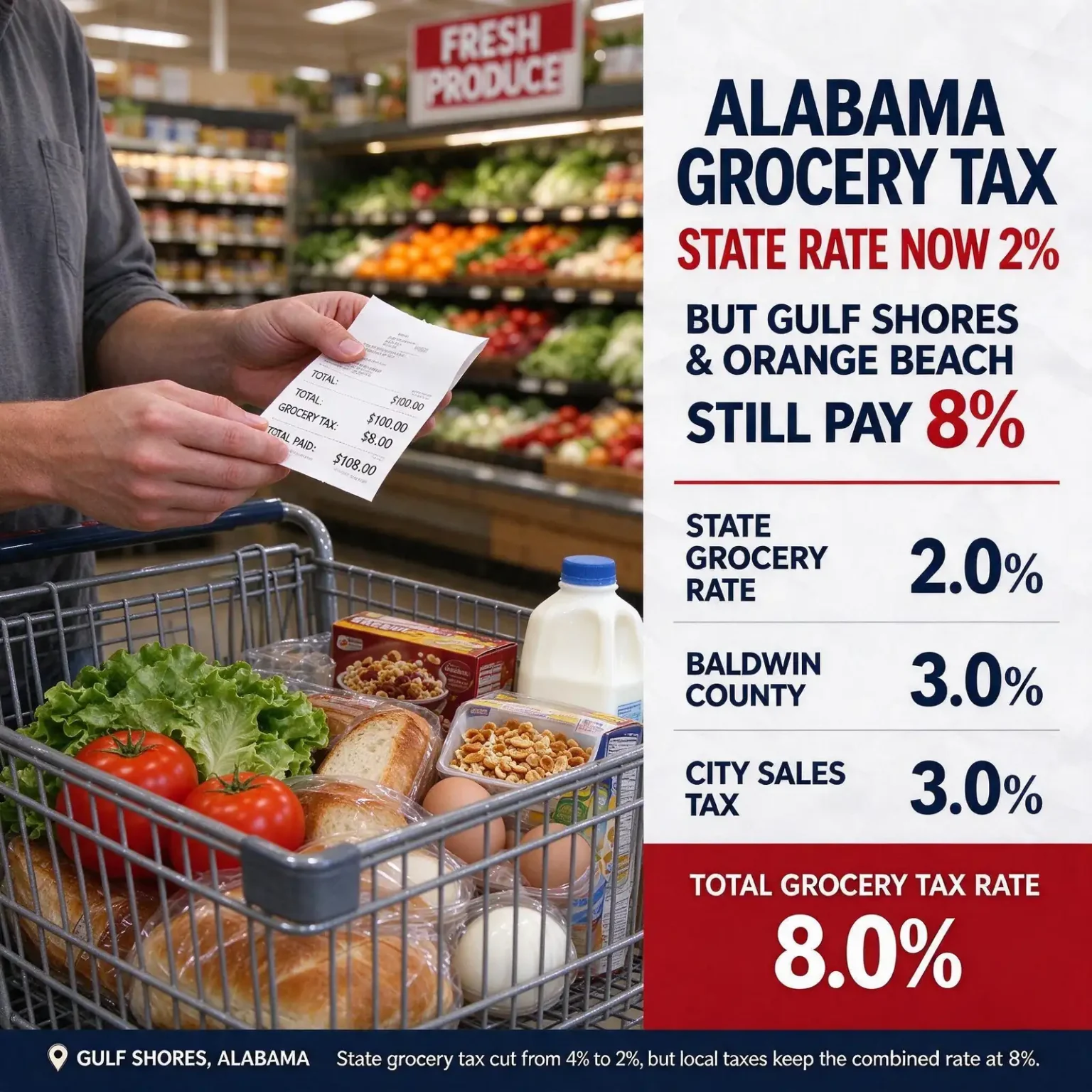
- State grocery rate: 2.0%
- Baldwin County sales tax: 3.0%
- City sales tax (Gulf Shores or Orange Beach): 3.0%
- Total combined grocery tax rate: 8.0%
By comparison, non-grocery items in both cities are taxed at the 10.0% general sales tax rate. In practical terms, a family spending $100 on groceries in either city pays $8 in sales tax, compared with $10 on $100 worth of non-grocery merchandise.
The two-point difference reflects the state’s cuts alone. The local share of the grocery tax, 6 percentage points in total, has not changed. For households in the two beach cities, that means three-quarters of the tax they pay on food now goes to local governments rather than the state.
What the Numbers Mean for a Household Budget
Because groceries are a weekly expense for most families, small percentage differences add up over the course of a year. At the current 8% combined rate in Gulf Shores and Orange Beach, a household that spends $200 a week on groceries pays $16 a week in sales tax on that food.
Had the state rate remained at 4%, and with the county and city rates where they stand today, that same household would face a 10% combined rate, or $20 a week. The state’s two cuts therefore save that family about $4 a week, or roughly $208 over a full year.
Those savings will look different for every household, depending on how much each family spends at the grocery store. Larger families and those who cook most meals at home will see bigger dollar savings, while the local 6% share remains a fixed part of every grocery receipt in the two cities.
Shoppers can also check their receipts for a simple way to see the effect. Food items that qualify as groceries are taxed at the lower combined rate, while non-food items purchased on the same trip, such as household supplies, are generally taxed at the full 10% general rate.
Why Local Governments Have Kept Their Share
Baldwin County, Gulf Shores and Orange Beach could each reduce or eliminate their portion of the grocery tax, but doing so would require action from their own governing bodies. The county commission and each city council would need to pass dedicated ordinances or resolutions to opt into an exemption.
So far, local leaders have not taken that step. Local governments rely heavily on sales tax revenue to pay for municipal services, infrastructure and public safety, and in tourism-driven communities like Gulf Shores and Orange Beach, sales taxes help support the police, fire, road and beach services that residents and visitors alike depend on.
Any local decision would involve the same trade-off the state has faced: every dollar of relief at the register is a dollar that must either be replaced from another source or cut from a budget. Residents who want to weigh in can follow the agendas of the Baldwin County Commission and the Gulf Shores and Orange Beach city councils, where any such proposal would need to be introduced and voted on.
The Education Trust Fund at the Heart of the Debate
The Education Trust Fund is one of Alabama’s two main state budgets, alongside the General Fund. It supports K-12 public schools as well as the state’s community colleges and universities, and its two largest revenue sources are the state income tax and the state sales tax.
Because the sales tax on groceries has been earmarked for education since its creation, every cut to the state grocery rate shows up directly in the education budget. The more than $270 million a year that families now keep is money the Education Trust Fund no longer collects, and lawmakers must account for that loss each year when they write the education budget.
That connection matters locally. Gulf Shores and Orange Beach each operate their own city school systems, and Baldwin County’s public schools, colleges and universities across the state all draw on state education dollars. Supporters of the cuts argue that families deserve relief on a necessity like food, while budget watchers caution that any future reduction would need a reliable replacement to avoid squeezing classrooms.
What Comes Next for the Grocery Tax
For decades, Alabama politicians have campaigned on promises to completely eliminate the state’s sales tax on food, pitching relief at the register as a winning message for working families. Yet nearly a century after the tax was created in 1937, it remains firmly embedded in the state’s revenue structure.
The recent cuts represent the most significant progress on the issue in generations. Full repeal, however, continues to stall over a central challenge: finding a permanent way to replace hundreds of millions of dollars in dedicated education revenue.
With the issue appearing in campaign messaging ahead of the Nov. 3 general election, voters are likely to keep hearing about it. Shoppers who want to understand the stakes can look at their own receipts: in Gulf Shores and Orange Beach, the 8% grocery rate shows exactly how much of the tax is state, how much is local and how far relief has come.
Until state leaders agree on a lasting alternative to fund public schools, the grocery tax is likely to endure both as a reliable political talking point and as an unavoidable daily cost for Alabama families.