Foley Nonprofit Permit Fees Cut Up to 50% Under New City Council Ordinance
The Foley City Council approved an ordinance allowing qualifying nonprofits to apply for up to 50% off zoning, building and land development permit fees, with waivers over $5,000 requiring council approval.
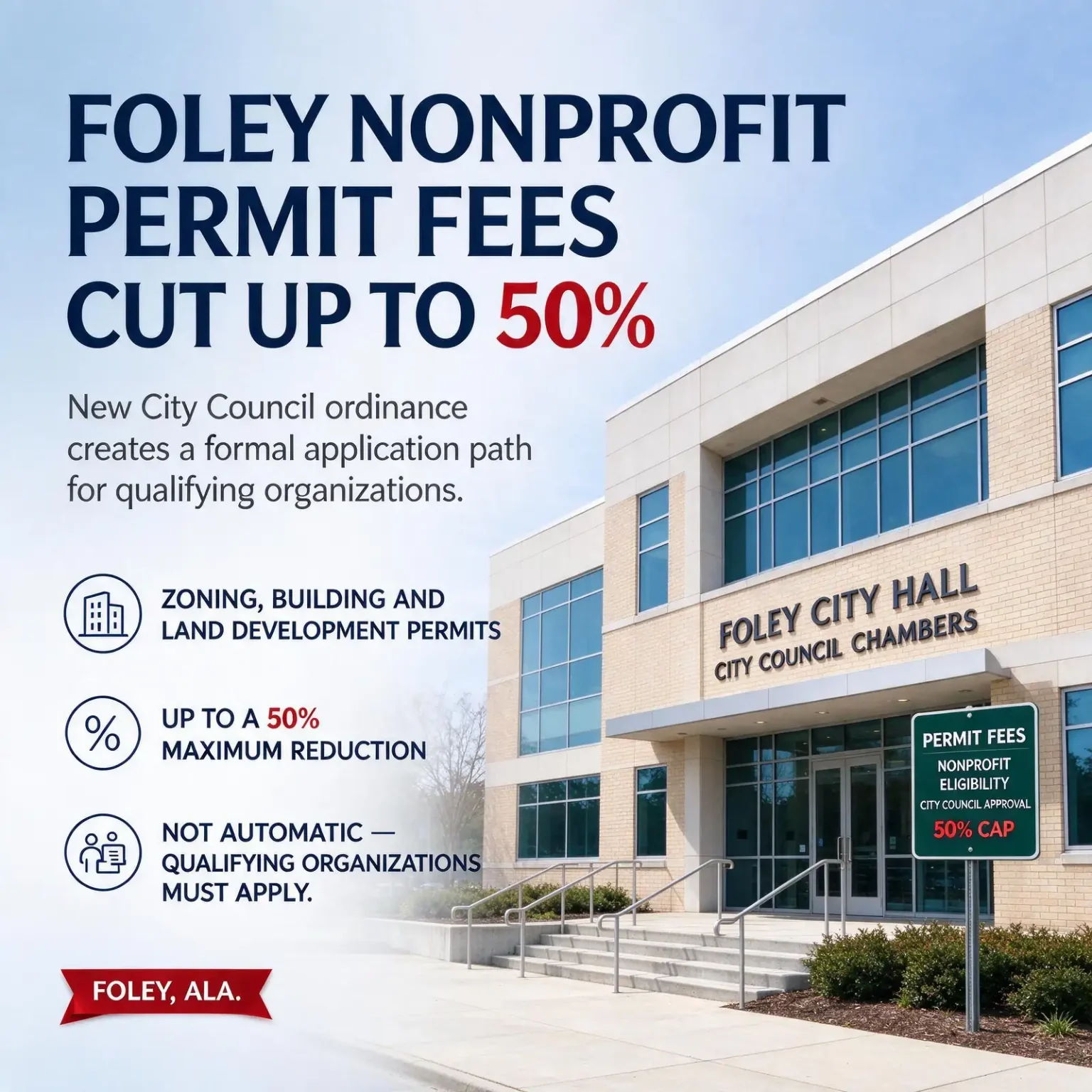
FOLEY, Ala. — Foley nonprofit permit fees could drop by as much as 50% under a new ordinance approved by the Foley City Council, giving qualifying organizations that serve local residents a formal way to request relief on zoning, building and land development costs.
Council members approved the ordinance on its final reading Monday, Oct. 5. The measure replaces what had been an informal, case-by-case practice with written rules spelling out which groups qualify, which fees can be reduced and who has the authority to approve a reduction.
Mayor Ralph Hellmich said the change recognizes the public benefit nonprofits provide while still protecting taxpayers from carrying the full cost of the city services those permits pay for.
What the New Ordinance Does
Under the ordinance, eligible nonprofit organizations may receive a reduction of up to 50% on fees for three categories of city permits:
- Zoning permits
- Building permits
- Land development permits
Those fees typically come into play when an organization builds a new facility, renovates or expands an existing one, or develops a property. For nonprofits working on tight budgets, permit costs can add up quickly on construction or renovation projects.
The reductions are discretionary rather than automatic. Qualifying agencies must apply, and the city may grant a reduction upon application. That means an eligible organization is not guaranteed a specific discount simply because it holds nonprofit status.
How the Savings Could Work
Because the ordinance sets a maximum reduction of 50% and a $5,000 limit on what staff can approve, the size of a nonprofit’s permit bill will help determine how its request is handled. The examples below are hypothetical and are meant only to show how the limits interact.
- A nonprofit facing $4,000 in eligible permit fees could receive a reduction of up to $2,000, an amount within city staff’s authority.
- A nonprofit facing $10,000 in eligible fees could receive a reduction of up to $5,000, which is still at the staff limit.
- A nonprofit facing $14,000 in eligible fees could seek a reduction of up to $7,000, but because that waiver would exceed $5,000, it would need City Council approval.
In every case, the actual reduction is up to the city, since the ordinance makes reductions discretionary. An organization may receive less than the maximum, depending on how its application is evaluated.
Which Organizations May Qualify
The ordinance is aimed at nonprofits that serve Foley residents and provide services in a broad range of areas. Those areas include:
- Health
- Safety and public safety
- Welfare and social services
- Education
- Housing
- Recreation
The wide list reflects the variety of groups that operate in a growing city like Foley, from organizations focused on youth and education to those providing housing assistance, health services or recreational programs. Organizations seeking a reduction must be registered nonprofit organizations.
Because the process depends on an application, nonprofits considering a project in the city will want to plan ahead and contact city staff about the requirements before applying for permits.
How Fee Waivers Will Be Approved
The ordinance creates two levels of approval based on the dollar amount involved. City staff members may waive up to $5,000 in fees for registered nonprofit organizations.
Any waiver exceeding $5,000 must go to the full City Council for approval. That threshold keeps smaller requests moving through city offices while ensuring that larger reductions receive a public vote by elected officials.
The two-tier structure is meant to balance efficiency with oversight. Routine requests from nonprofits doing modest projects can be handled administratively, while significant waivers are brought before the council in an open meeting.
From Informal Practice to Written Rules
Foley has reduced fees for some organizations in the past, including churches. But the city had no written guidelines governing those decisions, no clear list of which fees could be lowered and no defined standard for which organizations were eligible.
The new ordinance changes that by putting the rules in the city code. Hellmich said the goal is to make the process transparent for everyone involved.
“We’re codifying it so that everyone knows what the rules are up front,” Hellmich said. “There are some things you can’t waive, and so this lets everybody know up front where things stand.”
The ordinance addresses the cost of permits, not the permits themselves. A nonprofit that receives a fee reduction still needs the same zoning, building and land development approvals as any other property owner, and its projects remain subject to the city’s normal review and inspection process.
Organizations that do not apply, or that do not meet the eligibility criteria, will continue to pay the city’s standard permit fees. The ordinance simply creates a defined path for those that qualify to seek relief, replacing the uncertainty that came with the city’s earlier informal approach.
For nonprofits, written rules offer predictability. An organization planning a new building or expansion can now see in advance which fees may be reduced and how to request a reduction, rather than relying on past practice or informal requests.
Balancing Nonprofit Support and Taxpayer Costs
Permit fees help cover the cost of the city staff time involved in reviewing plans, issuing permits and conducting inspections. Reducing those fees means the city absorbs part of that cost, which is why Hellmich described the ordinance as a balance between supporting nonprofits and protecting taxpayers.
“It’s a step toward recognizing that they provide a benefit the government doesn’t, but we still don’t want citizens to bear all the cost,” Hellmich said. “It doesn’t cover all the costs, but it’s a step toward recognizing that they provide a benefit to the city.”
The 50% cap reflects that approach. Rather than eliminating fees entirely, the ordinance allows the city to share the cost with qualifying organizations, so the groups still contribute toward the services they use while receiving meaningful relief.
Supporters of fee reductions for nonprofits often point out that charitable groups provide services that might otherwise fall to local government or go unmet. By lowering the cost of building and expanding facilities, the city can make it easier for those groups to put more of their resources toward their missions.
What It Means for Foley Nonprofits
For local charities, churches, youth programs and service agencies, the ordinance could make a practical difference on future projects. A nonprofit planning to build a new facility, renovate an existing space or develop land in Foley may now be able to reduce part of its permitting costs by applying under the new rules.
Organizations interested in the program should keep a few points in mind:
- Reductions are available for zoning, building and land development permit fees.
- The maximum reduction is 50% of eligible fees.
- Reductions are not automatic; organizations must apply.
- City staff may waive up to $5,000 in fees; larger waivers require City Council approval.
- Organizations must be registered nonprofits providing services such as health, safety, welfare, education, housing, social services, recreation or public safety.
Questions to Ask Before Applying
Because the ordinance is new, nonprofits considering a project may want to clarify a few details with city staff before submitting permit applications:
- What documentation is needed to show the organization is a registered nonprofit serving Foley residents?
- Which specific fees on the project qualify as zoning, building or land development fees under the ordinance?
- Which fees, if any, cannot be reduced?
- Should the reduction request be submitted before or alongside the permit application?
- How long does review take, particularly for requests that must go to the City Council?
Asking those questions early can help an organization build accurate cost estimates into its project budget, especially for larger construction or renovation projects where permit fees are a meaningful expense.
How to Learn More or Take Part
Nonprofit leaders who want details on eligibility or the application process can contact Foley City Hall, where city staff handle permit questions and requests. Organizations should ask about the required documentation before submitting permit applications.
Residents who want to follow how the ordinance is applied can watch for waiver requests above $5,000, which must appear before the City Council. The council holds a work session followed by its regular meeting in the council chambers at Foley City Hall, and recent meetings have begun at 4 p.m. on Mondays. Meeting agendas are posted by the city ahead of each session.
With the ordinance now approved, Foley’s long-standing practice of helping community organizations now rests on a clear, written framework, giving nonprofits and taxpayers alike a better understanding of how and when the city will share in the cost of permits.