Hurricane Isaias Recovery in Escambia County Presses On in Brewton a Week Later
A week after Hurricane Isaias, debris piles line roads in Brewton and Escambia County as crews clear trees, about 1,000 remain without power and the sheriff says the work isn't done.
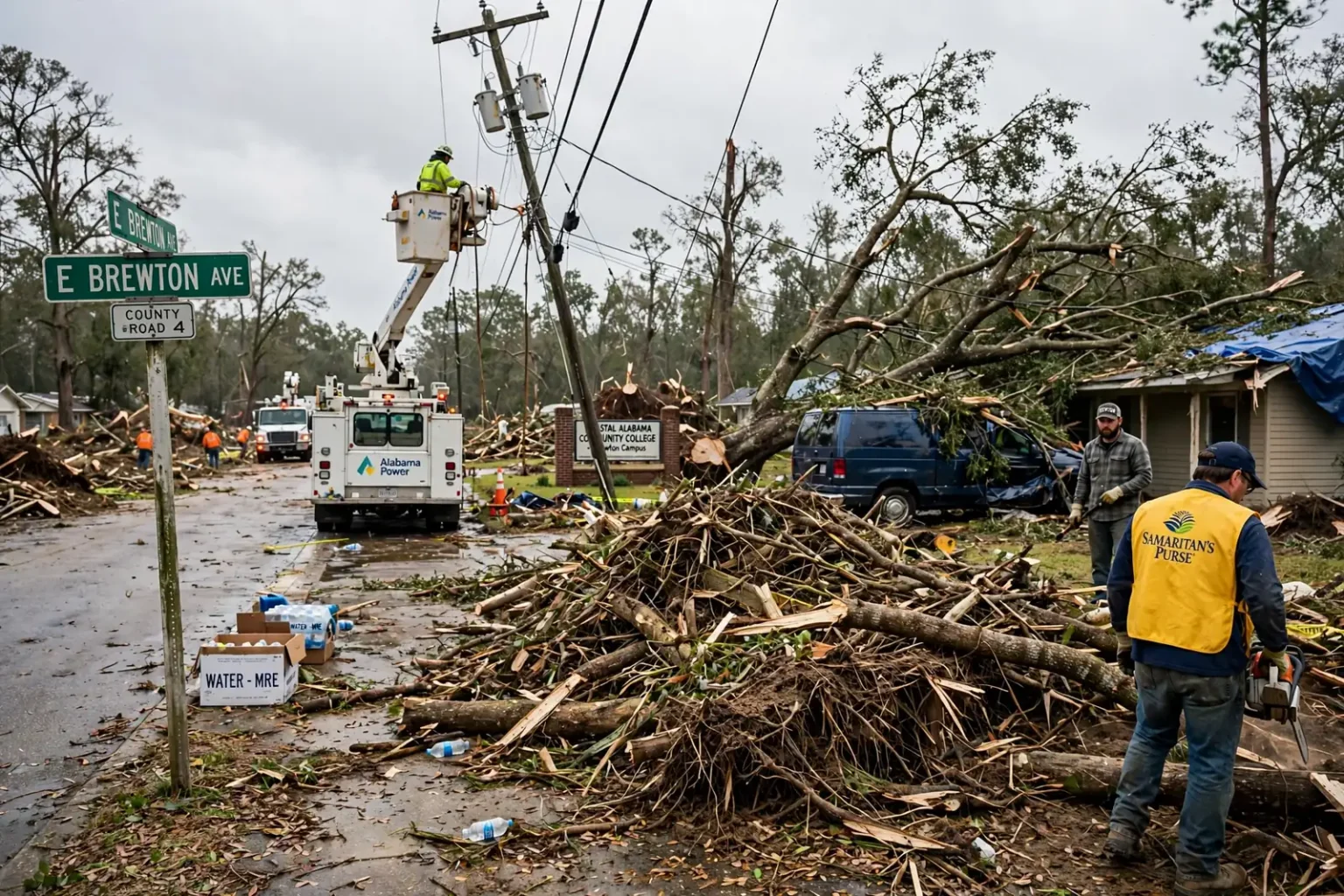
BREWTON, Ala. — One week after residents first stepped outside to survey what Hurricane Isaias left behind, the Hurricane Isaias recovery in Escambia County is visible on nearly every road. Debris piles line the right-of-way, chain saws hum in backyards and utility bucket trucks remain a common sight, even as officials caution that the hardest work is far from finished.
Saturday, Oct. 17, marked seven days since homeowners in Brewton and the surrounding communities got their first full look at the damage. Isaias came ashore near Destin, Fla., on the evening of Friday, Oct. 9, and raced north into Alabama overnight, leaving Saturday, Oct. 10, as the first morning of cleanup for many south Alabama families.
Residents, contractors and county leaders describe a recovery that has moved quickly in some areas but remains uneven, particularly for renters who lost their homes and for rural households still waiting on electricity.
Debris Piles Mark Progress Across Escambia County
Anyone who drives around Escambia County for long will pass pile after pile of limbs, trunks and root balls stacked at the edge of yards. The piles are a sign that cleanup is underway, but they are also a reminder of how many trees came down and how much work still remains.
Contractors have been pulling broken stumps from the ground, roots and all, while log stacks grow along the roadside. On some properties, crews are finishing cleanup around parking lots and driveways as other workers gather loose limbs and move them to the public right-of-way for pickup.
Contractor Bryce Martin said the pace of work has been brisk, with many crews and utility companies operating at the same time.
“A lot of people doing tree work as it’s I’d say it’s pretty fast. I mean, there’s power companies everywhere. A lot of bucket trucks, people a lot of moving parts. But I feel like the efforts have been good,” Martin said.
Levi Durden, who was working to tidy up around a parking lot, described a similar urgency among the crews working across the area.
“It’s been a fast pace. It’s been all hands on deck, and we’ve been doing all we can to get it back to a good state,” Durden said.
Coastal Alabama Community College Campus Shows Scars
The storm also left its mark on the Brewton campus of Coastal Alabama Community College. Many fallen trunks and branches have already been hauled away, but tilted stumps and patches of overturned soil show where large trees once stood.
The Brewton campus has deep roots in the community. It was long home to Jefferson Davis Community College, which in 2017 was consolidated with Alabama Southern Community College and Faulkner State Community College to form Coastal Alabama Community College. The combined college now serves students at locations stretching from Gulf Shores and Fairhope to Monroeville, Thomasville, Atmore and Brewton.
The cleanup on campus mirrors what is happening across the city, where removing debris is only the first step before property owners can fully assess and repair what the storm damaged.
Homeowners Work Piece by Piece
Not far from the college, Evan Brock’s house is still standing, but his backyard tells a different story. A massive tree came down onto his roof and also landed on his van, and he has been removing it a section at a time.
Brock said he is grateful that no one was hurt. Because the weight of the tree is resting on both the house and the vehicle, he has been careful about how he takes it apart.
“It’s laying on my van and on the house. So kind of taking it apart slowly, because I don’t know what’s going to fall this way, that way,” Brock said.
His approach reflects a broader safety concern after storms. Trees that are partly uprooted or still leaning on structures can shift without warning, and emergency officials across the Gulf Coast routinely urge homeowners to leave large or unstable trees to experienced crews whenever possible.
Displaced Residents and Unseen Losses
While debris piles and bucket trucks are easy to see, some of the storm’s toll is harder to spot. A number of residents have had to leave their homes or apartments after the buildings were left unsafe, and some have moved to other areas while they look for a place to stay.
Brewton resident Darius Williams said the losses have been difficult to watch.
“Disappointed because a lot of people lost a lot of stuff like it done a lot of damage. You got people in their homes that this happened to move out, and it’s just. It’s crazy, man,” Williams said.
Displacement can extend the recovery long after roads are cleared. Families who rent may have little control over when repairs are made, and those who lost belongings may need help replacing furniture, clothing and other basics before they can settle somewhere new.
Sheriff Heath Jackson: ‘The Work Isn’t Done’
Escambia County Sheriff Heath Jackson outlined the county’s progress and its remaining needs in a written statement. He said that as of Saturday, roughly 1,000 people countywide were still without electricity.
“The power companies have worked tirelessly to get power back up,” Jackson said. He added, “All county roads are passable, but still be cautious due to debris close to the roads.”
Jackson credited the county’s emergency management director and partners from neighboring and allied agencies for the response. “Our EMA director and other help from Baldwin, Mobile, Lee, Poarch Creek, and Clarke County EMA had a great plan in place. We were able to push out water, MRE’s, and tarps to staging areas for distribution,” he said.
The sheriff said demand for supplies has eased as electricity returns and outside groups arrive. “We still have people in need. We have been able to scale back those efforts due to power coming back and the huge amounts of volunteer organizations who have came to help,” Jackson said.
He singled out one relief group in particular. “Samaritan’s Purse has been a huge help on recovery efforts and just being a good safe option for people who need help with getting trees off houses and out of driveways,” Jackson said. Samaritan’s Purse is an international Christian relief organization based in Boone, N.C., that regularly sends volunteer teams to help with debris removal after hurricanes and tornadoes.
Jackson also thanked state and federal officials who checked in during and after the storm. “During the storms and aftermath, Senator Katie Britt, Tuberville, Congressman Barry Moore, Jerry Carl, and Sheriff Paul Burch and Sheriff Anthony Lowery kept in touch, offering anything we needed and could get. Also, State EMA Director Jeff Smitherman came and offered his assistance,” he said.
What Escambia County Still Needs
Despite the progress, Jackson was direct about the gaps that remain. He pointed to residents who lost everything, renters facing the loss of their apartments, unbudgeted cleanup costs and rural homes that still lack running water.
“I’m proud of our efforts but the work isn’t done. We still need help. We have many people who lost everything, who are being kicked out of their apartments, millions of dollars of debris cleanup that isn’t budgeted for, and power still out in the rural areas where well pumps are not working,” Jackson said.
The issue of well pumps is especially important in a largely rural county like Escambia. Many homes outside the cities rely on private wells, and those wells need electricity to run. Until power is restored, those households may lack water for drinking, cooking, bathing and flushing, which makes bottled water and other supplies essential.
Jackson closed his statement on a note of resilience. “Escambia county always bounces back. Our community is strong, loyal and dedicated to each other. Our relationships are strong with our outside partners because Escambia county isn’t just a name, it’s a reputation,” he said.
Here is a summary of where the recovery stood as of Saturday, Oct. 17, based on the sheriff’s statement:
- Power: About 1,000 people countywide were still without electricity, mainly in rural areas.
- Roads: All county roads were passable, though debris remained close to many roadways.
- Supplies: Water, MREs and tarps were distributed through staging areas; those efforts have been scaled back as power returns.
- Volunteers: Numerous volunteer organizations, including Samaritan’s Purse, were helping residents remove trees from homes and driveways.
- Unmet needs: Displaced renters, families who lost everything, unbudgeted debris cleanup costs and homes without working well pumps.
How Residents Can Stay Safe and Get Help
As cleanup continues, residents can take several practical steps to protect themselves and help the recovery move smoothly:
- Drive with caution. The sheriff warned that debris remains close to the edges of county roads, so slow down and watch for crews and equipment.
- Keep debris in the right place. Place limbs and storm debris at the public right-of-way so it can be picked up, without blocking roads, ditches, drains or mailboxes.
- Leave dangerous trees to professionals. Trees resting on houses, vehicles or power lines can shift unexpectedly. Stay away from any downed lines and treat them as energized.
- Ask for help. Residents who need assistance with fallen trees or other storm needs can reach out to Escambia County emergency management officials or volunteer groups working in the area, including Samaritan’s Purse.
- Check on neighbors. Older residents and families in rural areas without power or water may need help getting supplies.
Officials have not announced a firm timeline for full power restoration or for countywide debris pickup to be completed. Residents should continue to follow updates from the Escambia County Sheriff’s Office and Escambia County EMA for the latest information on resources, distribution sites and cleanup schedules.
For now, the debris piles that dot Brewton and the rest of the county stand as both a measure of how far the community has come in a week and a reminder of how much remains to be done.