Baldwin County Schools Propose Leaner $312 Million Budget for 2016 Despite Enrollment Growth
Baldwin County school officials presented a $312 million budget for 2016, down from $330 million, even as enrollment continues to climb.
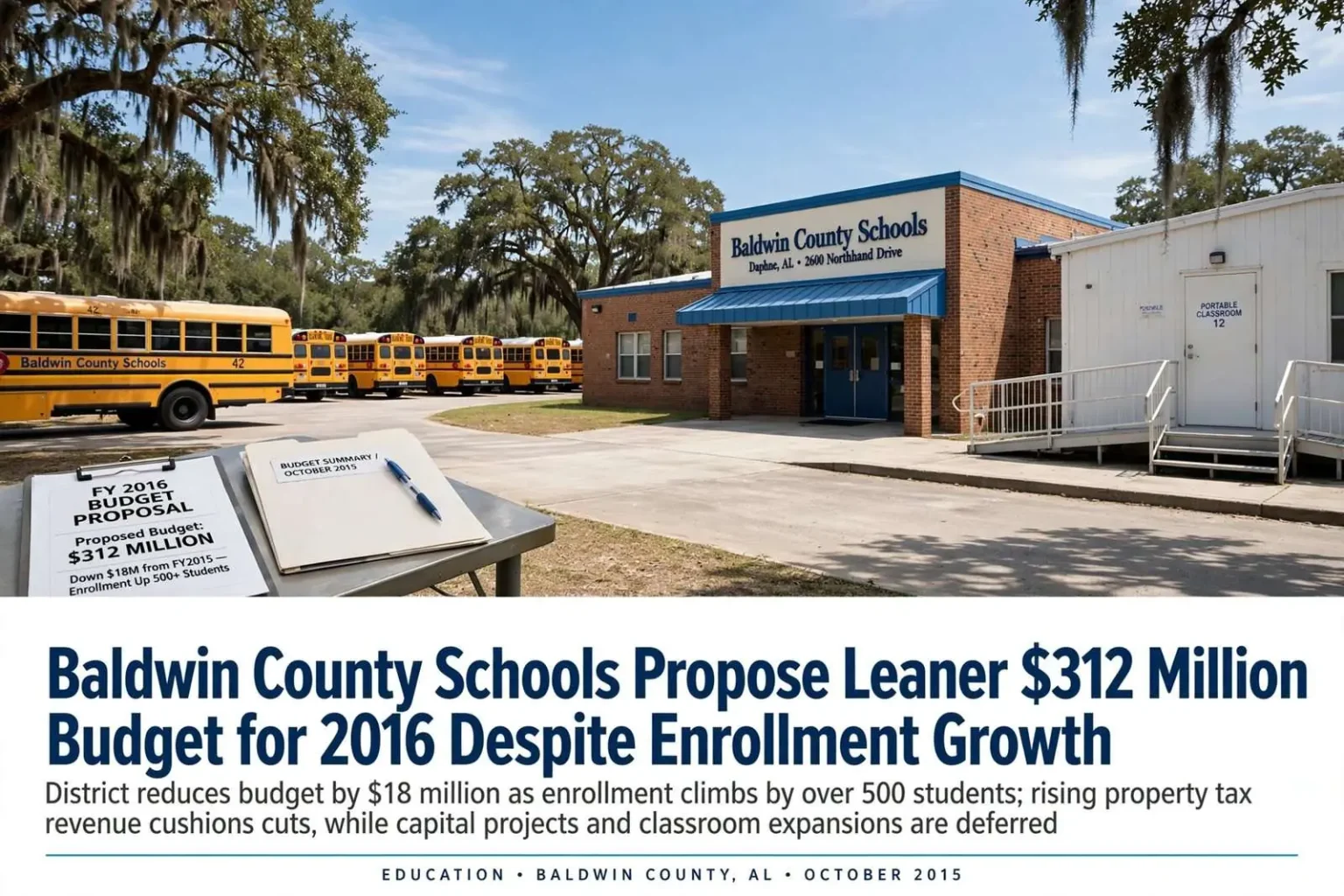
The Baldwin County school system is preparing to operate on a leaner budget for the 2015-2016 school year, even as enrollment continues to climb by hundreds of students annually, according to a proposal presented to the county school board.
The system’s chief financial officer presented the seven-member board with a proposed budget totaling roughly $312 million for 2016, down from about $330 million the year before. That comes despite the district adding more than 350 students last year, with projections calling for as many as 500 additional students in the coming year.
The arithmetic behind those numbers is the district’s defining challenge. Baldwin County is one of Alabama’s fastest-growing school systems, stretching from the Eastern Shore suburbs to the beach communities of Gulf Shores and Orange Beach, and every new subdivision and apartment complex feeds new students into classrooms that must be staffed, supplied and — increasingly — built. A budget that shrinks by $18 million while the student body grows means the cuts are falling where growth is not: fewer dollars per pupil, tighter staffing ratios and deferred spending wherever the law and the classroom allow it.
Where the money comes from
Total revenue from local, state and federal sources is projected to rise slightly compared to 2015, an increase of about $4.4 million. A major piece of that local revenue, projected at roughly $113 million, comes from ad valorem taxes, which include property and probate taxes. That category brought in more than $45 million in 2015 and could top $47 million in 2016, up from around $42 million in 2014.
The ad valorem trend is the quiet good news in the proposal. Rising property values across Baldwin County — driven by the same population growth that adds students — have pushed property and probate tax collections up by millions year over year, and the projection of another $2 million increase reflects continued appreciation across the county’s housing stock. For a district that leans heavily on local money compared to state averages, that growth is the budget’s shock absorber.
The distinction between total local revenue and ad valorem collections matters for reading the numbers. The roughly $113 million local figure includes other local sources, but property taxes are the engine, and they are also the most politically sensitive: Baldwin County voters have been protective of their tax rates even as school leaders have argued that growth outpaces revenue. Each budget cycle reopens that conversation.
Where the money goes
On the spending side, general fund expenditures are expected to total about $224 million, a decrease of nearly $7 million from the previous year. Administrative costs represent roughly 2.9 percent of the overall budget, close to a full percentage point below the state average, following about $2.2 million in administrative cost reductions implemented over the past year under the previous superintendent’s leadership.
That administrative figure is the number board members are likely to quote when the budget faces public comment. Alabama districts have long faced scrutiny over overhead spending, and a county system operating its administration below the state average — while absorbing thousands of new students over recent years — gives district officials a concrete answer to the cost question. The $2.2 million in reductions came from consolidating positions and trimming central office functions under the previous superintendent’s administration.
But the gap between a $312 million total budget and a $224 million general fund is itself a story. The general fund pays for the core operations — salaries, benefits, classroom instruction — while the rest of the budget moves through restricted funds: capital projects, transportation, child nutrition, federal program money that can only be spent where the rules allow. A shrinking total with a stable general fund means the cuts are concentrated in the capital and discretionary categories, which is another way of saying that building for growth is getting harder.
A district in transition
The budget proposal arrives during a period of leadership transition for the district. An interim superintendent has been overseeing operations while the school board searches for a permanent leader, having recently interviewed five semifinalist candidates for the position. Board members have indicated that two or three finalists are likely to be brought back for additional interviews, though it remains possible none of the current semifinalists will ultimately be selected.
Conducting a superintendent search while finalizing a budget puts the board in an awkward sequence. Budgets set in the spring determine staffing contracts and school-level allocations for the fall, so decisions cannot wait for a permanent leader — but whoever is ultimately hired will have inherited spending choices they had no hand in making. Interim leadership also tends to slow long-range planning, which in a fast-growing district is precisely the work that matters most: where to buy land, which schools to expand, how to redraw attendance zones.
The five semifinalists who faced the board represent the range of profiles systems like Baldwin County typically draw: sitting superintendents from other Alabama districts, central office administrators seeking their first top job, and candidates from outside the state. Bringing finalists back for second interviews suggests the board wants public scrutiny and deeper questioning before the hire, a process that has grown more transparent in Alabama as search practices have drawn criticism elsewhere.
The uncertainties ahead
Whoever takes over the district will inherit a budget shaped by several looming financial uncertainties.
Foremost among them is the growth-versus-revenue equation itself. Every 500 new students bring state per-pupil funding with them, but they also bring costs the formula does not fully cover — classroom wing additions, portable classrooms, bus routes stretched across one of the largest school districts, by area, in the state. The district’s fast-growing corridors around Spanish Fort, Daphne, Fairhope and the beach schools need bricks as much as budgets, and capital money depends heavily on local taxation and borrowing capacity.
The state funding picture adds its own uncertainty. Alabama’s Education Trust Fund has cycled through lean years that forced proration — across-the-board cuts to promised state allocations — and district finance officers build their local budgets assuming some risk that state money arrives short. A conservative budget like this one builds in that caution, but a real proration year would force mid-year cuts in a system already running leaner than the year before.
And the leadership question compounds everything. Superintendents set priorities — how aggressively to build, how to staff growth corridors, whether to seek another tax vote from county voters — and a district the size of Baldwin County cannot hold those decisions open indefinitely. The board’s search, its finalists and its eventual hire will therefore matter as much to next year’s budget as any line item in this one.
The proposed budget now moves through the board’s review process, with public hearings and a required advertised period before the seven members vote. When they do, they will be adopting a document that is, by any reading, a bet: that ad valorem growth keeps climbing, that the state’s funding holds, and that a district shrinking its spending while growing its enrollment can make the math work one more year.
Baldwin County’s enrollment growth has a geography that makes the budget harder, not easier. The county is Alabama’s largest by land area, and its growth is not evenly spread: the Eastern Shore communities of Spanish Fort, Daphne and Fairhope and the coastal cities of Gulf Shores and Orange Beach absorb most of the new arrivals, while some inland and northern schools grow slowly or not at all. That means the district cannot simply assign new students to empty seats — the seats that are empty are often in the wrong towns, and the ones that are full need new classrooms in the fastest-growing zones.
Teachers and staff feel the squeeze in familiar ways. When a district adds hundreds of students while trimming its budget, hiring slows to the minimum required by growth, class sizes creep upward where caps allow, and requests for new programs compete against the baseline cost of the current ones. The general fund’s nearly $7 million decrease, spread across a system of thousands of employees, is the difference between the district people want and the one the money permits.
Parents and local officials watch the ad valorem line closely for the same reason. Property tax collections of more than $45 million a year make Baldwin County’s local contribution one of the larger in Alabama, but the county’s per-student wealth and its rapid growth mean the demand for new capacity outruns even rising collections. School boards in fast-growing systems across the Southeast face the same dilemma: build now with borrowed money, or wait and put portables on campuses that were full two years ago.
The seven-member board’s review of the proposal will include a public work session where the finance office walks through the revenue assumptions line by line. Those assumptions — especially the ad valorem projection and the state funding estimate — are where budget documents like this one most often change between proposal and adoption, and where board members who want a different priority will find the dollars to fund it.