Bay Minette Cleaner Accused of Stealing Nearly $400,000 From Homeowners She Worked For
Baldwin County deputies seized vehicles, electronics, and other property after a Bay Minette woman allegedly took nearly $400,000 in cash from a home where she worked as a cleaner.
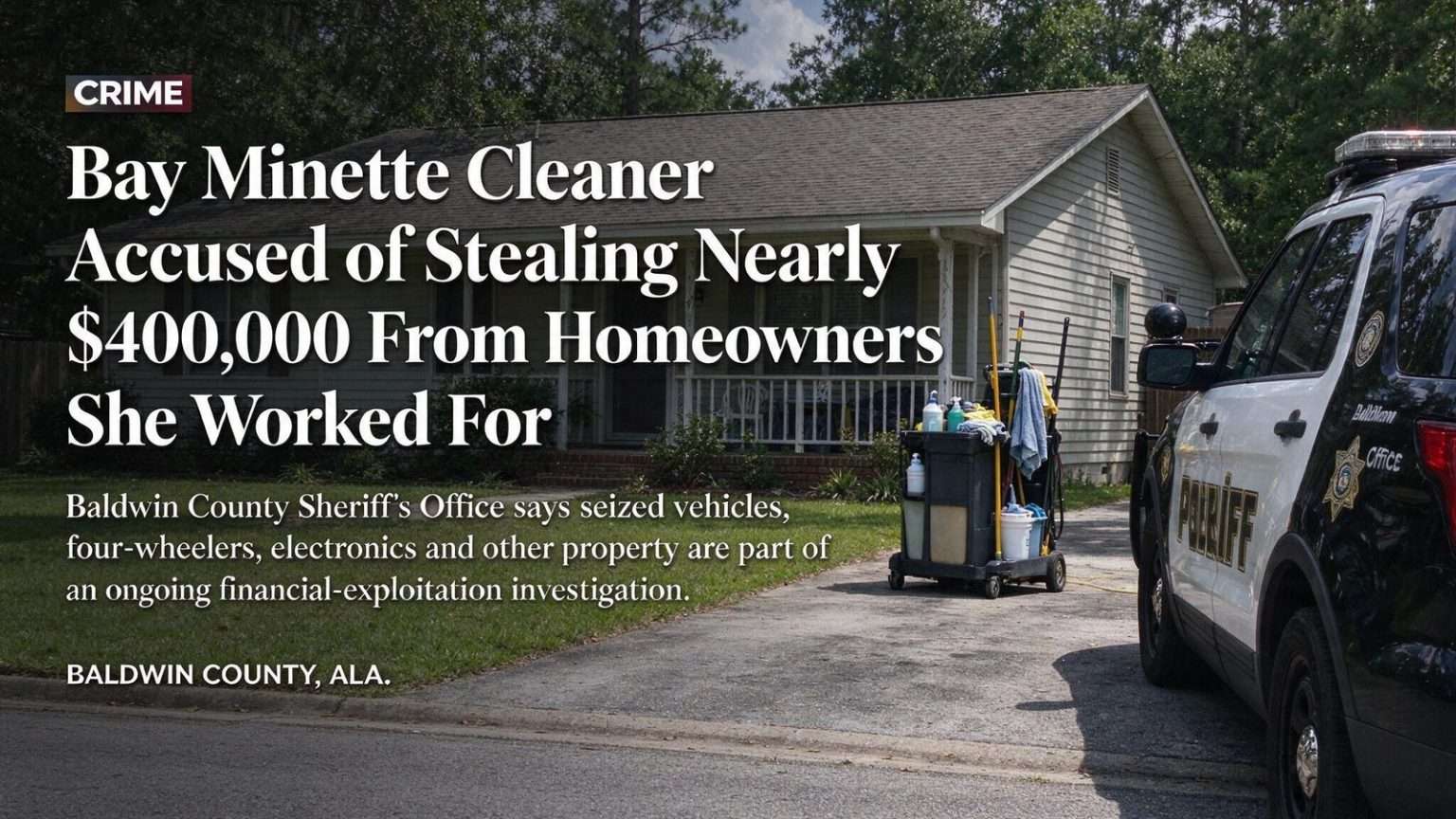
The Baldwin County Sheriff’s Office has seized vehicles, four-wheelers, electronics, and other property after investigators say a Bay Minette woman spent nearly $400,000 in cash allegedly stolen from a home where she worked as a cleaner, in a case authorities are treating as financial exploitation of an elderly victim.
How the Theft Was Discovered
According to the sheriff’s office, deputies received a report on Aug. 25 regarding the theft of a large amount of U.S. currency from a home in Baldwin County. The victims told investigators that nearly $400,000 in cash had been stolen from their residence over time, and they identified their cleaning lady as the primary suspect in the theft.
Baldwin County Sheriff’s Office investigators identified the suspect as Tabitha White, 28, of Bay Minette, and brought her in for an interview. According to the sheriff’s office, White told investigators during that interview that over the course of several months, she had taken “handfuls” of cash while cleaning the residence — an account that, if accurate, suggests a pattern of repeated, incremental theft rather than a single large-scale act, a method that can allow a theft of this magnitude to go undetected for an extended period.
Tracing the Money Through a Search Warrant
Investigators say White allegedly used the stolen funds to purchase a wide range of items, a pattern of spending that ultimately led authorities to obtain and execute a search warrant at her residence. During that search, investigators seized documents connected to various purchases, along with vehicles, four-wheelers, electronics, lawn equipment, construction supplies, and other property believed to have been bought using the stolen money.
Tracing large sums of stolen cash back to specific physical purchases is a common investigative strategy in cases where a suspect has not simply hoarded or spent down cash, since receipts, delivery records, and financing paperwork tied to major purchases like vehicles or equipment can establish a documented paper trail connecting a suspect’s spending to the timeline of the alleged theft — evidence that can prove more concrete in court than testimony alone.
Charges Filed
White was charged with one felony count of financial exploitation of the elderly, a charge Alabama law reserves for cases in which a person in a position of trust — such as a caregiver, cleaner, or financial fiduciary — is accused of illegally acquiring or using an elderly person’s funds or property. The sheriff’s office said additional charges may be filed as the broader investigation into the case continues, leaving open the possibility that the scope of the theft, or the number of related charges, could expand as investigators continue reviewing financial records and the seized property.
A Crime Built on Trust
Cases involving domestic workers, caregivers, or cleaners accused of stealing from the households that employ them carry a particular kind of betrayal that distinguishes them from more anonymous property crimes: the access that made the alleged theft possible was granted voluntarily, based on a working relationship built over time. That dynamic often allows this kind of theft to continue undetected far longer than a single break-in or external theft might, since the person with access is trusted precisely because they are inside the home on a recurring, expected basis rather than as an intruder.
Financial exploitation targeting elderly homeowners specifically has drawn increased attention from law enforcement agencies nationally in recent years, as investigators and adult protective services agencies have worked to improve detection of exploitation that can otherwise go unreported for months or years, particularly when victims are reluctant to acknowledge that someone they trusted was responsible.
The Baldwin County Sheriff’s Office has not indicated whether additional victims have come forward or whether White is believed to have worked as a cleaner for other households in the area. The investigation remains ongoing.
A Growing National Concern: Elder Financial Exploitation
Financial exploitation of elderly and vulnerable homeowners has drawn increasing attention from law enforcement agencies and adult protective services programs nationally in recent years, as investigators have documented a wide range of schemes ranging from scam phone calls and fraudulent home repair contracts to, as alleged in this case, theft by caregivers or household workers who have gained a victim’s trust over time. The National Council on Aging and similar organizations have noted that cases involving trusted in-home workers can be especially difficult to detect, since victims often continue employing the person responsible for months or years without suspecting the theft, particularly when a perpetrator takes cash in smaller, less noticeable increments rather than through a single dramatic theft.
Investigators and financial counselors who work with elderly victims frequently recommend that families monitor for warning signs including unexplained changes in a loved one’s spending patterns, missing cash or valuables, and reluctance from a caregiver or household worker to allow family members to be present during their working hours — patterns that, in hindsight, often become visible only after a case like this one comes to light through a victim’s own report to law enforcement.
\n
Building a Case Through Financial Records
\n
Cases involving alleged theft of large cash sums present particular investigative challenges compared with financial crimes involving traceable bank transfers, since cash by its nature leaves no direct paper trail at the moment of theft. Investigators in cases like this one typically must instead work backward from a suspect’s spending, using purchase records, financing documents, and physical evidence recovered through search warrants to build a circumstantial case connecting the timeline of alleged theft to a corresponding pattern of unexplained acquisitions — the approach Baldwin County investigators appear to have used in tracing White’s alleged purchases back to the stolen funds.
How Alabama Law Defines Financial Exploitation of the Elderly
Alabama’s financial exploitation of the elderly statute was enacted specifically to address situations like the one described in this case, where a caregiver, household worker, or other person in a position of trust uses that access to illegally obtain an elderly person’s money or property. The law distinguishes financial exploitation from ordinary theft in part because of the relationship between the accused and the victim, recognizing that crimes committed by someone the victim trusted and voluntarily allowed into their home or financial affairs carry a distinct kind of harm beyond the monetary loss itself. Depending on the dollar value involved, financial exploitation of the elderly can be charged at different felony classes under Alabama law, with cases involving larger amounts of money — such as the nearly $400,000 alleged in this case — generally treated as more serious felony charges carrying correspondingly longer potential prison sentences upon conviction. The statute also allows prosecutors to pursue restitution as part of any sentence, meaning that beyond potential incarceration, a defendant convicted of financial exploitation can be ordered to repay victims for their financial losses, though actual recovery often depends heavily on whether a defendant has assets or income capable of satisfying a restitution order.
What Happens to Property Seized During an Investigation
The vehicles, four-wheelers, electronics, and other property seized during the search of White’s residence will likely factor into the case in two distinct ways as it proceeds through the court system. First, the items themselves serve as evidence, helping investigators and prosecutors establish the paper trail connecting alleged stolen funds to specific purchases made after the theft is said to have occurred. Second, seized property purchased with allegedly stolen funds can become part of a broader restitution or forfeiture process, through which courts may order that property be returned, sold, or otherwise used to compensate victims for their financial losses. That process typically unfolds over months, well after an initial arrest, as prosecutors build a complete accounting of what was allegedly stolen and how those funds were spent, comparing purchase records and receipts recovered during the search against the timeline investigators establish for when the missing cash disappeared from the victims’ home.
Vetting In-Home Workers
Cases like this one frequently prompt broader conversations among homeowners about how to reduce the risk of hiring a caregiver, cleaner, or other household worker who may later exploit their access. Consumer protection agencies and elder-care advocacy organizations commonly recommend that families hire only through licensed, bonded, and insured cleaning or caregiving services rather than informal arrangements, since bonded companies typically conduct background checks on employees and carry insurance that can help cover losses if theft does occur. Even when hiring independently, experts generally advise conducting a criminal background check, checking references from previous employers, and starting on a limited or supervised basis before granting a new worker unsupervised access to a home, particularly for elderly homeowners or others who may be less able to closely monitor a worker’s activities on a daily basis. Financial safeguards — such as avoiding keeping large amounts of cash in a home, using bank accounts with alert notifications for unusual activity, and periodically reviewing financial statements with a trusted family member — are also frequently recommended as practical steps that can make this kind of slow, incremental theft easier to detect before it reaches the scale alleged in this case.
Reporting Suspected Elder Financial Exploitation
Alabama, like other states, maintains an Adult Protective Services program, operated through the Alabama Department of Human Resources, that investigates reports of abuse, neglect, and financial exploitation involving elderly or vulnerable adults, working alongside law enforcement agencies such as the Baldwin County Sheriff’s Office on cases that involve potential criminal conduct. Adult Protective Services investigators are trained specifically to assess situations involving vulnerable adults who may be reluctant or unable to report exploitation themselves, and the agency can intervene even in cases where a victim has not directly contacted law enforcement, relying instead on reports from family members, financial institutions, healthcare providers, or other community members who notice warning signs. Financial institutions in particular have increasingly trained staff to watch for signs of elder financial exploitation, such as unusual large cash withdrawals or a caregiver accompanying an elderly customer and appearing to direct their financial decisions, reflecting a broader push in recent years to catch this kind of exploitation earlier, before losses reach the scale described in the Baldwin County case.