Judge Orders Emergency Mental Health Commitment for Thomas Steele in Mobile Double Homicide Case
A Mobile County judge has ordered Thomas Steele, charged with capital murder in the deaths of his grandmother and aunt, committed to the Alabama Department of Mental Health for treatment and an in-patient competency evaluation.
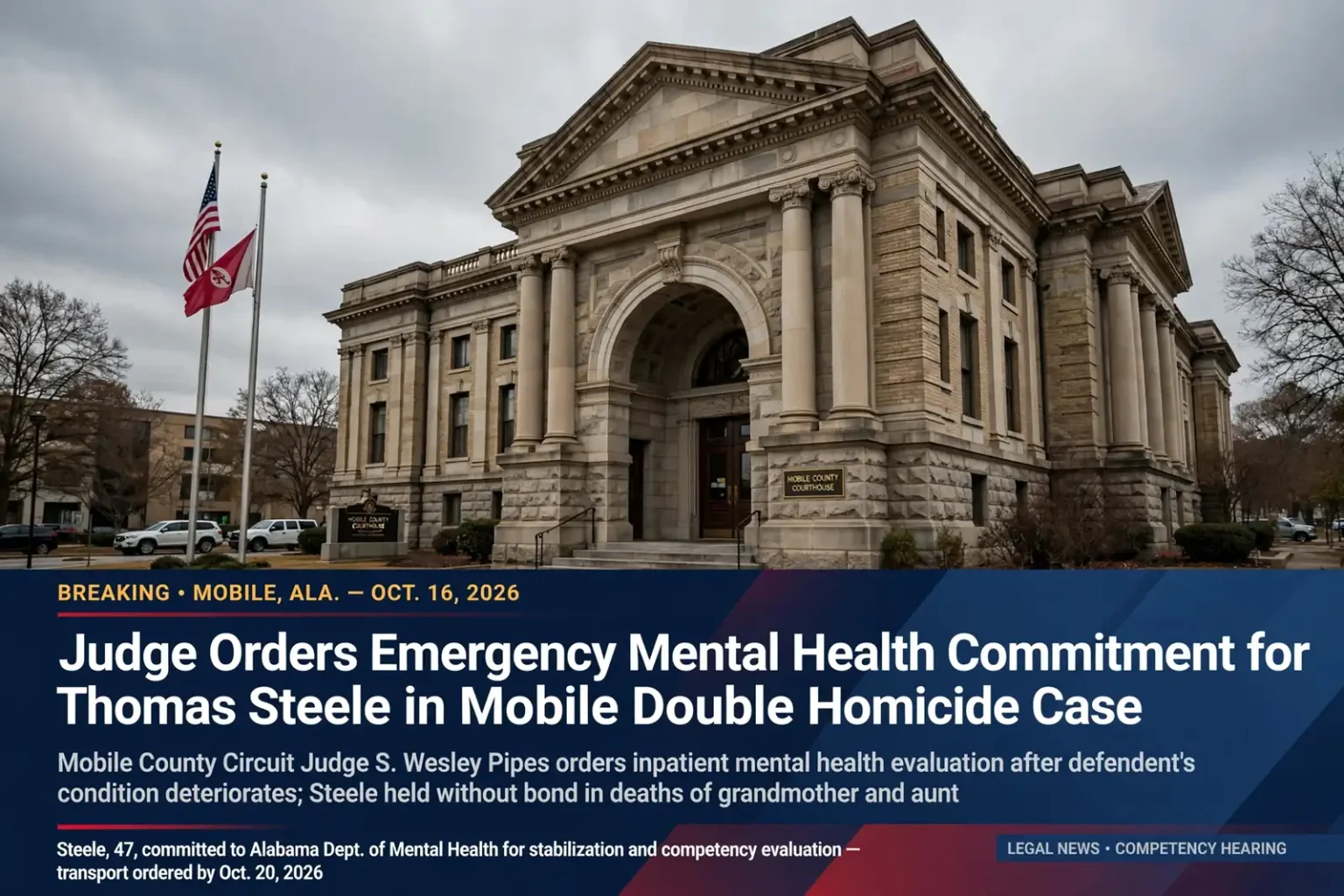
MOBILE, Ala. — A judge on Friday ordered Thomas Steele, the Mobile man charged with capital murder in the deaths of his grandmother and aunt, committed on an emergency basis to the Alabama Department of Mental Health, finding that his mental condition has worsened in the days since his arrest and that an outpatient evaluation would no longer be enough to judge whether he is fit to stand trial.
The order, filed Friday afternoon, Oct. 16, by Presiding Mobile County Circuit Judge S. Wesley Pipes, directs that Steele be taken into the department’s custody for stabilization, treatment and an in-patient evaluation of his competency. It requires that he be transported no later than Tuesday, Oct. 20.
Steele, 47, is charged with two counts of capital murder in the deaths of Dora Boone, 85, and her daughter, Christy DeLoach, 65, inside the Carolina Court home in west Mobile the three shared. He is held without bond at Mobile County Metro Jail. He has not been convicted of any crime and is presumed innocent.
Judge cites a ‘deteriorated’ condition
Friday’s order builds on an earlier decision. At Steele’s first court appearance on Tuesday, Oct. 13, Pipes denied bond and ordered a forensic evaluation through the Alabama Department of Mental Health to determine whether Steele is competent to proceed. That initial order contemplated an outpatient assessment, meaning evaluators would examine him while he remained in jail.
Three days later, the judge concluded that approach would not work. In his written order, Pipes said that after the first order was entered, “it has become apparent that defendant’s mental condition has deteriorated and that an outpatient evaluation will not be sufficient to determine his mental condition.”
The judge pointed both to Steele’s condition and to the case itself. “As such, and because of the severity and circumstances of the charges against defendant, it is ordered that he is immediately and on an emergency basis committed to the Alabama Department of Mental Health for stabilization, treatment, and an in-patient evaluation of his competency to stand trial, with transport to occur no later than October 20, 2026,” Pipes wrote.
The order does not describe what specific changes in Steele’s behavior or health prompted the decision. Jail records Friday still listed him as an inmate at Metro Jail, and it was not immediately clear whether he had been moved.
How the case reached this point
Mobile police were called to the 2400 block of Carolina Court, in the Chapel Hill subdivision, at about 1:36 p.m. Monday, Oct. 12, for a death investigation. Officers found the two women dead inside the home and took Steele into custody at the scene by about 2:30 p.m. He was first booked on two counts of murder, and the charges were upgraded the next day to capital murder.
A criminal complaint filed in Mobile County District Court alleges that Steele killed both women with a chainsaw. Authorities have not described a motive, and Mobile County District Attorney Keith Blackwood has said further details will come out in later court proceedings. DeLoach’s adult daughter, who also lived in the home, was reported to have been in the house at the time and was not hurt.
When Steele appeared before Pipes on Oct. 13, the judge raised the matter of appointing a lawyer. Steele said he had not hired one, and when the judge turned to the court-appointed attorney standing beside him, Steele quietly said, “Kill him.” Officers escorted him from the courtroom without a struggle. His appointed attorney told the court he believed a mental health evaluation was appropriate.
According to one report, Steele is scheduled to be arraigned Nov. 19. The emergency commitment and the competency process could affect that timeline, since a criminal case generally cannot move forward while questions about a defendant’s competency are unresolved.
A 911 call hours before the deaths
The court order arrives days after the release of a transcript of a 911 call placed from the Carolina Court home on the morning of Oct. 12. The dispatch office confirmed the call came from the residence. The caller, identified as DeLoach, phoned shortly after 11 a.m. to ask for advice about her nephew.
According to the transcript, she told the dispatcher that Steele, whom she described as bipolar, had stopped taking his lithium medication and was “doing some bizarre things.” She said he had told her he planned to devote his life to God and give up electronics, that he had canceled his benefits and was preparing to give away his car, and that she feared he would end up living on the street. She said she had already called the 988 crisis line and that he was not suicidal.
When the dispatcher asked whether Steele needed medical attention or had threatened anyone, DeLoach said no. “He’s calm! He’s not violent or anything,” she said, according to the transcript, adding that she might let the situation “play itself out.” The dispatcher offered the number for the Mobile Police Department, and the call ended. It is not known whether DeLoach later reached police.
According to the criminal complaint, the deaths occurred roughly two and a half hours after that call. Prosecutors have not commented on Steele’s psychiatric history, and the transcript reflects a family member’s description rather than any medical finding. Our earlier coverage includes more about the call and about the two women.
What an in-patient competency evaluation means
Competency to stand trial is a narrow legal question. It asks whether a defendant, right now, can understand the charges and court proceedings against him and can work with his lawyer on a defense. The standard comes from the U.S. Supreme Court’s 1960 decision in Dusky v. United States, and trying a defendant who does not meet it violates the constitutional guarantee of due process.
In Alabama, the procedure is set out in Rule 11 of the Alabama Rules of Criminal Procedure. When a judge finds reasonable grounds to doubt a defendant’s competency, the court orders an examination, and mental health professionals report their findings back to the judge. The judge, not the evaluators, makes the final ruling, typically after a hearing at which both sides can present evidence.
Many evaluations are done on an outpatient basis, with a forensic examiner interviewing the defendant in jail. An in-patient evaluation is different. The defendant is placed in a secure state facility, where clinicians can observe him over a longer period, provide treatment and gather a fuller picture before reaching conclusions. The Alabama Department of Mental Health’s forensic hospital for people committed through the criminal courts is Taylor Hardin Secure Medical Facility in Tuscaloosa. The order filed Friday commits Steele to the department and does not name a specific facility.
Pipes’ order also calls for “stabilization” and “treatment,” not only an evaluation. That wording allows clinicians to begin treating Steele’s condition rather than simply assessing it.
What could happen next
The competency process can unfold in several ways. Blackwood said earlier in the week that an evaluation could take 30, 60 or as long as 90 days.
- Found competent: If evaluators and the judge conclude Steele understands the proceedings and can assist in his defense, the case would resume, moving toward a preliminary hearing, grand jury review and arraignment in circuit court.
- Found incompetent: If Steele is found incompetent, the prosecution generally cannot proceed. He would remain in state care for treatment aimed at restoring competency, and the court would review his progress periodically.
- Restored to competency: If treatment restores his competency, the criminal case would pick up where it left off.
- Not restorable: The U.S. Supreme Court held in Jackson v. Indiana in 1972 that a defendant cannot be held indefinitely solely because he is incompetent to stand trial. In that situation, states typically turn to civil commitment proceedings if the person is found to pose a danger to himself or others.
Competency is separate from any insanity defense. Whether Steele can stand trial now is a different question from what his mental state was on Oct. 12. Under Alabama law, a defendant may be found not guilty by reason of severe mental disease or defect if, at the time of the offense, he was unable to appreciate the nature and quality or the wrongfulness of his acts. The defense must raise that claim and prove it by clear and convincing evidence. A defendant found not guilty on that basis can still be committed to state mental health care if he is considered dangerous.
Blackwood has said his office is prepared to prosecute the case “whichever path it goes.”
The charges and possible penalties
Steele is charged under the section of Alabama’s capital murder law that covers the killing of two or more people by one act or as part of one scheme or course of conduct. Capital murder is the most serious offense in the state’s criminal code. A conviction carries a sentence of either life in prison without the possibility of parole or death. Prosecutors have not said which penalty they would pursue, a decision that typically comes later in a case.
The Alabama Constitution allows judges to deny bail in capital cases when the proof is evident or the presumption great. Steele has been held without bond since his arrest.
Remembering the victims
Dora Boone and her late husband, Phillip, bought the Carolina Court home in 2014, according to deed records, and DeLoach lived there with them. Neighbors said DeLoach cared for her mother after her father’s death.
For nearly 20 years, DeLoach worked as a hairstylist at Mr. Sam’s Hair Fashion on McGregor Avenue in Mobile. Co-workers said she almost never missed a day, arrived with a smile and readily shared her faith with clients and colleagues. Neighbors described her as friendly and hardworking, with a love of gardening and family.
Mobile police continue to ask anyone with information about the case to call 251-208-7211 or text an anonymous tip to 844-251-0644.
Mental health advocates note that people living with mental illness are far more likely to be victims of violence than to commit it. Anyone worried about a loved one in a mental health crisis can call or text 988 to reach the 988 Suicide & Crisis Lifeline, which can connect callers with local crisis services. If someone is in immediate danger, call 911.