Fairhope Education Advisory Committee Plans Community Forum After Tax Vote
After Baldwin County voters rejected a school tax increase, Fairhope's Education Advisory Committee is organizing a public forum to gather input.
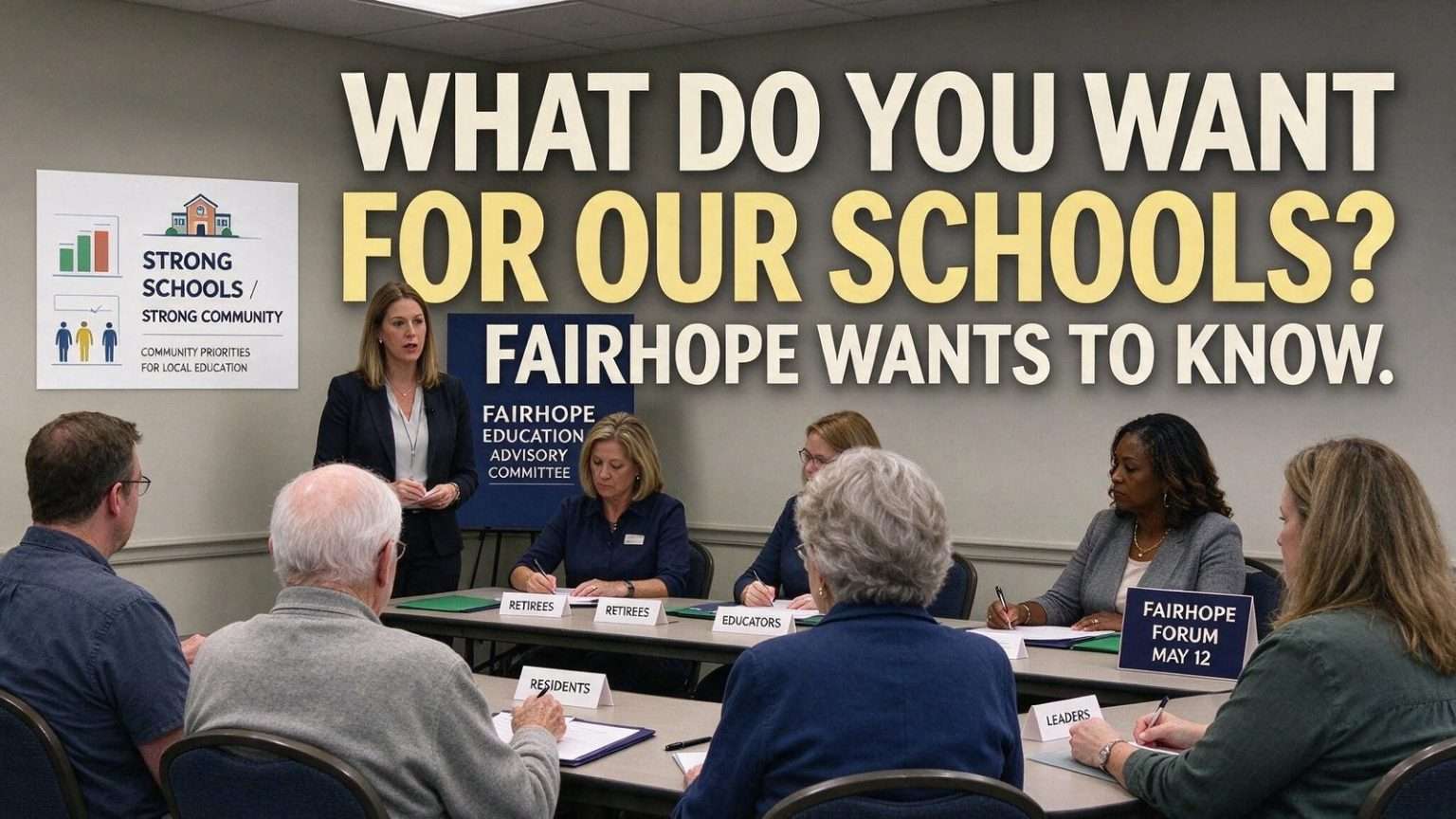
Fairhope officials are looking inward on public education after Baldwin County voters soundly rejected a proposed property tax increase for schools on March 31. The defeat has prompted the city’s Education Advisory Committee to organize its own community forum, tentatively scheduled for May 12, to gauge what residents actually want for local schools. The failed measure would have raised property taxes by 8 mills to help fund a 10-year, $350 million school expansion plan for Baldwin County. Two of three separate tax renewal measures on the same ballot also failed countywide, though Fairhope voters themselves approved all three renewals within city limits.
The split result made Fairhope’s vote count a subject of particular interest across the county. Within the city limits, voters supported the renewals — but the new 8-mill increase sank the overall effort, with more than 700 voters who backed the renewals switching their stance against the additional tax. The pattern suggested that Fairhope voters were not rejecting school funding outright, but declining to underwrite a specific plan.
Unpacking the Vote
Councilwoman Diana Brewer, the city council’s liaison to the Education Advisory Committee, said the panel met the day after the vote to start unpacking what happened. “The question was: what were people voting against?” Brewer said, noting that the reasons likely varied widely among voters. The upcoming forum is meant to move past that question and toward a longer-term conversation about what residents want from Fairhope’s schools.
The distinction matters for any future request for school funding. A ballot measure bundles many decisions into one choice — the size of the tax, the school system’s capital plan, the allocation across a county of vastly different communities — and defeat can mean objection to any one of them. Brewer’s question captures the uncertainty facing both the school board and city officials: whether the no votes were aimed at the millage, at particular projects in the expansion plan, or at a broader distrust of how the money would be spent.
The stakes extend well beyond this year’s ballot. Baldwin County Public Schools is one of the largest school systems in Alabama, covering a county whose population has boomed while its school facilities have strained to keep pace. The $350 million plan represented the system’s answer to that growth, and its failure leaves the district searching for another path to fund classrooms across communities from Bay Minette to Gulf Shores.
Five Groups, Five Visions
Plans call for dividing forum participants into five groups: city residents with children, people who live outside the city limits but use its schools, retirees, community leaders and educators. Each group would be asked to articulate its own vision for local education, according to Brewer.
The structure is designed to surface differences that a single open meeting might blur. Retirees on fixed incomes, parents weighing classroom sizes, and educators living the daily realities of the schools each carry distinct priorities, and Fairhope’s unusual position — a city whose schools draw students from well beyond its corporate limits — adds a constituency that few municipal forums must accommodate. Asking each group for its own vision, rather than a collective statement, lets the committee compare what each segment of the community actually values.
Details, including the exact time and location, are expected to be finalized at the committee’s meeting on April 15 at the Fairhope Public Library board room, with a full briefing to follow at the city council’s April 27 work session. Organizers have discussed holding the forum at 6 p.m. on May 12 at the Fairhope United Methodist Church’s Christian Life Center on Morphy Avenue.
Local economist Semoon Chang, director of the Gulf Coast Center for Impact Studies, is expected to speak at the event about the economic stakes tied to public education funding in Baldwin County. Chang has long tracked the Eastern Shore economy, and his participation signals the forum’s framing: school funding as an economic issue that shapes property values, business recruitment and the city’s appeal to families, not merely a tax question.
A City That Has Invested in Its Schools
The forum builds on a track record of city investment in schools. Since 2012, when four new council members took office, Fairhope’s council has approved more than $1 million for the five-school feeder pattern that includes Fairhope High, Fairhope Middle, Fairhope Intermediate, Fairhope Elementary and J. Larry Newton Elementary. Just before the referendum, the council unanimously backed renewing 7 mills of existing property tax alongside the since-rejected 8-mill increase.
That history shapes the city’s unusual role in school politics. Fairhope is one of the Baldwin County communities whose schools define its identity — the system’s reputation is part of what draws families to the Eastern Shore city — and the council’s million-dollar support for the feeder pattern reflects a willingness to supplement county dollars with city money. The unanimous vote to renew the existing 7 mills, even as the countywide package failed, gave Fairhope’s position a concrete marker: keep what funds the schools today, ask questions about what the new money would buy.
Mayor Tim Kant said he believes residents broadly value education but were unsettled by the specifics of the county school board’s capital plan, which included reopening a K-1 center downtown that had closed in 2011 and adding 20 classrooms to Fairhope High. “I think some of the choices they had were confusing,” Kant said, adding that officials now have to work with the outcome voters delivered.
The two projects Kant cited were among the most debated elements of the plan locally. Reopening the downtown K-1 center, closed just three years earlier, raised questions about whether the district’s own recent decisions had contributed to the crowding the tax was meant to relieve, while the addition of 20 classrooms at Fairhope High would reshape one of the city’s most visible campuses. Voters who supported school funding in principle could reasonably ask whether those specific choices represented the best use of an 8-mill increase.
The Numbers Behind the Referendum
Turnout for the March 31 referendum was about 38 percent of registered voters, with just over 4,000 of roughly 10,500 eligible voters casting ballots at the Fairhope Civic Center. The single-site election concentrated voting in one location downtown, and the turnout figure, while modest, ran high for a special election on a standalone question.
Special elections live or die on turnout, and the 38 percent figure indicates that the tax question genuinely engaged the community. Campaigns on both sides had weeks to make their case, and the intensity of the vote — including the more than 700 voters who split their ballots between the renewals and the increase — shows an electorate sorting through the details rather than delivering a blanket verdict on education.
That split is what the Education Advisory Committee’s forum hopes to unpack. If the countywide result were read as simple opposition to school spending, Fairhope’s own numbers would contradict it; the city approved the renewals that anchor existing school funding. The committee’s task, as Brewer framed it, is to convert that mixed message into a clear statement of what Fairhope residents want — and to give both the school board and the city council a picture of public priorities before any future request reaches the ballot again.
What a Community Forum Can Change
Community forums occupy a particular place in Alabama local government. They carry no formal power — no ordinance, no appropriation — but they give elected officials something ballots rarely provide: a detailed, face-to-face read on what constituents actually want, gathered before the next high-stakes decision. For a city like Fairhope, whose council has already shown a willingness to spend city money on schools, the forum’s findings could directly shape the next round of city contributions to the feeder pattern.
The timing also matters for the Baldwin County school board. A district that just saw a $350 million plan rejected must decide whether to revise the plan, seek alternative funding, or defer expansions and absorb the crowding that comes with the county’s growth. A clear articulation of what Fairhope residents would support — and what they rejected — offers one community’s answer at a moment when the board is recalibrating countywide.
For residents, the forum is a chance to move past the binary of a ballot question. Voters could only choose yes or no in March; in May, participants in the five groups can say what they would fund, what they would cut, and how the schools they use should grow. That granularity is what Brewer and the committee are after, and it is the kind of input that rarely survives the compression of a referendum.
The Road to May 12
The schedule runs through April and into May: committee finalization on April 15 at the library board room, a council work session briefing on April 27, and the forum itself — tentatively 6 p.m. on May 12 at the Christian Life Center on Morphy Avenue — with Chang’s economic presentation anchoring the evening. Each step is public, consistent with the city’s practice of conducting school-related business in open sessions.
Whether the forum produces a consensus or simply a clearer map of disagreement, its outcome will inform how Fairhope approaches the next phase of school funding politics in Baldwin County. The city enters that phase from a distinctive position — a council that has spent its own money on schools, a mayor who believes his residents value education but questioned the plan’s specifics, and a community whose voters split their ballots in ways that invite exactly the conversation the committee has organized.
The broader lesson of the March 31 vote may be that support for schools and support for a plan are two different things, and Baldwin County’s communities will be sorting out the difference for months to come. Fairhope’s forum, whatever it produces, is an early attempt to do that sorting in public — with retirees, parents, educators, community leaders and out-of-limits school users each given a seat at the table and a chance to say what they want from the schools that serve the Eastern Shore.