Mobile Opera Artistic Director Steps Down Amid Funding Cuts
Mobile Opera's longtime artistic director has resigned after budget cuts forced the arts organization to restructure how it operates.
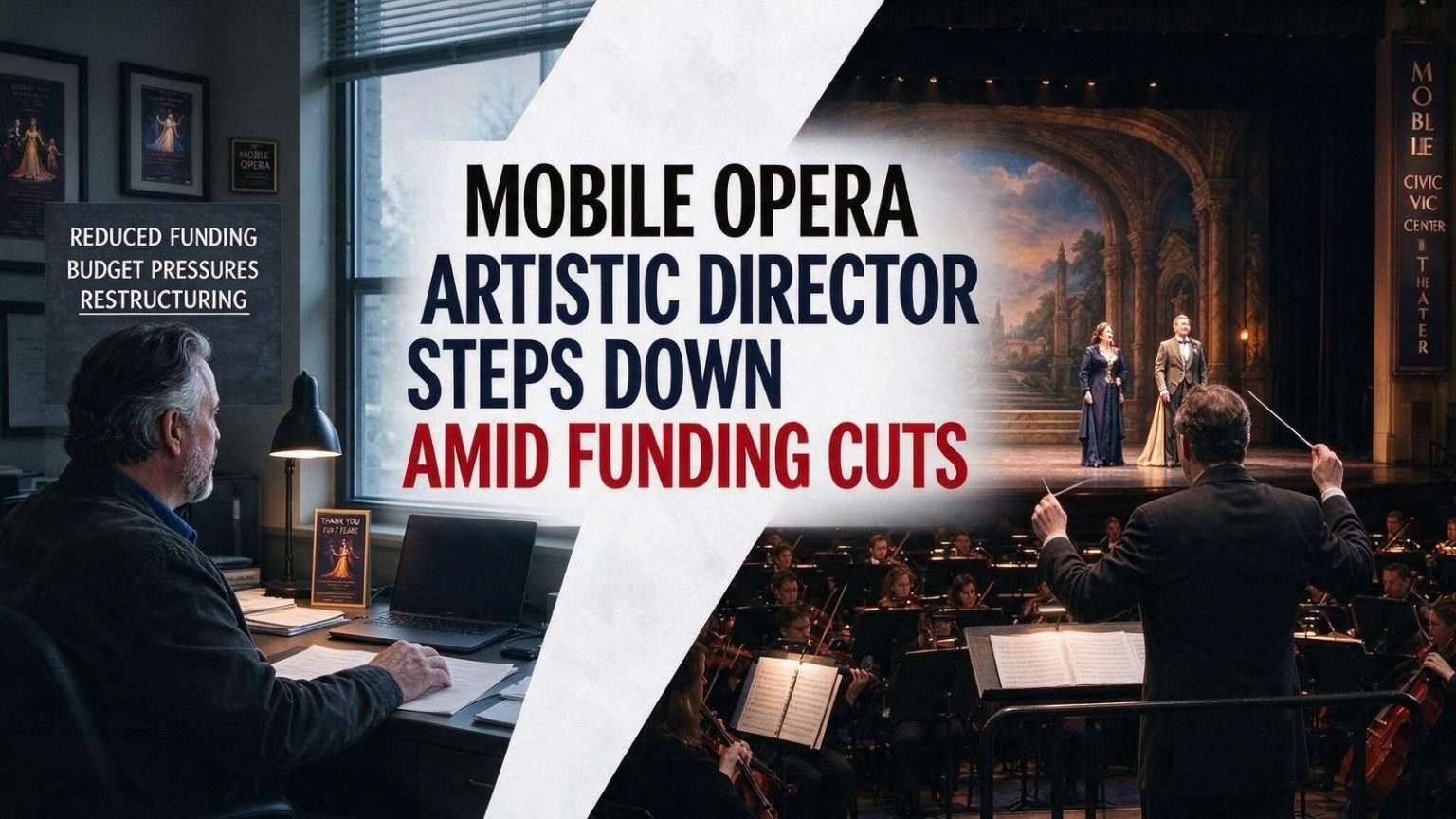
Mobile Opera is entering a new chapter after its artistic director of seven years stepped down, a change the organization says was driven by financial pressures rather than performance. The departure removes one of the company’s two top leadership positions and marks a significant shift in how the organization will produce opera in Mobile going forward. The director told colleagues he had been carrying a resignation letter for months before a meeting last week made the decision final. He said the position was being eliminated as part of a broader restructuring tied to reduced arts funding, and that he held no ill will toward the organization or the city he has called home for years.
Before coming to Mobile, the director held posts with opera and orchestra programs in Kansas City, and he says he now plans to focus on guest conducting engagements around the country. His seven-year tenure spanned a period of considerable change for the company, which like many mid-sized opera organizations has worked to balance artistic ambitions against a shifting funding landscape. Colleagues describe his departure as amicable, and his move back into guest conducting follows a path familiar to many regional arts leaders whose full-time posts have been reduced or consolidated in recent years.
Mobile Opera’s general director said the company does not intend to hire a replacement. Instead, the artistic director’s responsibilities — from selecting each season’s productions to casting singers and preparing English supertitles for foreign-language works — will be absorbed into the general director’s own role. Future conductors for Mobile Opera performances will instead be brought on for individual shows rather than as a salaried position. The approach converts a fixed annual salary cost into production-by-production expenses, giving the company flexibility to scale its staffing to each show’s budget while reducing the organization’s ongoing payroll obligations.
Leadership was careful to note the departure had nothing to do with the departing director’s work, calling him a skilled musician who did excellent work during his tenure. That framing reflects the delicate position arts organizations occupy when financial necessity forces staffing changes, since maintaining relationships with the conductors, singers and directors who work production to production is essential to future seasons. Company leaders have emphasized that the restructuring is intended to preserve Mobile Opera’s performance schedule, not to scale it back.
The 2014 funding cuts that reshaped Mobile arts groups
The shake-up traces back to cuts announced in 2014 affecting arts organizations that receive support from the city of Mobile. Mobile, like many American cities, has long channeled modest municipal funding to cultural organizations, treating the arts as part of the city’s economic and civic life alongside tourism and downtown development. When city budgets tightened, the organizations that depended on that support were forced to make their own hard choices, and Mobile Opera’s restructuring is among the most significant reorganizations to result from the cuts.
Among the changes was the end of a rent waiver Mobile Opera had relied on for its performance space at the Mobile Civic Center Theater, a cost the company says has added tens of thousands of dollars to its annual budget. The Civic Center, the city-owned downtown complex that has hosted concerts, Broadway tours and community events for decades, had effectively provided the opera company free or reduced use of its theater as a form of municipal support. Once the waiver ended, the company began paying market-rate costs for its performance home, an expense that flowed directly through to a budget already strained by reduced public funding.
The loss of the rent waiver illustrates how small changes in municipal policy can cascade through nonprofit cultural organizations, which typically operate with thin reserves and little capacity to absorb new annual costs. For a company staging fully produced operas, with orchestras, sets, costumes and singers, tens of thousands of dollars in new venue costs represent a meaningful share of a season’s budget. Mobile Opera’s leadership has said the restructuring is designed to put the company on sustainable footing in light of that new reality.
A spokesperson for the mayor’s office pushed back on the idea that city funding decisions were solely to blame, saying Mobile Opera’s internal financial management played a significant role in the restructuring. The spokesperson emphasized that the mayor remains a strong supporter of the arts community, even as the city works through difficult budget choices. The exchange highlights a familiar tension between city hall and the cultural sector, in which municipal officials point to the total support they provide and the broader budget pressures they face, while arts leaders measure the consequences of each specific cut to their operations.
What the restructuring means for opera in Mobile
For audiences, the most immediate question is how the consolidation of artistic leadership will shape future seasons. The artistic director’s duties covered the creative core of the company’s work: choosing which operas to stage, matching singers to roles, and preparing the English supertitles that make foreign-language works accessible to Gulf Coast audiences. Folding those responsibilities into the general director’s role concentrates both the business and artistic sides of the company in one office, a model smaller opera companies increasingly adopt when financial pressures make dual artistic and administrative leadership difficult to sustain.
The shift to per-production conductors also changes the texture of the company’s performances. Guest conductors hired show by show are common across regional opera, and the practice gives Mobile Opera the ability to match a conductor’s strengths to each production on the calendar. The trade-off is continuity, since a salaried artistic leader typically builds relationships with the company’s singers, musicians and chorus across seasons in ways that show-by-show hires cannot. Company leaders have said the goal is to maintain the quality of productions while operating within a leaner structure.
Mobile Opera occupies a distinctive place in the city’s cultural landscape as a company that has brought fully staged opera to the Gulf Coast for decades, serving an audience that spans Mobile, Baldwin County and the broader region. The company’s productions rely on a mix of professional singers, regional talent and community support, and its performances at the Civic Center Theater have long been fixtures of the downtown cultural calendar. How the company navigates its new financial structure will be watched closely by other area arts groups facing similar pressures.
The broader funding climate for Mobile arts organizations
Mobile Opera is not alone in confronting the arithmetic of reduced public support. Cultural organizations across Mobile have adjusted to the funding environment since the 2014 cuts, with some trimming staff, some relying more heavily on volunteers, and some partnering with schools, churches and community groups to stretch their programming budgets. The city’s arts sector includes a range of museums, theater companies, dance organizations and music groups, all of which compete for a pool of private donations and grant funding alongside the municipal support that remains available.
Arts advocates in Mobile have argued that the sector’s economic contribution justifies public investment, pointing to the audiences that cultural events bring downtown to restaurants, parking facilities and businesses on performance nights. City officials, meanwhile, face recurring pressure to fund streets, drainage, public safety and other core services, and arts appropriations sit in direct competition with those demands. The result has been a prolonged recalibration, in which organizations that once counted on steady municipal support have rebuilt their budgets around private philanthropy, ticket revenue and earned income.
For now, Mobile Opera says it is focused on stabilizing its finances while continuing its performance schedule, with the general director taking on a larger role in shaping upcoming seasons. The company has not announced plans to change the scale or number of its productions, and its leadership has framed the restructuring as a way to protect the art form’s future in Mobile rather than retreat from it. Whether the leaner structure succeeds will depend on the same forces that confront every cultural nonprofit on the Gulf Coast: sustained private giving, steady audiences and the continued goodwill of a city whose support, while reduced, remains part of the company’s foundation.
Opera company economics in mid-sized American cities
The pressures confronting Mobile Opera mirror those felt by opera companies across the country outside the largest metropolitan markets. Fully staged opera is among the most expensive art forms to produce, requiring orchestras, professional singers, stage crews and elaborate productions, while ticket revenue typically covers only a fraction of the cost of mounting a show. Mid-sized companies bridge that gap through donations, grants and endowment income, which makes them particularly sensitive to shifts in public funding and philanthropic priorities. When one source of support shrinks, the shortfall must be made up somewhere, and staffing is often where the adjustment lands first.
The per-production conductor model that Mobile Opera is adopting has become increasingly common among regional companies seeking to preserve their seasons while controlling fixed costs. Under that structure, each show carries its own staffing costs, and a season can be scaled up or down depending on the money available. For the departing artistic director, the move to guest conducting around the country follows the same logic from the artist’s side, as working musicians increasingly assemble careers from a series of engagements rather than a single salaried post.
For Mobile audiences, the practical test of the restructuring will come with the company’s next productions, when the general director’s expanded role and the guest conductor arrangement are first put into practice. Company leaders have committed to maintaining the English supertitles, casting standards and production values that patrons have come to expect, and the departing director’s tenure provides a benchmark for the seasons ahead.