Mobile Wins $1.65 Million Bloomberg Grant for Neighborhood Revitalization
Mobile Mayor Sandy Stimpson announced the city was selected for a Bloomberg Philanthropies program worth up to $1.65 million to tackle blight and revitalize struggling neighborhoods.
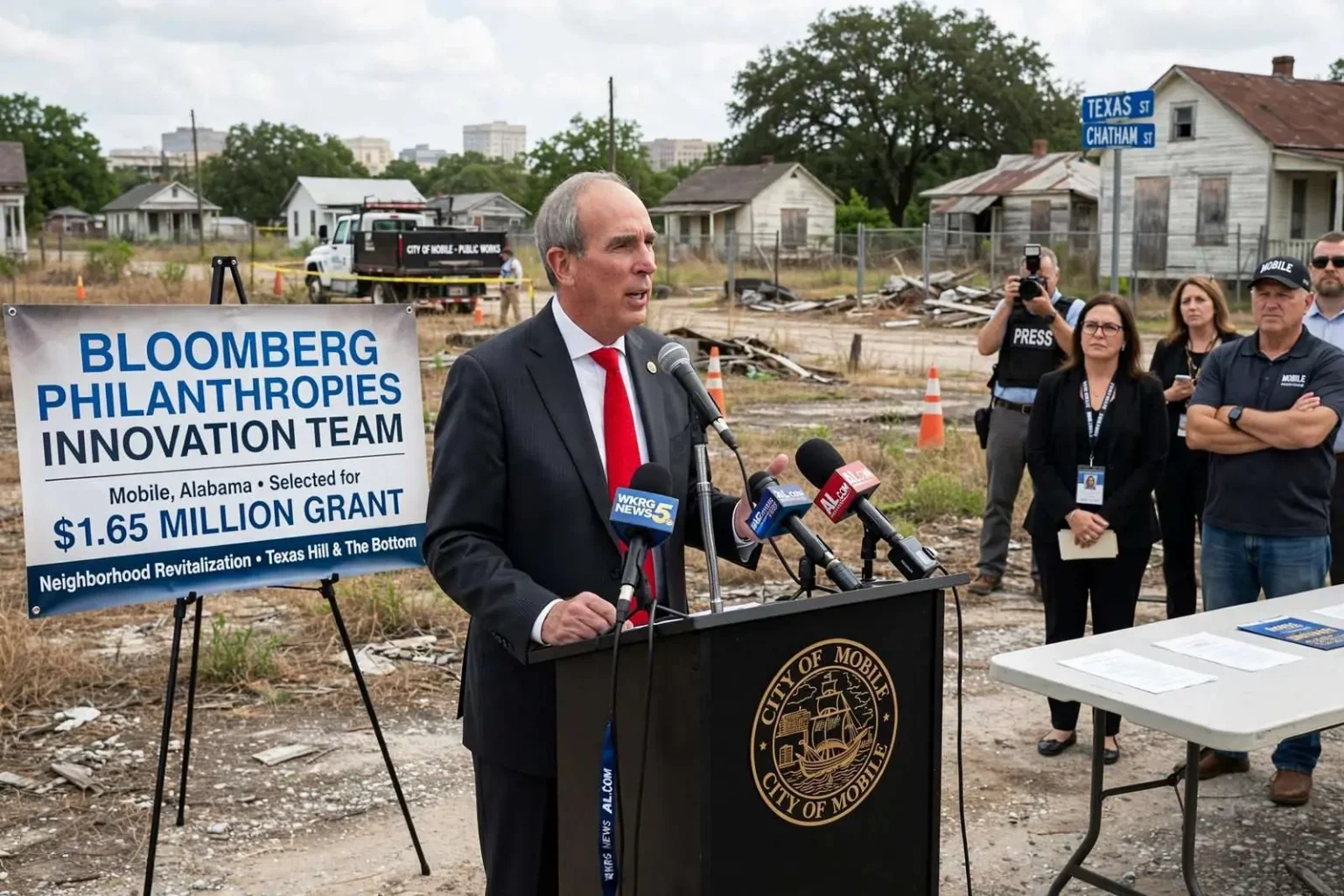
MOBILE, Alabama – Mobile Mayor Sandy Stimpson announced from a vacant lot in the Texas Hill community that the city had been selected as one of just a dozen U.S. cities chosen to join the latest expansion of Bloomberg Philanthropies’ Innovation Team program, a distinction that comes with as much as $1.65 million in funding over three years. Standing near the intersection of Texas and Chatham streets, Stimpson told a small crowd gathered for the announcement that the grant validated the administration’s broader push to position Mobile as one of the safest and most business- and family-friendly cities in the country by 2020.
“This award will provide critical resources to help us move forward on our journey. But it’s about much more than just money. It’s a validation of our efforts to transform Mobile,” Stimpson said. The mayor’s decision to deliver the announcement from an empty lot rather than a ceremonial venue underscored the subject at the heart of the city’s application: stubborn pockets of vacancy and blight that persist within sight of a revitalizing downtown.
The Innovation Team, or “i-team,” program was created by Bloomberg Philanthropies, the foundation established by former New York City Mayor Michael Bloomberg. The program’s central premise is that many of the problems cities face — vacant properties, aging infrastructure, inefficient services, lagging economic opportunity — are not unique to any one municipality, and that a small, dedicated in-house team freed from day-to-day bureaucracy can prototype solutions faster than traditional departments working alone.
Twelve U.S. cities selected for this round of the program are together splitting $45 million in funding aimed at helping local governments develop creative solutions to persistent urban challenges. The selection process drew applications from large and mid-sized cities across the country, and Mobile’s inclusion in such a small cohort places it alongside municipalities that Bloomberg Philanthropies identified as having both serious challenges and administrations capable of acting on new ideas. For a city of Mobile’s size, the grant ranks among the larger philanthropic investments in municipal government in recent memory.
How the i-team will work in Mobile
In Mobile’s case, the funding is expected to support a newly formed i-team made up of three full-time staff members plus additional support, with the team expected to begin its work by the following spring. The arrangement follows the model used in other Innovation Team cities, where team members typically bring backgrounds in data analysis, project management, design and public policy rather than traditional city department silos.
Stimpson said Bloomberg’s on-loan staff would help assess the city’s priorities and determine how the funding should be deployed once the team is in place. That expert support is a significant part of the grant’s value beyond the money itself: Innovation Team cities receive hands-on guidance from the foundation’s staff and access to a network of counterpart teams in other cities working on similar problems, allowing lessons learned in one community to be quickly applied in another.
City officials said the i-team’s mission will center on neighborhoods struggling with blight, poverty and high rates of vacant housing. The focus reflects a long-running tension in Mobile’s economy: while the downtown core has attracted new investment, restaurants and residential conversions in recent years, several historic neighborhoods immediately north of the central business district have continued to lose population and see properties fall into disrepair or tax delinquency.
An assistant city attorney identified two areas already targeted for revitalization efforts: the Texas Hill neighborhood and a nearby community known as The Bottom, both located north of Dr. Martin Luther King Jr. Avenue just a half mile from downtown Mobile. The proximity is striking for visitors and residents alike — neighborhoods marked by vacant lots and aging housing stock sit a short walk from offices, courthouses and the new investment along Bienville Square and Government Street.
Texas Hill, named for its elevated position above the surrounding lowlands, is one of Mobile’s oldest neighborhoods, with a housing fabric of early- and mid-twentieth-century cottages and shotguns built for workers who once filled nearby industries and the Port of Mobile’s docks. Like much of the area around Dr. Martin Luther King Jr. Avenue, the neighborhood has battled population loss since the middle of the last century, when highway construction, industrial decline and suburban migration hollowed out many of the city’s close-in communities.
The Bottom, similarly, takes its name from its low-lying geography along the southern edge of Three Mile Creek. Flooding and repeated storm damage contributed to decades of disinvestment, and large portions of the neighborhood remain owned by absentee landlords or have reverted to public and nonprofit hands through tax sales and demolitions. City crews have cleared dozens of derelict structures in the area over recent years, leaving behind the vacant lots that now dot the landscape.
Why the money matters more than the amount
While $1.65 million is a modest sum against the scale of neighborhood redevelopment — where a single house rehabilitation can run well into six figures — officials emphasized that the grant is not a construction fund. Instead, the i-team is intended to change how the city approaches the problem: mapping vacant property ownership, coordinating code enforcement, connecting lots and houses to reuse strategies, and testing approaches on a small scale before asking taxpayers to fund them broadly.
That data-driven approach is precisely what the Bloomberg Philanthropies program was designed to encourage. In earlier rounds of the program, Innovation Teams in other cities used their funding to tackle issues ranging from vacant and abandoned properties to small-business permitting, neighborhood blight, public health and government service delivery. Several teams produced policy changes or pilot programs that cities later expanded with their own budgets, which is the outcome philanthropic officials say they most hope to see.
For Mobile, the timing of the grant aligns with other efforts already under way. The city has pursued demolition of unsafe structures, land banking conversations and redevelopment planning in the neighborhoods north of downtown, and the announcement venue itself — a cleared lot in Texas Hill — illustrated both the scale of the challenge and the city’s interest in putting the properties back into productive use.
The Stimpson administration has made neighborhood revitalization a stated priority alongside its downtown-focused economic development record. Officials have repeatedly framed the city’s future competitiveness in terms of whether Mobile can offer safe, attractive neighborhoods as well as a thriving core, a message the mayor echoed in his remarks accepting the Bloomberg grant. The administration’s stated goal of making Mobile one of the country’s safest and most business- and family-friendly cities by 2020 gives the i-team a concrete benchmark against which its work can be measured.
What residents can expect next
With the city’s selection now formal, the next steps involve hiring and onboarding. The three-person core team will be recruited and seated with support from Bloomberg Philanthropies’ on-loan experts, and the group is expected to begin its work by the following spring. Early months will likely be devoted to research: assembling data on vacancy, code violations, ownership patterns and service requests in the target neighborhoods, and interviewing residents and stakeholders about what has and has not worked in past revitalization attempts.
Residents of Texas Hill, The Bottom and surrounding streets have seen study efforts come and go before, and skepticism about whether this round will produce visible change is common in areas long familiar with planning documents. The i-team model’s emphasis on rapid prototyping — testing interventions quickly, measuring results and discarding what fails — is designed in part to answer that skepticism by producing tangible early results rather than multi-year studies.
City officials said the grant period runs three years, giving the team a defined window to demonstrate progress on the blight, poverty and vacancy challenges in the target areas. Progress reports to Bloomberg Philanthropies are a standard condition of participation, and the foundation tracks team outcomes across its national network, giving Mobile an external accountability mechanism it would not otherwise have.
The broader stakes for Mobile
The half-mile stretch between downtown and Dr. Martin Luther King Jr. Avenue has become something of a barometer for Mobile’s revitalization narrative. Investments near the central business district have raised expectations that momentum will eventually spread northward, and the Bloomberg grant gives city government a dedicated tool for accelerating that spread rather than waiting on the private market to act on its own.
Community advocates have long argued that the neighborhoods north of Government Street hold some of the city’s best architectural stock and most convenient locations, and that targeted public investment — in streets, parks, code enforcement and housing rehabilitation — could unlock private reinvestment the way it has in other Southern cities that confronted similar vacancy challenges. Whether the i-team’s work proves that thesis in Mobile will be one of the more closely watched civic stories of the grant period.
For the Stimpson administration, the award also carries reputational weight. National philanthropic selection processes put a city’s management practices under scrutiny, and being chosen from a competitive national field signals to other funders and employers that Mobile’s government is viewed as capable of executing new initiatives. Officials have suggested the grant could help position the city for additional philanthropic and federal opportunities that favor cities with demonstrated capacity.
The announcement from the vacant lot at Texas and Chatham streets was, in that sense, both literal and symbolic: the city chose to stand exactly where the problems are most visible and declare that this is where the new resources will be pointed. The three full-time staff members who arrive by next spring will inherit a to-do list measured in hundreds of vacant properties, but they will also arrive with funding, expertise and national backing that neighborhood revitalization efforts in Mobile have rarely enjoyed.
As the i-team takes shape over the coming months, residents can expect public updates on its priorities and early projects. City officials said the team’s specific work plan will be refined with input from the community and from Bloomberg’s on-loan staff, and that the foundation’s emphasis on measurable outcomes means Mobile’s progress — or lack of it — will be documented and shared across the national network of Innovation Team cities. For a community that has watched revitalization plans gather dust, that visibility may prove as valuable as the $1.65 million itself.