Baker High School Drama Teacher Turns Shakespeare Into Real Talk for Teens
A Baker High School theater teacher in Mobile County uses emotional memory techniques to help students connect with Shakespeare and build stage confidence.
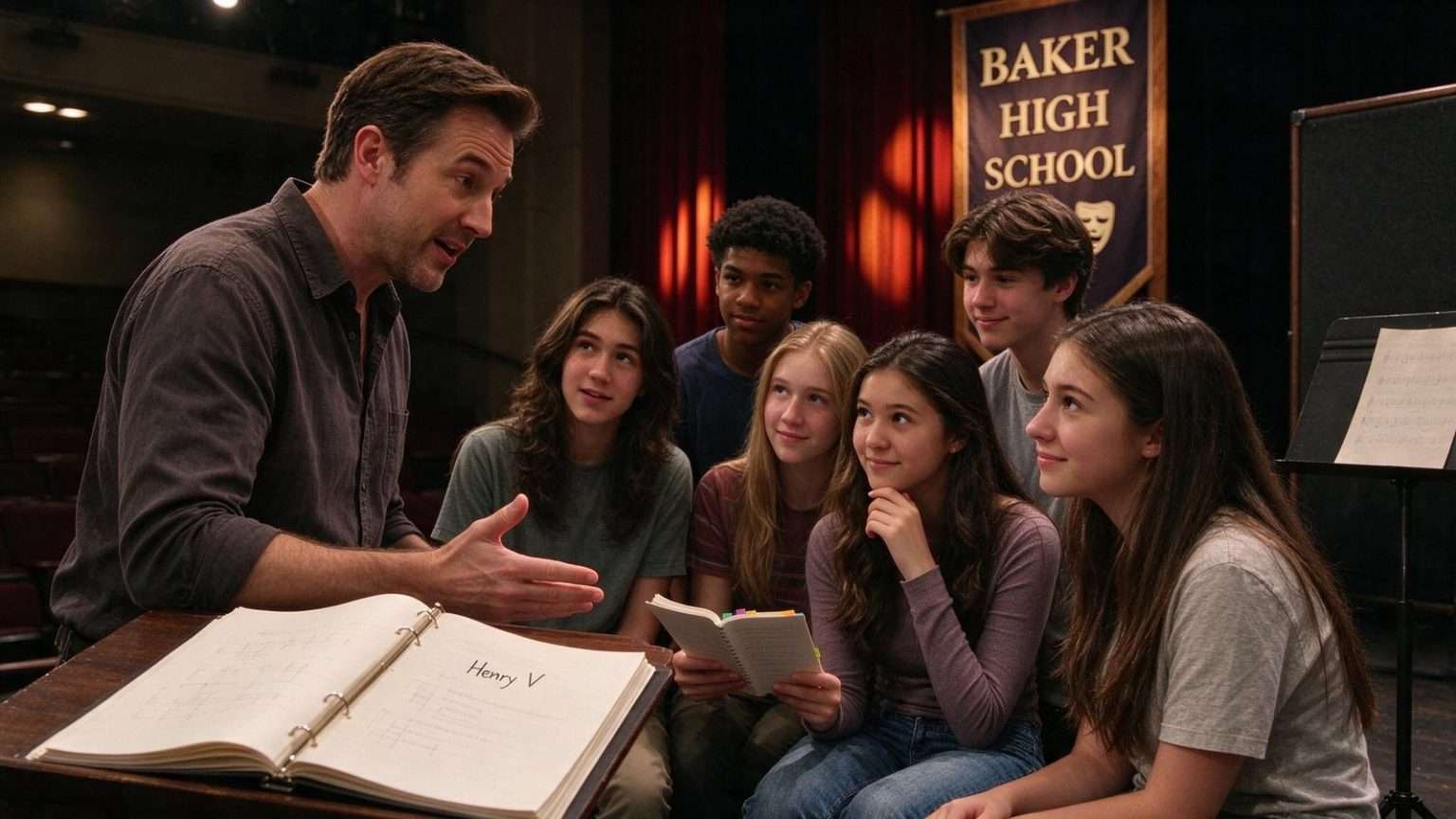
At Baker High School in west Mobile, one theater teacher has built a reputation for helping teenagers find themselves in some of literature’s oldest and most dramatic characters, from Shakespearean kings to star-crossed lovers.
Now in his fourth year teaching theater at Baker, the instructor previously spent five years running the drama program at Alma Bryant High School after graduating from the University of Montevallo with a degree in acting and directing. He later earned a master’s degree in liberal arts from Spring Hill College, stacking credentials from two of Alabama’s most respected liberal arts institutions onto a career spent almost entirely in public school classrooms.
The path from Montevallo’s theater program to Mobile County’s high school stages is a well-traveled one for Alabama theater artists. The university’s acting and directing program has long sent graduates into education and regional theater across the Southeast, and for many, the high school classroom is where the art form’s next audience is built.
A Second Life in Community Theater
Beyond the classroom, he stays active in the region’s community theater scene, directing an average of two productions a year at venues including the Mobile Theatre Guild, Theatre USA and the Joe Jefferson Playhouse, where he most recently directed a fall production of “Into the Woods.” The double duty — a full teaching load by day, a director’s schedule by night — is common among the Gulf Coast’s working theater artists, for whom the schools and the community stages have always been two halves of the same craft.
Those three institutions form the backbone of Mobile’s stage life. The Mobile Theatre Guild is one of the oldest community theaters on the Gulf Coast; Theatre USA connects the university’s campus to public audiences; and the Joe Jefferson Playhouse — named for the 19th-century actor who made Mobile his home — has anchored the city’s playgoing tradition for generations. Working across all three keeps a director busy, and it keeps him plugged into the adult theater community his students eventually join.
“Into the Woods,” Sondheim’s intertwined fairy-tale musical, is a favorite of school and community directors for good reason: it offers substantial roles across a wide cast, music that stretches young voices and themes about choices and consequences that land with teenagers as well as adults. A fall production at the Playhouse is the kind of project that fills rehearsal calendars for months.
He also helps organize the regional rounds of a statewide theater competition for young thespians, giving Mobile County students a chance to compete alongside peers from across Alabama. Competitive theater — one-act plays, individual events in acting and technical categories — has become a significant pipeline in the state, connecting high school programs to troupes, scholarships and college programs.
Teaching Shakespeare Through Real Life
In the classroom, the teacher relies heavily on a technique rooted in the Stanislavski method, encouraging student actors to draw on their own emotional memories rather than simply reciting Shakespearean verse as poetry. The method, developed by the Russian director Konstantin Stanislavski more than a century ago, treats acting as an act of truthful imagination: an actor builds a character from the inside out, finding the personal experience that makes the words believable.
He described coaching a football player playing King Henry to think about the character’s questions of authority and leadership in terms of his own experience leading teammates, drawing a direct line between a 400-year-old soliloquy and a modern teenager’s everyday life.
“Human emotions haven’t changed through all this time,” he explained, describing his approach to helping students relate to Shakespearean characters despite the unfamiliar language. The insight is the working philosophy behind his classroom: strip away the Elizabethan vocabulary and a king’s fear of losing his throne, a lover’s jealousy or a daughter’s defiance of her father are emotions any Baker High student recognizes from their own week.
That approach also explains why he embraces the casting surprises other teachers might avoid. A linebacker as Henry V is not a novelty act under the Stanislavski method — it is an opportunity, because the athlete arrives knowing exactly what it costs to lead, to be watched and to be responsible for people counting on him.
Favorite Plays and Growing Interests
His favorite plays to teach include “Much Ado About Nothing” for its humor and “A Midsummer Night’s Dream,” though he noted growing student interest in less commonly performed history plays like “Henry IV” and “Richard III.” The shift is notable; history plays demand more background from an audience, but they offer students characters wrestling with power, legitimacy and consequence — material teenagers increasingly find compelling.
The appetite for the histories also says something about where young audiences are. Stories of heirs and usurpers, of leaders who win crowds with words and lose themselves in ambition, read differently to a generation following politics and power unfold in real time on their phones. Teachers who pay attention to what students ask for — as this one does — find their course materials evolving with each class that walks in.
Baker High’s program benefits from a teacher who works both sides of the footlights. Classroom technique draws on his Montevallo training; production seasons draw on the professional habits of a working director; and the community stages draw, in turn, on the energy of the school program that keeps supplying audiences and future cast members. In a city the size of Mobile, that circuit is how theater stays alive between the big professional tours that pass through the region.
More Than Performance Skills
Beyond performance skills, the teacher said his broader goal is what theater gives students who never plan to set foot on a stage after graduation: confidence in front of a crowd, the discipline of rehearsal, the habit of listening and responding, and the empathy that comes from inhabiting a life unlike your own. Employers and colleges may never see the Stanislavski technique behind a student’s poise in an interview, but the training shows.
That is the quiet argument high school theater teachers make every season. A production is a months-long collaborative project with real deadlines and a paying audience — or at least a filled auditorium of families — and the students who carry it learn project management, teamwork and public performance as a byproduct of doing something they love.
At Baker High School, the theater program competes for students’ time with athletics, band, JROTC and the full calendar of a large west Mobile campus. A teacher who can recruit a football player into the lead of a Shakespeare play, as this one has, is filling his stage with exactly the cross-section of the student body that makes school theater matter as a community institution rather than a niche club.
The Mobile County Theater Pipeline
The ecosystem this teacher works within — Baker High, Alma Bryant before it, and the community stages of Mobile — shows how local theater sustains itself. High school programs feed the community theaters; community theaters give graduates a place to keep acting; and the universities, from Montevallo to Spring Hill to the University of South Alabama, supply the training that cycles back into the schools as the next generation of teachers and directors.
His two-productions-a-year pace as a community director is itself a form of teaching. Community casts typically mix veteran actors with first-timers, and a director who spends his days with teenagers brings a particular patience to those stages. The connection runs both ways: students follow their teachers’ community work, see what a lifelong relationship with theater looks like and imagine their own.
The statewide competition rounds he helps organize extend that pipeline further. Alabama’s thespian festivals and one-act competitions put Mobile County students in rooms with peers from Birmingham, Huntsville and beyond, and the experience of being judged — on preparation, on nerve, on craft — is formative in ways classroom performance cannot replicate. For some students, those weekends are where a hobby becomes an ambition.
Why Shakespeare Still Works on a High School Stage
The enduring question for every high school English and theater teacher is how to make a 400-year-old playwright feel alive to teenagers raised on streaming video. The answer this teacher has arrived at is not to modernize the text or apologize for it, but to move past the language to the people underneath it. Once a student recognizes that Hamlet’s anger at his uncle, or Beatrice’s sparring with Benedick, runs on the same fuel as their own family arguments, the verse stops being a wall.
“Human emotions haven’t changed” is a simple sentence, but it carries a whole pedagogy. It tells students that the canon belongs to them, not the other way around, and it reframes the work of acting from recitation to recognition.
That philosophy is why his classroom favorites skew comedies — “Much Ado,” “A Midsummer Night’s Dream” — where the emotional currents are familiar and the humor translates easily, and why he welcomes the student pull toward the histories, where ambition and consequence play out on a bigger canvas. A program where teenagers are asking for “Richard III” is a program doing something right.
Four years into his time at Baker, with a decade of Mobile County classrooms behind him and a double life on the city’s community stages, the teacher’s career traces the quiet infrastructure that keeps live theater alive on the Gulf Coast: one classroom, one season and one teenager discovering themselves in an old role at a time.