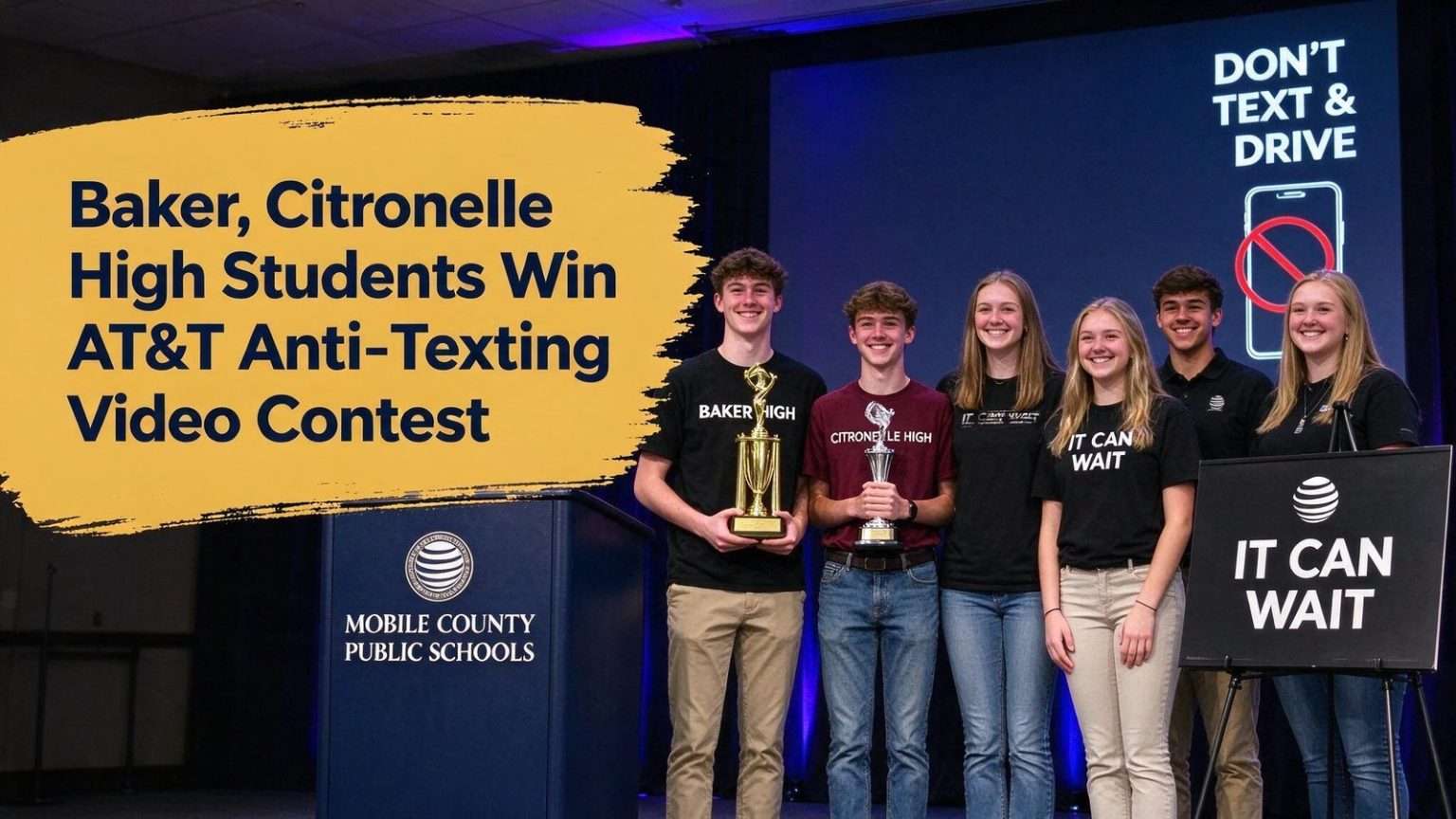
MOBILE, Ala. — Television production students at two Mobile County high schools have taken top honors in an AT&T-sponsored competition designed to keep teenagers from texting behind the wheel, with the winning videos now airing across local networks and the district’s own television channel.
AT&T decided to change its approach this year to its long-running “Don’t Text and Drive” school workshops, betting that a peer-to-peer message would resonate more than another adult-led presentation. “We have learned that if we want kids to hear the message, it’s better to have it come from other kids,” said Gigi Armbrecht, AT&T’s public relations executive for Mobile.
To put that idea into action, AT&T sponsored a video contest open to television production classes across the Mobile County school system. Seven high schools entered the competition, with student teams using GoPro cameras to produce 30-second public service announcements aimed at their peers.
Baker High School’s entry took first place, while Citronelle High School’s submission finished as runner-up. Both spots debuted publicly at the Mobile County school board’s Oct. 27 meeting before going into wider rotation on local television networks and on the Mobile County Public School System’s own TV channel, which broadcasts on Comcast channel 15 and AT&T U-verse’s on-demand channel 99.
Baker High’s winning video, produced by the school’s “BH1” student team, earned an additional honor: it will be featured on AT&T’s national “It Can Wait” campaign website, a platform dedicated to raising awareness about the dangers of distracted driving on a much larger scale than the local competition.
Armbrecht praised the contrasting approaches the two schools took to the same subject matter. She said Baker’s video leaned into entertainment value before delivering a serious message at the end, while Citronelle’s entry took a more fact-driven approach and involved dozens of students in its production — what she called “a completely different approach” to the same core message.
The contest reflects a broader push by AT&T and school districts nationwide to combat distracted driving among newly licensed teen drivers, a demographic public safety officials have long identified as especially vulnerable to the risks of texting behind the wheel. By putting the message in the hands of students themselves, organizers hope the videos will carry more weight with the audience they’re meant to reach.
Mobile is the county seat of Mobile County in southwest Alabama and the state’s only saltwater port. Situated where the Mobile River meets Mobile Bay near the northern Gulf of Mexico, the city has long served as a commercial and cultural gateway between Alabama and the wider Gulf Coast. Founded in 1702 as Fort Louis de la Louisiane and ruled in turn by France, Britain, and Spain before joining the United States in 1813, Mobile carries a layered heritage distinct from the rest of the state.
Today Mobile anchors a metropolitan area spanning Mobile County and neighboring Baldwin County, and it remains a center for shipping, aerospace, healthcare, and higher education in the region. Its downtown and waterfront have seen sustained revitalization, while historic neighborhoods preserve architecture from its colonial and antebellum past. The city’s identity is shaped as much by its working port and industrial base as by its festivals and food culture, making it a frequent focal point for news about growth and change in southern Alabama.
Education in South Alabama spans public school systems in Mobile and Baldwin counties, a network of private and parochial schools, and institutions of higher learning including the University of South Alabama, Spring Hill College, and community colleges. Public-school governance rests with locally elected boards.
Boards oversee budgets, curricula, and facilities, often amid debates over funding equity and student achievement. The region’s colleges contribute not only to the workforce pipeline but also to healthcare, research, and cultural life, and education policy set in Montgomery frequently shapes what local districts can do.
Schools are also central to community stability. Enrollment trends, facility conditions, and graduation outcomes are watched closely by families and employers alike, making education a persistent focus of public attention and news coverage across the Gulf Coast.
Local government in the Mobile area operates through a combination of mayor-council or commission structures at the municipal level and a county commission in Mobile County, with elected officials handling budgets, public safety, infrastructure, and zoning. Baldwin County has its own commission and a collection of incorporated municipalities.
Decisions made in council chambers and commission meetings affect roads, school funding, economic development, and quality of life, which is why coverage of local government is a staple of regional journalism. The interplay between city, county, and state authorities often determines how effectively the area can address shared challenges.
Because many services residents rely on are delivered at the local level, the choices of elected officials have direct, everyday consequences. Budget priorities, in particular, reveal a community’s values and shape the trajectory of growth and public welfare for years to come.
Collegiate athletics are a major part of life in southern Alabama, where the University of South Alabama in Mobile fields the Jaguars across a range of sports. The university’s football program, which began competition in the 2000s, has become a rallying point for students, alumni, and residents and a source of regional pride.
Beyond the campus, youth, high-school, and recreational leagues across Mobile and Baldwin counties sustain a deep local sports culture, and tailgating and game-day traditions reflect the social fabric of the community. Coverage of local teams regularly intersects with broader themes of economic impact, community engagement, and the role of athletics in mid-sized Southern cities.
Sports also serve as a lens on community investment. Stadium construction, scheduling, and the success of local programs ripple into nearby businesses and neighborhoods, making them a recurring and widely followed subject in regional reporting.
Baldwin County sits directly east of Mobile County across Mobile Bay and is the largest county in Alabama by land area. It encompasses the Eastern Shore communities of Daphne, Fairhope, Spanish Fort, and Foley and stretches south to the beaches of Gulf Shores and Orange Beach along the Gulf of Mexico.
Long among the fastest-growing counties in the state, Baldwin blends suburban development near the bay with tourism-driven coastal economies. Its proximity to Mobile and its position on the Eastern Shore make it a recurring subject of regional news covering growth, infrastructure, schools, and the balance between development and coastal preservation.
Mobile Bay is a shallow estuary in southern Alabama where freshwater from the Mobile, Tensaw, and other rivers mixes with saltwater from the Gulf of Mexico. It is among the largest estuarine systems in the United States and supports commercial and recreational fishing, shipping through the Port of Mobile, and wetlands that buffer the coastline from storms.
The bay’s Eastern Shore, in Baldwin County, includes Daphne, Fairhope, and Spanish Fort, while the Western Shore lies in Mobile County. Its ecology and economy have guided settlement for centuries, and the bay figures in regional debates over development, navigation, and conservation. Events on either shore are routinely covered as part of the interconnected life of the Mobile metro area.
The Gulf of Mexico borders Alabama’s southern edge and defines much of the state’s coastal identity. Alabama’s Gulf coastline, centered on Dauphin Island, Gulf Shores, and Orange Beach, supports a tourism industry built around beaches, charter fishing, and marine recreation, while offshore waters host shipping lanes and energy interests.
The Gulf’s warm, shallow shelf and exposure to hurricanes make weather and disaster preparedness recurring concerns for communities from Mobile to Baldwin County. The marine environment also underpins commercial seafood harvests that have sustained Gulf Coast families for generations, tying the region’s economy and culture closely to the water.
Alabama is a state in the southeastern United States bordered by Tennessee, Georgia, Florida, the Gulf of Mexico, and Mississippi. Often called the Heart of Dixie, it spans Appalachian foothills in the north and flat coastal plains in the south. Its largest cities include Birmingham, Montgomery, Huntsville, and Mobile.
Alabama’s history encompasses Indigenous roots, Spanish and French colonial settlement, a cotton-plantation economy, the Civil War and Reconstruction, and the Civil Rights Movement of the 1950s and 1960s, followed by a shift toward manufacturing, aerospace, and technology. Local news across the state frequently reflects this mix of tradition and change.
The Federal Bureau of Investigation is the principal investigative arm of the United States Department of Justice, tasked with protecting the country against terrorist threats, foreign intelligence operations, cyber attacks, and major criminal activity. Established in 1908, the bureau operates a network of field offices across the country, each responsible for federal law-enforcement matters within its region.
Field offices such as the one serving Mobile work closely with state and local agencies, reflecting the bureau’s reliance on partnerships rather than unilateral action. The director, appointed by the president and confirmed by the Senate, sets national priorities that cascade down to individual offices handling everything from counterterrorism to public-corruption and civil-rights investigations.
Because federal agents are seldom the first to notice a threat in a community, much of the bureau’s effectiveness depends on tips and vigilance from local residents and police. That reality has made community outreach, including visits by senior leaders to field offices, a deliberate part of how the FBI maintains trust and communication with the public it serves.