Vigor High School Shooting Attempt Could Bring Attempted Murder Charge
Prosecutors say a Vigor High School student who tried to fire a gun at a classmate will face an upgraded attempted murder charge in juvenile court.
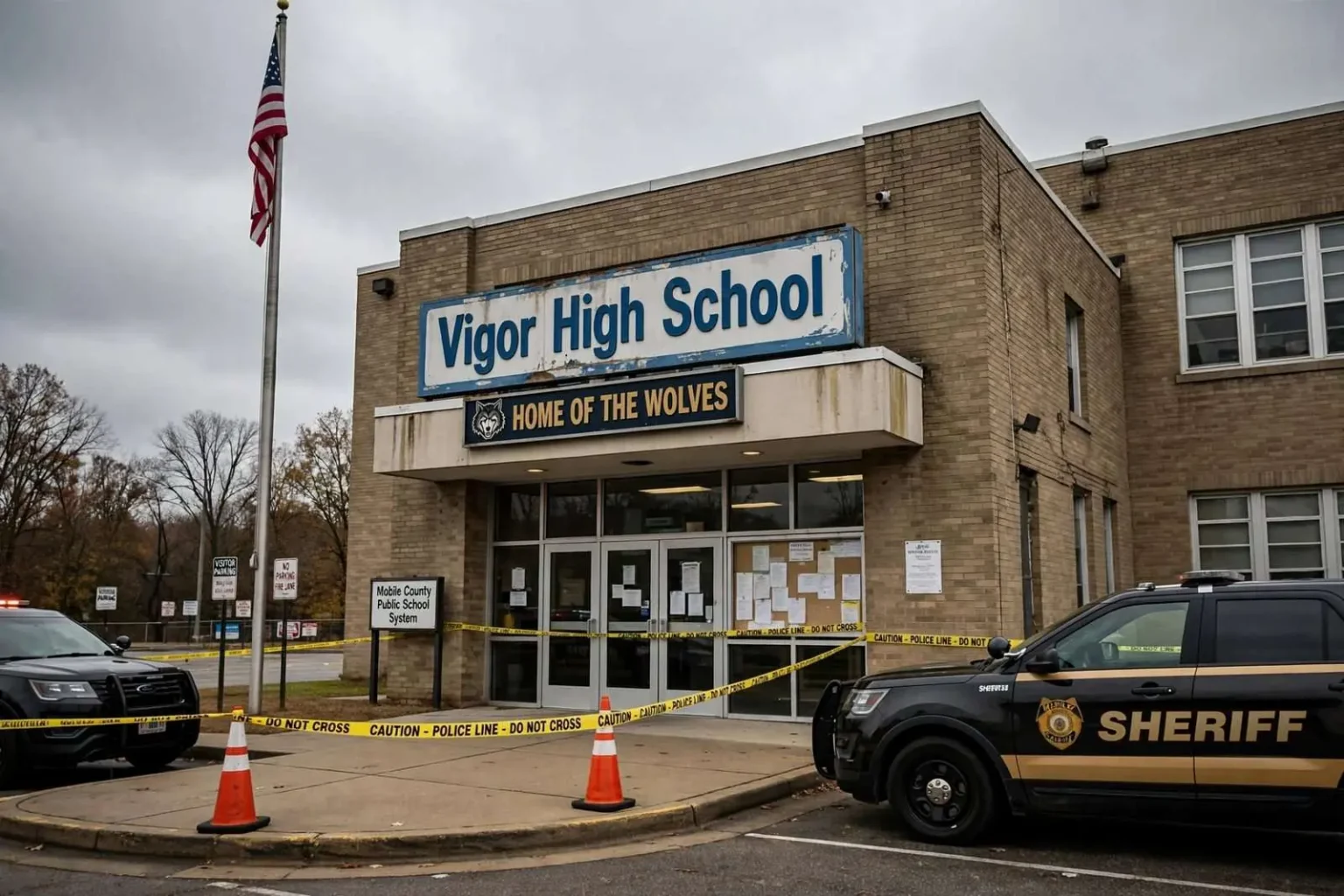
The Mobile County District Attorney’s Office says a 14-year-old accused of bringing a gun to Vigor High School and attempting to fire it at another student will face an upgraded charge of attempted murder, prosecutors announced days after the incident.
As of the announcement, authorities had not publicly identified the student, who remained in custody at the Strickland Youth Center, the county’s juvenile detention facility. The decision to escalate the charge — from an initial weapons-related count to attempted murder — signaled how seriously prosecutors were treating an episode that could have ended in a student’s death.
Vigor High School sits in Prichard, one of Mobile County’s older cities, and serves students from the surrounding communities north of Mobile. The campus, like others across the district, operates under the Mobile County Public School System’s security procedures, but the events that unfolded there tested those procedures in a way few school incidents do.
A gun that failed to fire
Police had previously said the student pulled the trigger of a .22-caliber revolver twice during a confrontation with a classmate, but the gun failed to fire either time. The details, laid out by investigators in the days after the confrontation, gave prosecutors the foundation for the attempted murder count: two deliberate pulls of the trigger, aimed at another student, stopped only by the weapon’s failure — not by the suspect’s change of heart.
Under Alabama law, attempted murder can be charged when a person takes a substantial step toward killing another with intent, even if the act is interrupted or fails. Prosecutors do not need a completed act of violence; the intent and the attempt are enough. A .22-caliber revolver, while small in caliber, is a lethal firearm, and two trigger pulls directed at a classmate fit squarely within the statute.
How the weapon reached the campus remained a question investigators had not fully answered in the days following the incident, and school officials faced familiar questions about how firearms make their way into buildings that students pass through each morning.
The path to an adult charge
An assistant district attorney said the teen will go through a transfer hearing in juvenile court, a proceeding similar to a preliminary hearing in adult district court, where a judge will weigh whether enough evidence exists to move the case to adult court.
“It was at a school — it doesn’t get more serious than that,” the prosecutor said, explaining the decision to pursue the more serious charge rather than a lesser weapons offense.
Transfer hearings are among the most consequential proceedings in the juvenile justice system. Alabama law allows juveniles as young as 14 to be transferred to adult court for certain serious offenses, and judges weighing such requests consider the seriousness of the alleged offense, the juvenile’s record, the prospects for rehabilitation within the juvenile system and the interest of the community. If a judge orders the transfer, the case proceeds as it would against an adult defendant, with the juvenile facing the same potential penalties an adult would face.
The Strickland Youth Center
The teen’s placement at the Strickland Youth Center reflects standard practice in Mobile County for juveniles held on serious charges. The facility, operated under the county’s juvenile court system, houses young people awaiting hearings and those adjudicated on delinquency matters, separate from the adult jail population. Judges there oversee not only detention matters but the full range of juvenile cases, from truancy and dependency proceedings to the most serious delinquency filings the county sees.
Should the case be transferred, the defendant would move from the youth center to adult detention, and the case would appear on a circuit court docket rather than a juvenile one. If the transfer is denied, the juvenile system retains jurisdiction, and its focus turns to rehabilitation — with a detention term that ends by the age of majority rather than the lengthy sentences adult court can impose.
Prichard police caught off guard
A Prichard police spokeswoman said her department had not been informed of the charge upgrade at the time reporters asked for comment, suggesting the decision moved through the district attorney’s office independently of local police. The disconnect underscored how charging decisions in serious juvenile cases rest with prosecutors, who review the evidence gathered by investigators and file the charges they believe the facts support.
Communication between prosecutors and the investigating agency is normally routine, but the sequence in this case — an announcement of the upgraded charge before the police department itself had been notified — drew notice in the local press coverage of the case. The district attorney’s office announced its decision days after the incident, after reviewing the statements and physical evidence gathered at the school.
The JROTC instructor’s intervention
Mobile County Public Schools officials separately praised the actions of a JROTC instructor, a retired Army lieutenant colonel, who is credited with physically subduing the armed student and holding him until officers arrived on campus. School administrators have pointed to his quick response as the reason the confrontation did not turn deadly.
JROTC instructors are a distinctive presence in high schools across Mobile County and the nation. Typically retired military officers, they lead the Junior Reserve Officers’ Training Corps programs that teach leadership, citizenship and military customs to students — and their training, discipline and physical conditioning place them among the few adults on a campus equipped to respond when violence erupts.
In this case, the instructor’s intervention meant the confrontation ended on the floor of a school hallway rather than in gunfire. District officials said his actions prevented what investigators described as a genuine attempt to kill a classmate, and the account of the takedown became the episode’s one unambiguous note of praise amid the alarm that followed.
Why prosecutors escalated
The push to charge a 14-year-old as an adult reflects the seriousness with which the district attorney’s office is treating firearm incidents on school grounds, even when, as in this case, no one was physically injured. Prosecutors weighed the alternative — handling the case entirely within the juvenile system, where sanctions are shorter and the record is sealed — and concluded that the facts demanded the sterner track.
The decision also serves a broader deterrent message. School officials and law enforcement leaders across Alabama have repeatedly warned students that bringing a weapon to campus carries consequences far beyond suspension or expulsion, and an attempted murder charge filed against a 14-year-old makes that warning concrete for every student, parent and teacher who followed the case.
It remains possible the case resolves without an adult trial. Defense attorneys routinely contest transfer hearings, and juvenile court judges in Alabama retain discretion over how the case will ultimately be handled. But the filing itself — attempted murder, in juvenile court, with a transfer hearing to follow — places the case among the most serious the county’s juvenile system handles.
School safety in context
The episode renewed familiar conversations about how weapons reach school campuses and what deters students from bringing them. Districts across Alabama use a layered approach: resource officers assigned to campuses, random weapon screenings, anonymous tip lines and the state-mandated expulsion policies that apply to students found with firearms on school property.
Prichard, like many older cities in Mobile County, has contended with elevated rates of youth violence in surrounding neighborhoods, and school campuses often serve as the one place where intervention is most visible. Educators in the district have noted that conflicts beginning outside school — in neighborhoods, on social media — are the ones most likely to surface in hallways and cafeterias, which is why the district pairs its security measures with counseling and conflict-resolution programs.
The district also operates under state requirements that shape its response to any weapon on campus. Alabama law mandates expulsion proceedings for students who bring firearms to school, and districts report such incidents to state education officials as part of annual school safety reporting. Those administrative consequences unfold on a separate track from the criminal case, but for the student in this case they compound the legal jeopardy already assembled by prosecutors.
What comes next
For the accused student, the next milestone is the transfer hearing, where a juvenile court judge will hear evidence in the case and decide whether the adult system should take over. Prosecutors will present the account of the two trigger pulls, the recovered revolver and the statements gathered at the scene; the defense will argue for the juvenile system’s jurisdiction and its rehabilitative mission.
For Vigor High School, the immediate aftermath centered on the instructor who stopped the confrontation. District officials said his actions — and the quick arrival of Prichard police — ensured that a morning that could have ended in tragedy ended instead with one student in custody, a campus shaken but intact, and a case now headed toward one of the most consequential hearings a 14-year-old in Mobile County can face.