Mobile County Schools Approve $2.8 Million Deal to Restore Barton Academy
Mobile County's school board approved a $2.8 million contract to renovate the historic Barton Academy and the nearby Yerby School buildings.
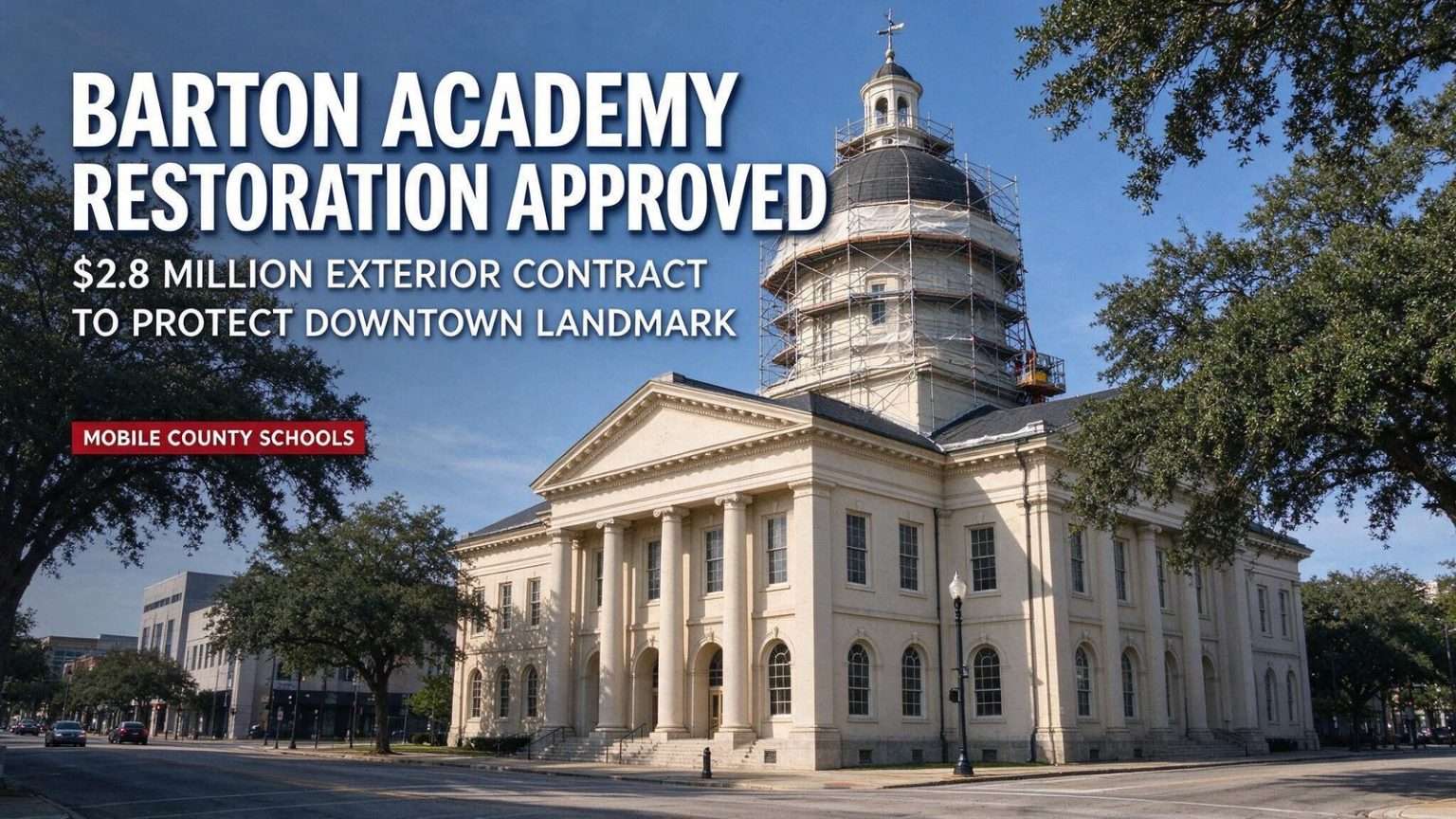
MOBILE, Alabama — The Mobile County school board has signed off on a $2.8 million construction contract aimed at restoring the exterior of Barton Academy, one of the oldest public school buildings in the country. The vote commits the district to the most visible phase yet of the long-running effort to save the Greek Revival landmark that anchors Government Street downtown, a building whose distinctive dome has watched over the city’s center since the era of Andrew Jackson.
Scope of the renovation
Board members approved the deal with a local construction firm during a regular meeting, authorizing exterior work that will include new windows, doors, a repaired roof and restoration of the building’s dome. Exterior envelope work of this kind is the critical first step for a historic building that has stood empty: windows and the roof keep water out, and keeping water out is what preserves everything behind the walls. The dome restoration carries symbolic weight as much as practical necessity, since Barton’s dome is the signature image of the building and one of the most recognizable architectural features in downtown Mobile.
The contract also covers repair work at the adjoining J.D. Yerby School building, which dates to the early 1900s. Including Yerby in the project makes sense from a campus-management standpoint, because the two buildings share a block and a future — any redevelopment of Barton will involve the structures around it. According to the school system’s facilities manager, the renovation had originally been budgeted at a higher figure before the final contract came in below that estimate, an outcome that leaves district funds available for the interior phases that would follow. Crews are expected to begin work within roughly a month and a half of the vote.
A building with deep local history
Barton Academy holds a unique place in Alabama history, having opened in 1836 as the state’s first public school. Designed in the Greek Revival style that defined antebellum Mobile’s public architecture, the building served for generations as the flagship of the city’s education system and later as the administrative headquarters of the Mobile County Public School System itself. Its place in the state’s educational history is the reason preservationists across Alabama have tracked its condition for decades — when Barton’s future is discussed, the stakes are described in terms of the birthplace of public education in Alabama, not merely a single downtown structure.
The building sat vacant for years after the school system relocated its central offices to a campus near Schillinger and Howells Ferry roads. The move west, which consolidated district administration into a modern campus, left Barton and its adjoining buildings without a daily purpose, and vacancy is the condition historic buildings survive least well. Empty structures deteriorate quietly — a roof leak goes unnoticed, a broken window admits rain, and systems that were maintained by daily use decay without anyone watching. The exterior contract the board approved is the direct answer to that condition, and it follows years of feasibility studies, architectural assessments and funding discussions about what Barton could become.
A nonprofit foundation dedicated to the historic property has separately been raising money toward an ambitious long-term plan to convert Barton Academy into an international school, a goal that has drawn support from preservationists and education advocates across the Mobile area. The international school concept would put students back inside the state’s first public school building while answering the practical question that has haunted the property since the offices moved out: what active use can pay for the building’s upkeep. Historic school buildings across the country have been revived through exactly this kind of reuse, and the foundation’s campaign has kept Barton in the public conversation while the district handled the structural work that must come first.
Other construction contracts approved
The same meeting saw the board sign off on several additional projects across the district, including a contract to replace the roof at Mary G. Montgomery High School and a separate agreement to repave the parking lot at the school system’s transportation facility on Padgett Switch Road. The transportation facility work is the kind of investment that rarely makes headlines but touches every school in the district daily, since the fleet based there covers one of the largest bus territories in Alabama across Mobile County’s sprawling geography.
Board members also approved reinforced doors at two elementary schools as part of ongoing campus safety upgrades. Door-hardening projects have become standard practice in districts nationwide as schools layer security measures onto older buildings, and elementary campuses get particular attention because their populations are the youngest and their buildings often date from eras when open corridors and classroom wings were the norm.
Facility and personnel decisions rounded out the meeting’s agenda. In other business, the board approved a lease arrangement with the city of Prichard allowing two area high schools to use Prichard Municipal Stadium for home football games, while two other district schools were cleared to use the stadium at no charge. Shared-stadium arrangements are common across large districts where campuses lack their own venues, and the Prichard agreement ties the district’s athletics calendar to a municipal facility whose upkeep is supported by the city. The board also finalized a principal assignment at one of the district’s middle schools, part of a broader round of administrative moves within the system as the school year approaches.
The mixture of items on the agenda — a landmark restoration, routine roof and paving contracts, security upgrades, a stadium lease and a personnel action — captures how a district the size of Mobile County operates. With more than 50,000 students spread across Alabama’s largest school system, the board’s monthly meetings handle everything from marquee historic projects to the paving of a bus yard, and each carries its own constituency watching the vote.
What the Barton vote represents
The Barton Academy project stands out among the approvals as a marquee investment in preserving one of Mobile’s most recognizable historic landmarks, with district officials framing the restoration as both a safety necessity and a step toward the building’s eventual return to active use. The sequencing matters: exterior stabilization must precede any interior redevelopment, whether the international school plan or another future use, and the district’s $2.8 million commitment signals that the building will be protected while the foundation’s fundraising continues.
For downtown Mobile, the restoration’s visibility will be immediate. Barton sits on Government Street in the heart of the historic district, and scaffolding around its dome will make the project one of the most public construction efforts in the city. For the preservation community, the vote closes a chapter that began when the building emptied and opens the practical work of keeping the state’s first public school structurally sound. And for the district, coming in under the original budget on the contract leaves room in the capital plan for the phases that follow — the windows and roof that keep the weather out today being the precondition for whatever Barton Academy becomes tomorrow.
The next milestone will be mobilization, with crews expected on site within roughly six weeks of the board’s vote. By the time the exterior work is finished, Mobile will have a protected Barton Academy — watertight, re-glazed and crowned with a restored dome — and a clearer path toward putting the state’s first public school back to work educating students, nearly two centuries after it opened its doors.
The historic context surrounding the vote is worth spelling out, because it explains why a single construction contract has drawn attention far beyond a routine board agenda. Barton Academy opened its doors in 1836, when Mobile was still a growing port city and the idea of tax-supported public education was itself young in America. As Alabama’s first public school, it set the precedent that education in the state would be a public undertaking, and generations of Mobile students passed through its classrooms in the decades when the building anchored the city’s school system. Structures that old that remain in educational use are rare anywhere in the country, which is the basis for the building’s reputation as one of the oldest public school buildings in the United States.
The Greek Revival architecture that makes Barton a landmark was the deliberate choice of a city that wanted its public buildings to project permanence and civic seriousness. The columned front, the central dome and the symmetry of the Government Street facade have made the building a reference point in Mobile’s architectural history, appearing in period photographs, postcards and every serious survey of the state’s historic structures. Buildings of this era demand specialists — masons who can match historic mortar, contractors experienced with vintage windows and roof structures — and the selection of a local firm for the work connects the restoration to Mobile’s own community of preservation trades.
The wider district picture
The rest of the meeting’s construction agenda illustrates the scale of maintaining a district of Mobile County’s size. Mary G. Montgomery High School’s roof replacement is the kind of project that prevents cascading damage if done on schedule and becomes an emergency if deferred, and its approval alongside Barton shows the board balancing landmark investments against unglamorous but essential work. The Padgett Switch Road paving contract serves the transportation department whose buses log thousands of miles daily across the county, and the reinforced doors at two elementary schools continue the security upgrades that have moved through the district’s campuses in recent years.
The stadium arrangements with Prichard carry their own local history. Prichard Municipal Stadium has long hosted football in the northern part of the county, and formalizing its use by district high schools keeps Friday night football tied to a community venue rather than requiring each campus to maintain its own field and stands. The no-charge access for two of the schools reflects the cooperative spirit of the arrangement between the district and the city.
Taken together, the meeting’s decisions sketch the district’s near-term priorities: protect a historic landmark while the long-term plan matures, keep the operational infrastructure sound, harden elementary campuses, and sort the athletics and administrative logistics that the coming school year requires. The Barton contract is the item that will change Mobile’s skyline first — and the one that keeps the promise attached to Alabama’s first public school building alive.