Mobile Residents Pitch Names for Proposed I-10 Bridge Over Mobile River
As the $850 million I-10 Mobile River Bridge moves toward public review, residents are already floating ideas for its official name.
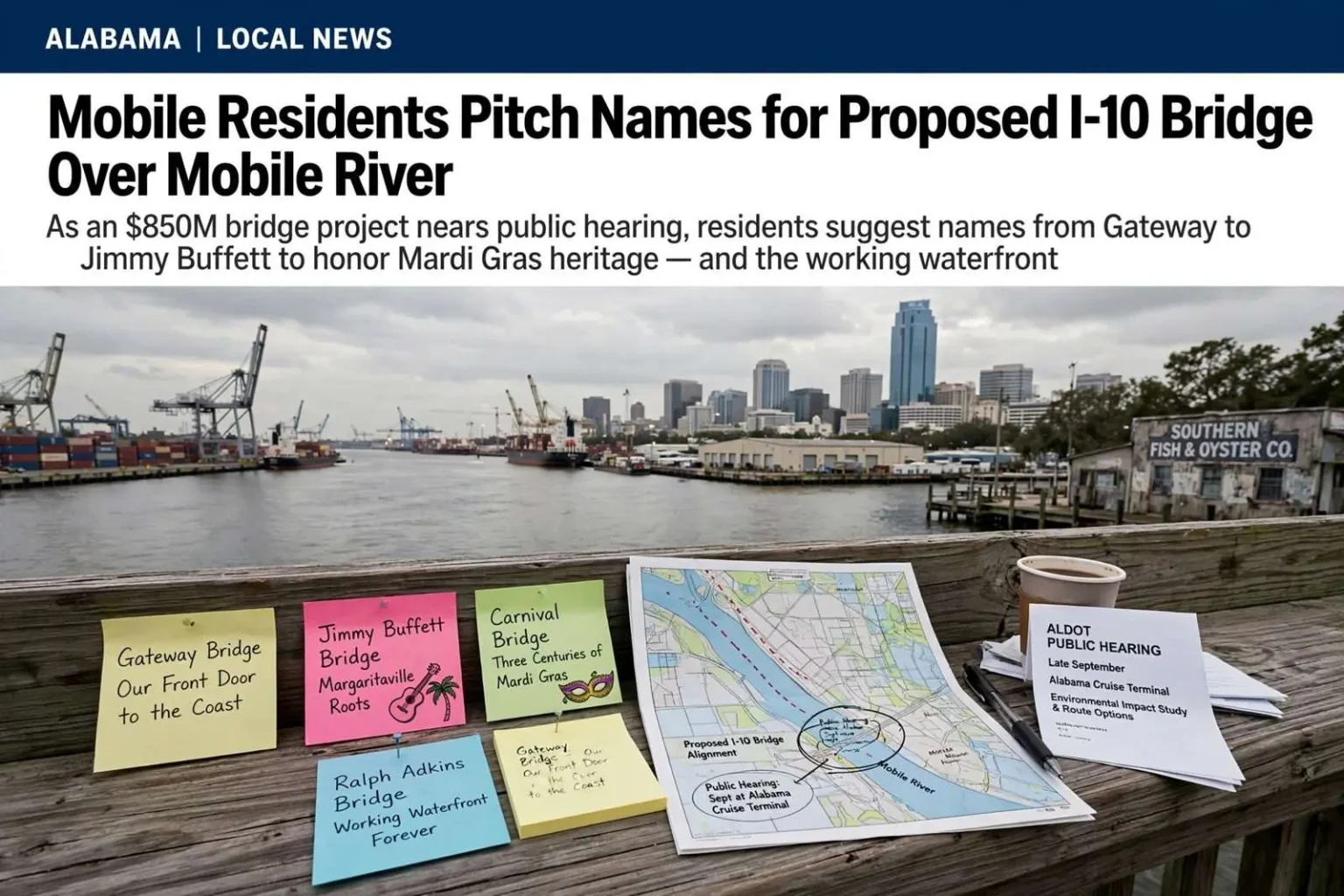
Long before construction crews break ground, Mobile residents are already arguing over what to call the proposed Interstate 10 bridge across the Mobile River, a roughly $850 million project that would reshape the city’s skyline and its daily commute. The debate over a name — conducted in living rooms, barbershops and city council chambers rather than in any official forum — says as much about Mobile’s sense of itself as about the bridge: a city proud of its history, protective of its harbor and eager to put its stamp on the largest public works project in a generation.
The Alabama Department of Transportation has scheduled its first public hearing on the project for late September at the Alabama Cruise Terminal, where officials will walk through an environmental impact study and possible routes for the structure. The session marks the formal beginning of a review process that will stretch for years — studies of wetlands, historic districts, traffic patterns and air quality — before a single pier is driven into the riverbank.
A Name Before a Route
No route has been finalized, let alone an official name, but that has not stopped local voices from staking out early positions. Mobile City Councilman Fred Richardson has been among the most vocal, proposing that the roughly 215-foot span be called the Gateway Bridge. Richardson has said he intends to press the idea with the region’s congressional delegation, arguing the name reflects the bridge’s role as an entryway to the city and the wider Gulf Coast. The name carries practical appeal as well: “Gateway” requires no individual’s name, no sponsor and no political coalition to defend, which is precisely why so many residents have rallied to it as a default.
Other suggestions floated around town lean on Alabama football rivalries and local celebrity, with names honoring legendary coaches, current University of Alabama football leadership, and homegrown musician Jimmy Buffett all making the rounds in early conversations. The football names reflect the state’s unmatched passion for the Crimson Tide; the Buffett option reflects the fact that the singer of “Margaritaville” grew up in Mobile, where he absorbed the dockside culture that would fill his songs. Some residents have suggested a nod to Mobile’s Mardi Gras traditions, reflecting the city’s status as home to the oldest Carnival celebration in the country — a claim, backed by more than three centuries of history, that residents guard jealously against rivals up the river.
Not every idea is purely sentimental. Ralph Adkins, longtime owner of Southern Fish & Oyster Co., has raised the prospect of naming the bridge after himself in exchange for a multimillion-dollar buyout of his property, should the final route require the government to acquire his business. The offer — half salesmanship, half serious point about the human cost of the project — highlights what a new bridge route means for the working waterfront: seafood houses, marine businesses and family properties that have lined the river for generations would stand directly in the path of the approaches.
What the Bridge Would Change
An environmental impact study under federal law is a deliberate, years-long exercise. Engineers and consultants compile candidate routes, model traffic decades into the future, survey wetlands and historic properties along each alignment and publish the findings for public comment. Every comment submitted at a hearing or in writing must be considered and answered in the final document, which is why transportation departments treat the first hearings as the foundation of everything that follows — including the litigation that often arrives afterward.
The stakes extend beyond Mobile. Interstate 10 is the Gulf Coast’s primary freight artery, linking the ports of Mobile, Pensacola, New Orleans and Houston, and truck traffic through the Wallace Tunnel grows with each expansion at the State Docks. Planners have warned for years that a failure at the tunnel crossing — an accident, a flooding event or a hurricane evacuation — would sever the region’s main east-west route, and the bridge is presented as the remedy for exactly that vulnerability.
The project’s scale explains the intensity of the interest. The proposed span would carry Interstate 10 across the Mobile River north of the existing George Wallace Tunnel, whose twin tubes beneath the river have bottlenecked the interstate for decades. Traffic through the tunnel routinely backs up for miles during rush hours and port movements, and freight planners have long identified the crossing as one of the Gulf Coast’s most significant chokepoints. A new bridge with the clearance to let the port’s tallest ships pass underneath would separate through traffic from local traffic and free the tunnel for downtown movements.
For the working river, the height matters as much as the route. The Port of Mobile has grown into one of the nation’s busiest deepwater ports, and its cranes and container ships demand a clearance that a low tunnel crossing can never accommodate. A 215-foot span would rank among the taller bridges on the Gulf Coast, visible from across the downtown skyline and a permanent alteration to the view that Mobile residents have of their own harbor.
Financing questions hang over all of it. A project estimated at roughly $850 million ranks among the most expensive transportation undertakings in Alabama’s history, and the money would come from a combination of federal highway funds, state contributions and — in the proposals circulating at the time — tolls on the new crossing. Tolling has proved contentious wherever it is proposed, and the bridge’s cost has made the question of who pays, and how, as charged as the question of what to call it.
The Road to a Name
Mobile’s existing crossings tell the story of how the city has crossed its river before. The Bankhead Tunnel, opened in the early 1940s, and the George Wallace Tunnel, opened in the early 1970s, both dip beneath the river in tubes that float lowered into place — engineering marvels of their eras, and both constrained today by the modest clearances of a different age. A high-level bridge would be the city’s first new river crossing in half a century and its first ever designed for the container ships of the modern port.
Businesses along the waterfront have watched the route studies with particular anxiety. Marine railways, seafood processors and shipyard suppliers occupy parcels near the river that any downtown-side approach would bisect, and owners like Adkins have made the point that relocation money — not naming rights — is the issue that will decide whether the working waterfront survives the project. State right-of-way acquisition follows the environmental process, meaning the buyouts and relocations would come years after the first public hearing.
In the meantime, the name debate goes on at porch and council tables, an argument Mobile seems to relish. Whatever the final choice — Gateway, a legendary coach, a favorite son or a Carnival homage — it will be attached to a structure that will stand over the Mobile River for a century, and the residents already arguing about it understand better than most that a bridge’s name is the part of a billion-dollar project that belongs, in a small way, to everyone.
Whatever name eventually sticks, it will ultimately be up to state transportation officials and, in some cases, federal lawmakers to make it official. Alabama has a tradition of naming its major crossings for public figures — governors, senators and statesmen lend their names to bridges and tunnels across the state — and the legislature has historically had the final word on commemorative names. A local campaign can build momentum, but the formal christening happens in Montgomery or Washington.
The naming conversation nonetheless offers residents an early, informal way to weigh in on a project expected to dominate discussion in Mobile for years, from environmental review through construction financing questions. Public hearings like the one planned for the cruise terminal are where the process becomes real for most residents: maps of candidate routes, renderings of the span, and the first structured opportunity to ask ALDOT officials how the project would touch particular neighborhoods and businesses.
Local leaders say the coming public hearing will be the first real opportunity for residents to speak directly to ALDOT about route options, even as the debate over what to call the eventual span continues to play out informally across the community. City Hall’s input — through the council and the mayor’s office — will help shape the local position the state hears, and Richardson’s Gateway proposal is an early entry in that conversation.
The politics of infrastructure naming can matter. A name that rallies the community can smooth a project’s path through years of hearings and appropriations; a contested name can become one more fight in an already contentious process. That is why early skirmishes over names are rarely as trivial as they seem — they are proxies for deeper questions about who the bridge is for, what it honors and what Mobile wants the rest of the country to see when it crosses the river.
For now, the span exists only in maps and renderings, its route unchosen and its name unsettled. But the argument itself has been a kind of preview: a city that cares enough to fight over what to call a bridge that has not been built is a city that will be watching every step of the project that follows, from the environmental study presented at the cruise terminal to the day the first traffic rolls across the river high above the working waterfront.