Preliminary Hearing Sends Mobile County Constable’s Murder Case to Grand Jury
A Baldwin County judge found probable cause in a fatal Spanish Fort bar parking lot shooting involving a Mobile County constable.
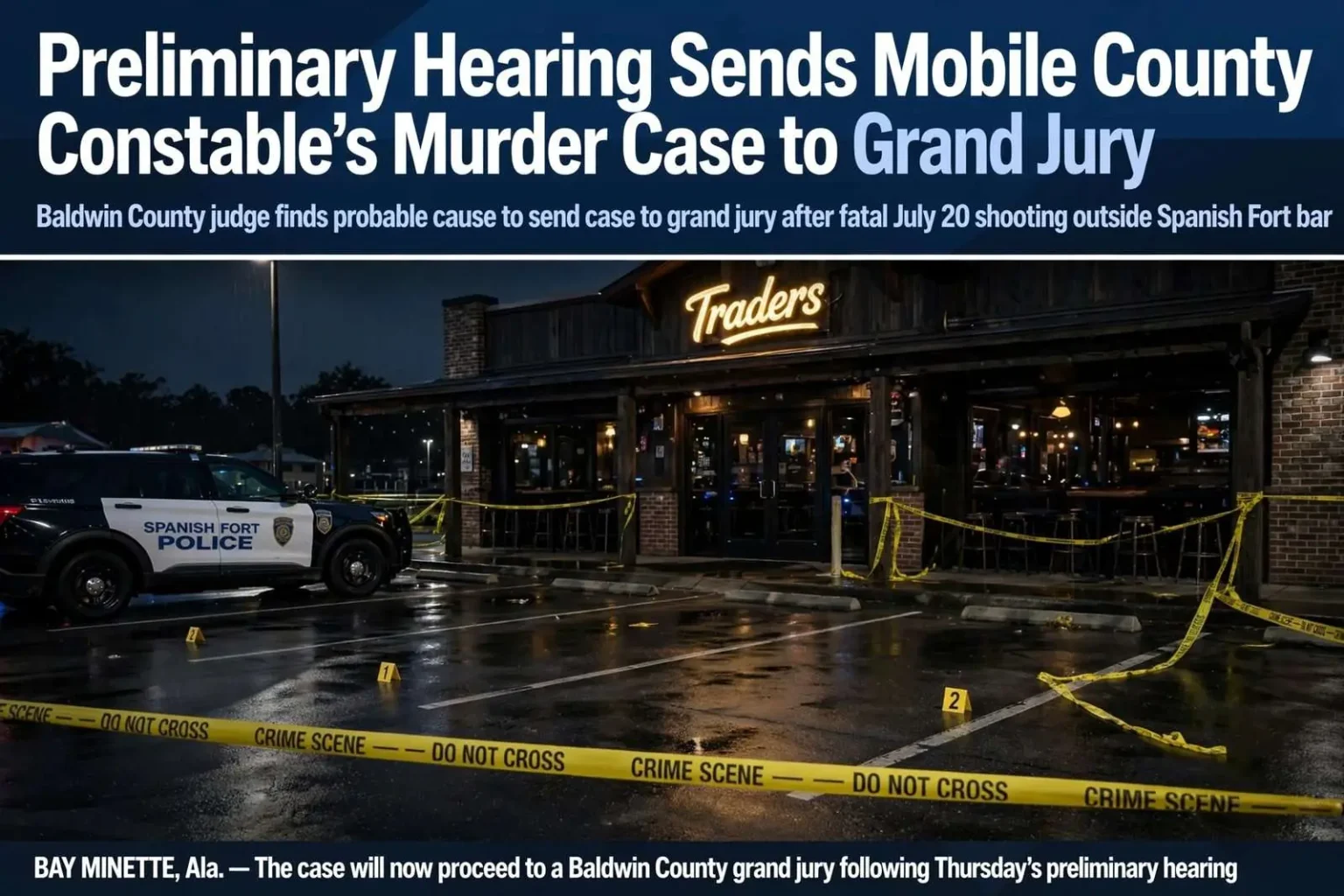
A Baldwin County District Court judge has ruled there is enough evidence to send a murder case against a Mobile County constable to a grand jury, following a preliminary hearing that laid out competing versions of a deadly confrontation outside a Spanish Fort bar. The ruling moves the case from the district court stage, where judges test whether probable cause exists, to the grand jury, which will decide whether to hand down an indictment.
Larry Sheffield, 68, is charged in the death of 52-year-old Jeffrey McMillan, who was shot in the parking lot of Traders in Spanish Fort on July 20. The shooting, which occurred in the lot of a popular bar along the Eastern Shore corridor, drew investigators from Spanish Fort police and left prosecutors in Baldwin County preparing one of the more closely watched cases of the year.
A Spanish Fort police investigator testified that Sheffield told officers his gun discharged accidentally during a struggle while McMillan was on top of him. But the officer said that account does not line up with the physical evidence found on McMillan’s body or at the scene, including a mark from the gun barrel left on the victim’s head. The distinction matters: an accidental discharge during a mutual struggle and a barrel pressed against a victim’s head describe very different events, and the prosecution built its preliminary case around that gap.
According to testimony, the two men had been friendly earlier in the evening before tensions escalated into two separate confrontations at the bar. The first involved a shoving match inside, after which Sheffield left money at the bar and walked out to his truck. Investigators say McMillan later came outside as well, leading to a second, fatal encounter in the parking lot. Witnesses nearby told police they heard only a gunshot and did not see the altercation itself, leaving the physical evidence and the defendants’ statements as the center of the dispute.
Self-Defense Claim Meets Prosecutors’ Account
Sheffield’s attorney argued the shooting was a clear case of self-defense under Alabama’s stand-your-ground law, saying his client had a right to protect himself once McMillan approached him outside. The defense contends Sheffield was leaving the scene peacefully when the confrontation was renewed, framing the encounter as a second aggression by McMillan that Sheffield had no obligation to absorb.
Alabama’s stand-your-ground statute, on the books since 2006, removes the duty to retreat before using deadly force in self-defense in any place a person has a right to be. The law has been invoked in courts across the state in the years since, and it remains one of the most consequential defenses available in Alabama homicide cases. A stand-your-ground claim can end a prosecution before trial if a judge accepts it, which is why arguments over who initiated the parking lot confrontation carry such weight here.
Prosecutors pushed back forcefully, with a Baldwin County assistant district attorney telling the court that evidence points to Sheffield as the aggressor who exited his vehicle and approached McMillan rather than the reverse. Prosecutors said forensic evidence is expected to contradict key parts of Sheffield’s account of how the parking lot confrontation unfolded, including the sequence of movements that would determine whether Sheffield was retreating or advancing when the shot was fired.
Following the hearing, the judge determined probable cause exists for the case to proceed, finding the testimony and evidence sufficient to send the charges to a Baldwin County grand jury. The decision does not determine guilt or innocence, and it does not resolve the self-defense question. It means only that a neutral judge found the state’s evidence credible enough to warrant grand jury review, the standard threshold for moving a felony case forward in Alabama.
Grand Jury Takes the Next Step
The grand jury stage works differently from the preliminary hearing. In Alabama, a grand jury is a panel of citizens who hear evidence presented by prosecutors in secret and decide whether probable cause exists to indict. Unlike the public preliminary hearing in Bay Minette, grand jury proceedings are closed to the defense, the press and the public. If the grand jury returns an indictment, the case moves to Baldwin County Circuit Court for arraignment and, eventually, trial. If it declines, the charges can be dismissed, though prosecutors may re-present the case later.
The case’s next hearing will also test whether the stand-your-ground argument survives beyond the preliminary stage. Defense attorneys can raise immunity under the statute in a pretrial hearing, where the burden patterns differ from trial: Alabama law places the burden on the defendant to show immunity by a preponderance of the evidence at such hearings, a lower bar than the state carries at trial but a meaningful one. A successful immunity claim would end the prosecution outright, which is why both sides are already building their record on the parking lot sequence.
The Constable Question
Sheffield’s position as a Mobile County constable adds a layer to the case. Constables in Alabama are elected county officers, a holdover from an earlier era of county government, and they hold office in their home county rather than the one where an alleged offense occurs. The title does not itself change the legal analysis of the shooting, but it guarantees public attention when a holder of the office faces a homicide charge in a neighboring county.
Spanish Fort, where the shooting occurred, sits along the eastern shore of Mobile Bay at the junction of Highways 31 and 98 near Interstate 10, one of the fastest-growing parts of Baldwin County. Its commercial corridors draw evening traffic from Daphne, Fairhope and points across the bay, and bars and restaurants along the corridor have become regular stops for residents on both sides of the water. An after-hours shooting in that setting inevitably draws scrutiny of parking lot security and bar practices, though no such issues have been raised publicly in this case.
The timing of events matters in every self-defense claim, and this case presents the classic disputed sequence: a shoving match inside, a walk to a truck, a second encounter in the parking lot, and a single gunshot that witnesses heard but did not see. Who moved toward whom, and when, will decide whether the law protects Sheffield or condemns him, and neither side disputes that the answer will come from physical evidence and the credibility of statements made to police that night.
The barrel mark described by the investigator is likely to be a focal point. Marks from a firearm’s muzzle on a victim’s body are the kind of forensic detail that can support or destroy an account of a struggle at arm’s length, and prosecutors signaled that forensic analysis still to come will bear directly on Sheffield’s story. The defense, for its part, maintains that the physical evidence is consistent with a gun firing during a close-quarters tussle, not a deliberate act.
For McMillan’s family, the hearing was the first public accounting of how a night out ended in death. Preliminary hearings often provide the fullest early picture of a case, since prosecutors must put on enough evidence to establish probable cause, and families typically learn details there that never appear in arrest reports. What emerged in Bay Minette was a portrait of two men who began the evening on friendly terms and ended it with one dead in a parking lot and the other charged with murder.
The case also lands in a judicial circuit that has handled several high-profile stand-your-ground disputes in recent years, giving Baldwin County judges and prosecutors practical experience with the law’s application. Defense attorneys across the state watch how such claims fare here, because outcomes in the Eastern Shore courts tend to influence how the defense is raised elsewhere in south Alabama.
Sheffield remains presumed innocent as the case moves forward. The grand jury will consider the evidence prosecutors present, and any indictment will return the case to open court, where the defense can challenge the evidence publicly and press its immunity claim. Until then, the accounts offered at the preliminary hearing, an accidental discharge during a struggle on one side, an aggressor who pressed a gun to a man’s head on the other, stand as the two versions a Baldwin County jury may someday be asked to choose between.
What happens next will unfold on the grand jury’s schedule, which meets periodically through the year rather than on the criminal docket’s timeline. When the panel acts, the case will either advance to circuit court, where trials in Baldwin County for serious felonies typically follow within a year of indictment, or pause while prosecutors reconsider. Either outcome extends a story that began with a July night in a Spanish Fort parking lot and has now formally reached the doors of a grand jury room.