Spanish Fort Apartment Complex Rattled by Overnight Armed Standoff
Neighbors describe gunfire, tear gas, and a tense overnight standoff after a Spanish Fort man barricaded himself in his apartment.
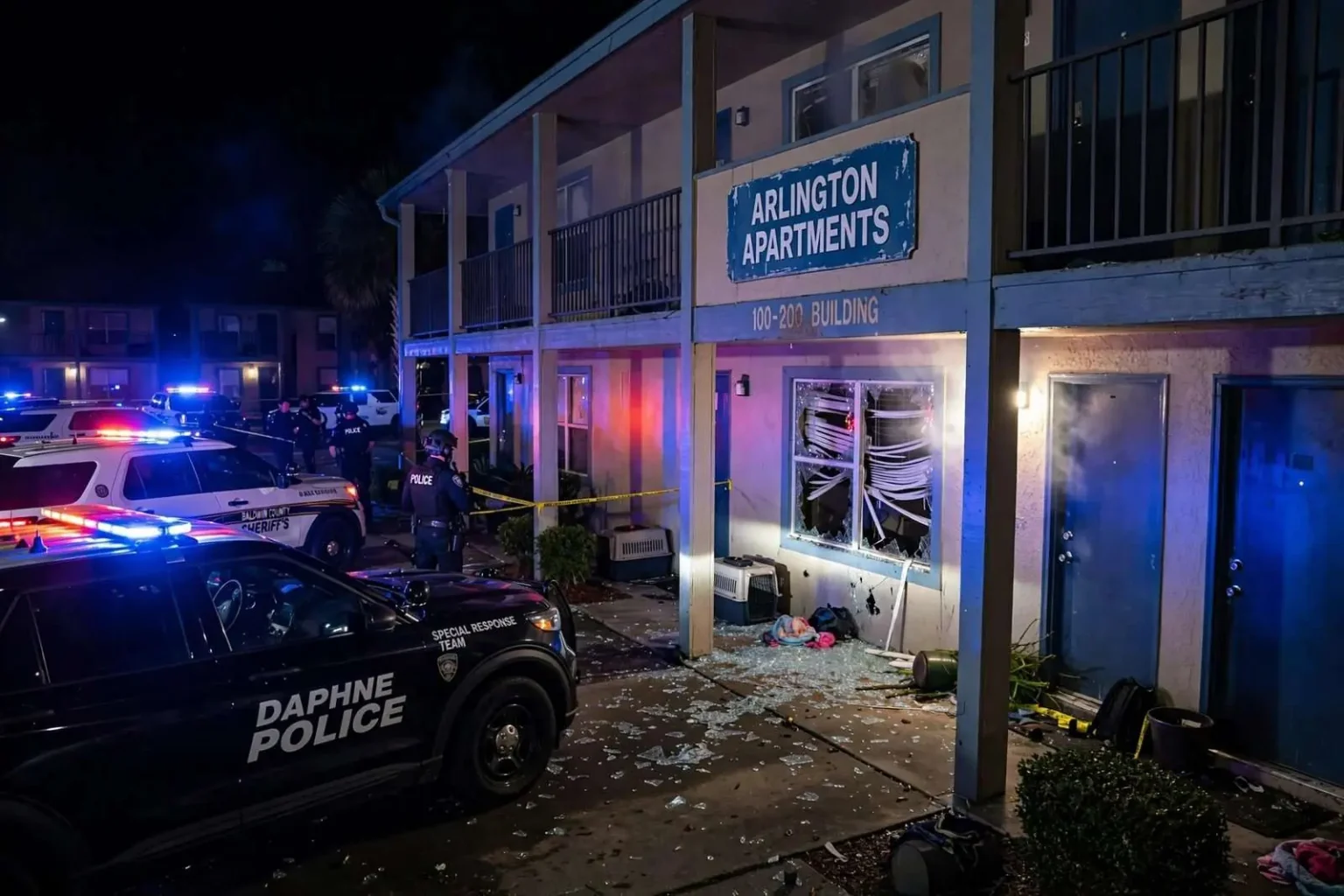
Residents of the Arlington Apartments in Spanish Fort are still shaken after a domestic dispute escalated into an hours-long armed standoff that filled the quiet Baldwin County complex with gunfire, tear gas, and a heavy law enforcement presence overnight.
Police were called to the complex around 10 p.m. after a woman reported that her husband had fired shots at her inside their ground-floor apartment. Responding officers found the man had barricaded himself inside, prompting the Daphne Special Response Team to be called in to attempt negotiations. When those talks broke down, officers made what was described as a dynamic entry into the unit and took the man into custody.
The woman who called police was not injured in the incident, though she returned to the apartment the following morning too shaken to speak with reporters, standing amid broken glass outside her front door. Her escape from the unit as the standoff began almost certainly prevented a far worse outcome, and investigators will review the response for the lessons it holds about domestic violence calls, which remain among the most dangerous situations officers handle.
A night of gunfire and gas
Neighbors say the ordeal began without warning and quickly turned frightening. One resident who lives directly across from the apartment said she was woken by her dog and looked outside to see a police sniper positioned near her own front door. Moments later, gunfire erupted from the barricaded apartment, with at least two rounds striking her unit. She and other nearby residents were evacuated to the complex clubhouse in the middle of the night as the standoff continued.
Another neighbor recalled hearing what she initially mistook for early fireworks before realizing gunshots were being fired nearby. She and her family watched much of the standoff unfold from an upstairs window, describing officers shooting out a nearby streetlight to reduce visibility and eventually deploying what appeared to be tear gas into the apartment in an effort to force the man out. When that didn’t work, officers broke a window and created an opening in the blinds before ultimately entering the unit.
For families herded into the clubhouse in the dark — children in pajamas, pets in carriers, phones pressed to ears — the night stretched on for hours. The complex’s close quarters, with units sharing walls and balconies within feet of one another, left little margin between safety and danger, and residents on both sides of the courtyard felt the percussion of every shot.
Multiple residents described the couple involved as a quiet, older pair who had lived at the complex for years. That portrait — unremarkable neighbors, no history of visible trouble — has unsettled the community as much as the gunfire itself, a reminder that the kinds of disputes that end in standoffs rarely announce themselves to those living next door.
The 911 call came in at about 10 p.m., and within minutes the complex’s narrow drives filled with patrol cars. Officers established a perimeter around the ground-floor unit, cleared neighbors from adjacent buildings, and waited for the tactical team to arrive from Daphne a short drive up the road. What had been an ordinary weeknight in a garden-style apartment complex turned into an overnight operation that kept much of the property in lockdown until nearly dawn.
How the response unfolded
The call-out of the Daphne Special Response Team reflected the mutual aid arrangements that bind Baldwin County’s police departments together. Spanish Fort, a growing city of modest size along the Interstate 10 corridor, does not maintain a full-time tactical unit of its own, so a barricaded, armed subject triggered a call to neighboring Daphne’s team, whose officers train for exactly this kind of prolonged negotiation-and-entry scenario. Department sheriff’s deputies and other area agencies typically assist with perimeter and evacuation duties in such events, and the overnight mobilization brought squad lights, command vehicles, and officers from multiple jurisdictions to the complex.
Negotiators worked the barricaded man for hours before the decision was made to go in. The sequence described by residents — the shooting out of the streetlight, the introduction of chemical agents, the breaking of the window — matches the escalating steps a tactical team takes to disorient a subject and reduce his ability to target officers before a dynamic entry. Such entries are a last resort, used when negotiators conclude that time is working against the safety of the subject, the victim, or officers themselves.
That the incident ended with the man in custody and no one injured — neither the officers who entered, the wife who had been shot at, nor the neighbors whose units caught stray rounds — will be counted as the response’s bottom line. But the aftermath left the complex rattled and the community asking how a quiet couple’s home became the scene of an overnight siege.
Domestic violence and the danger of the barricade
The standoff fits a pattern familiar to law enforcement nationwide: domestic disputes are among the most volatile calls officers answer, and when firearms are present and a subject barricades himself, the potential for tragedy multiplies. Advocates across Baldwin County and the Gulf Coast have long worked to connect victims of domestic abuse with protective orders, shelters, and support services before disputes reach the point of violence. The woman’s 911 call — and her decision to get out of the apartment — exemplified the choices that advocates urge, and her survival underscores how critical those first minutes are.
Research on domestic violence situations consistently shows that separation and its immediate aftermath are the most dangerous moments for victims, and an armed partner facing the end of a relationship represents the highest-risk scenario. Responding agencies in Baldwin County coordinate with victim advocates and the district attorney’s office in such cases, ensuring that charges, protective orders, and support services follow the criminal response.
Chemical agents such as the gas residents described are used to compel a subject to leave a structure without forcing officers through a doorway under fire. They are chosen precisely because they are less lethal than the alternatives, though they linger in carpets, curtains, and ventilation systems — and in the units of neighbors downwind. The streetlight officers disabled served a tactical purpose as well, denying a barricaded shooter the illumination that would silhouette officers positioned outside.
A community picking up the pieces
In the days after the standoff, life at the Arlington Apartments carried the marks of the night. Broken glass still glittered outside the couple’s ground-floor unit. Bullet holes marked the siding and windows of the unit across the courtyard. Residents traded accounts of the night in hushed conversations on stairwells and in parking lots, and some admitted they had barely slept since.
The man taken into custody faced charges stemming from the shots fired at his wife and the siege that followed. Prosecutors in Baldwin County treat domestic violence gunfire cases with gravity, and the additional conduct involved in a barricade — endangering neighbors, firing at officers’ positions — typically adds to the legal exposure. The woman, meanwhile, has the community’s sympathy and, advocates stress, access to services designed for exactly this aftermath.
Apartment complex management worked to reassure residents, and neighbors organized informally to check on one another — particularly the families with young children who spent the night in the clubhouse. For a complex that residents describe as quiet and family-oriented, the standoff has prompted hard conversations about safety, about reporting concerns before they escalate, and about how quickly ordinary life can be shattered one door away.
Spanish Fort itself is a community more accustomed to growth news than crime headlines. Anchored by the Eastern Shore Centre and a string of new subdivisions, the city has grown rapidly in recent decades as families have moved across Mobile Bay in search of its schools and lower costs. Its police department, like the city, is young and comparatively small — which is why the sight of a tactical operation on its streets stood out so sharply for residents unused to such scenes.
The incident also serves as a reminder to residents across Baldwin County’s growing suburbs: the quiet appearance of an apartment complex or a neighborhood tells little about what happens behind any single door. Domestic disputes escalate in every kind of community, and the response that ended this one without a death — a wife who called for help and got out, neighbors who stayed clear, and officers who talked for hours before forcing their way in — is worth remembering the next time a 911 call goes out after dark.
For the residents evacuated to the clubhouse, the morning after brought the slow accounting that follows any such night: who had been where, whose windows were hit, and when they could go home. Officers escorted small groups back to their units once the scene was secured, and by daylight the tactical vehicles were gone, leaving behind shattered glass, spent casings, and a courtyard full of questions.